
Multi-Vendor Inventory Chaos During Q4 and How to Manage It
Every business that works with multiple vendors knows that Q4 arrives with an entirely different rhythm. It is the one period of the year when every weakness in the operational chain becomes louder, faster, and harder to ignore. The final quarter does not wait for anyone to catch up. It accelerates demand, compresses timelines, shortens reaction windows, and quickly transforms even well-coordinated workflows into a stressful race against time. When a business relies on multiple suppliers, this pressure multiplies. Instead of one predictable inventory source, teams must juggle many different inputs at once, each with its own timing, accuracy level, and communication habits. Q4 turns those variations into daily challenges.
The core reason Q4 becomes overwhelming is because vendors themselves are under pressure. They rush to ship before cutoffs, they push larger volumes than usual, and they do not always provide the documentation that warehouses rely on during the rest of the year. A shipment might arrive earlier than planned, but with incomplete packing slips. Another might be delayed without warning. A third could contain substitutions or unexpected product variations that disrupt count accuracy. When these variations collide with the sharp rise in orders, the warehouse becomes the place where all inconsistencies must be resolved instantly. There is no luxury to postpone or investigate later. Everything in Q4 becomes urgent.
This urgency creates a very specific type of inventory chaos. Items that were clearly labeled all year suddenly arrive with mixed markings. Cartons that normally contain predictable quantities might be off by just one or two units, but that one or two creates a ripple effect across platforms, sales channels, and stock availability. The same SKU may come from two vendors at the same time, each packaged differently. Staff try to stay ahead, but the volume works against them. Every moment spent reconciling one vendor’s shipment is a moment taken away from processing another. The margin for error narrows, and the consequences of each small discrepancy become more visible.
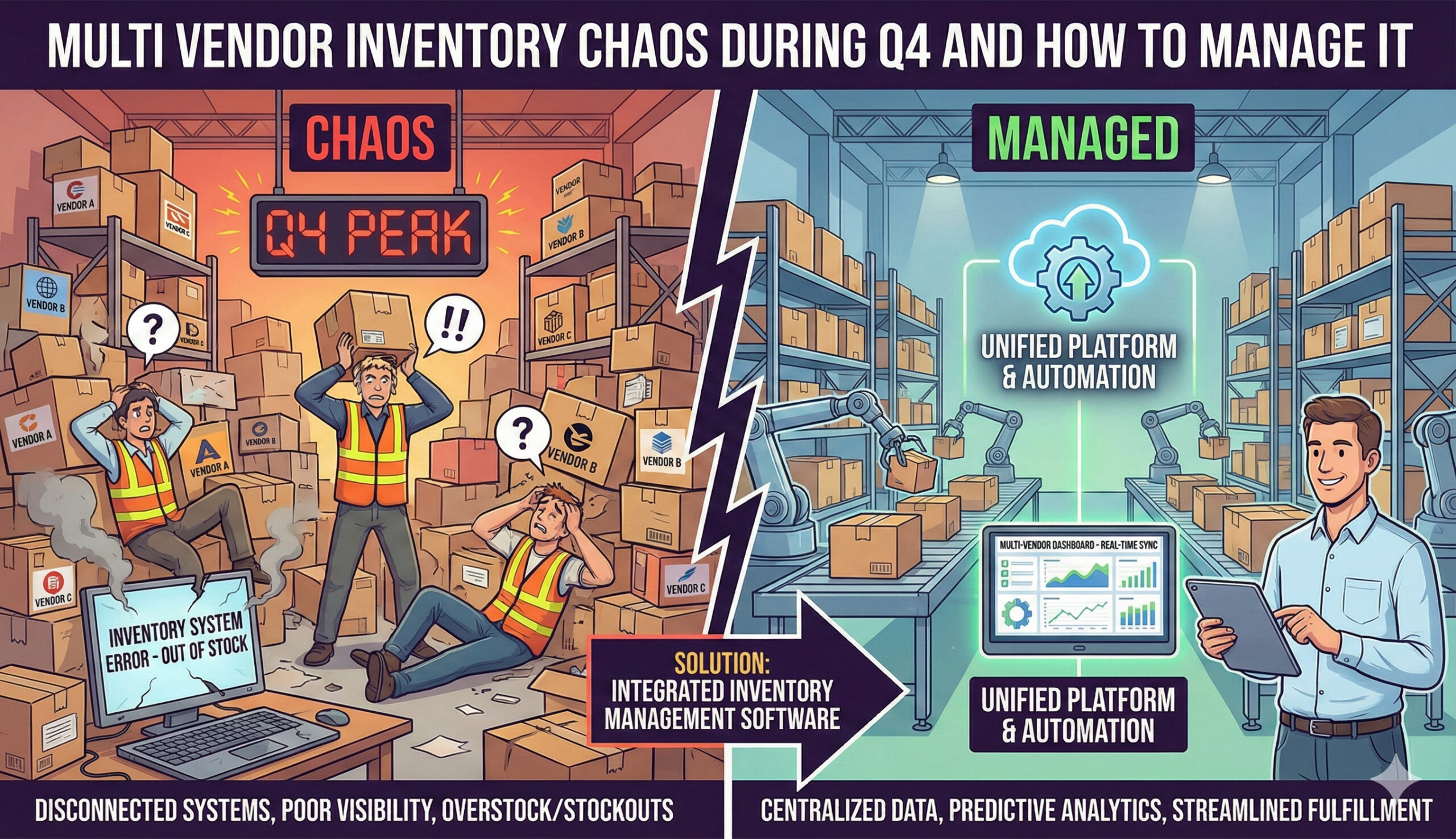
Overselling is often the first symptom. When demand spikes and counts are not updated in real time, systems display stock that no longer exists. Customers place orders that cannot be fulfilled, and backorders stack up. At the same time, some items begin to pile up silently in the warehouse simply because they were not recorded correctly on arrival. Under Q4 pressure, the difference between what the system claims and what is physically present becomes wider every hour. Teams work harder than they have all year, yet they feel further behind because they lack a stable core that ties all vendor activity together.
Forecasting also becomes unreliable in Q4. A product can turn into a bestseller almost overnight. A bundle can suddenly move faster than expected. A vendor might promise a restock but deliver only a fraction of it. Without a unified view of all incoming inventory, the warehouse ends up reacting instead of planning. Decisions that normally feel strategic become rapid-fire judgments. Entire days disappear into troubleshooting vendor discrepancies, chasing packing slip mismatches, and correcting errors across channels. These challenges are not caused by poor effort. They are caused by the fact that Q4 amplifies every operational weakness.
What turns this chaotic season into a manageable one is not luck. It is structural clarity. A business that operates with real-time synchronization across all vendors can keep pace with Q4 because there is no guessing. The moment a shipment arrives, the system knows. The moment a carton count changes, every connected channel reflects the update. Instead of juggling spreadsheets, manual notes, email chains, and separate vendor workflows, teams work inside a platform that centralizes everything. Predictive analytics help highlight which items are trending upward. Inventory movements update instantly so that stockouts and overselling do not catch the business off guard. Fulfillment can flow smoothly because the warehouse no longer fights to correct upstream confusion.
This is where CommerceBlitz OMNI naturally fits into Q4 operations. OMNI stabilizes multi-vendor complexity by giving every team a single place where vendor data, inbound shipments, inventory adjustments, and order fulfillment are connected in real time. In the months that demand the most accuracy, OMNI replaces uncertainty with clarity. Teams finally have the freedom to focus on moving product instead of chasing information. Q4 becomes less about surviving chaos and more about operating with confidence.
If you want to see how OMNI can support your peak season workflow and give you the stability you need during the busiest period of the year, you can schedule a demo and we will personally walk you through how OMNI fits your exact operational setup.