
How to Handle Holiday Returns Without Breaking Your Workflow
Holiday sales are usually measured in orders shipped, revenue generated, and peak volumes achieved. What often gets less attention is what happens immediately after. Returns. Not just a few here and there, but waves of them arriving all at once, often from multiple channels, with mixed conditions, incomplete data, and very little patience from customers waiting for refunds or exchanges.
Returns themselves are not the problem. Every retail and fulfillment operation expects them. The real problem is that most workflows are designed around outbound orders, not reverse logistics. When returns hit at scale, they expose every weakness in inventory accuracy, order visibility, and process consistency. Teams that managed to hold things together during Q4 suddenly find themselves firefighting again in January.
The reason holiday returns feel so disruptive is because they rarely arrive cleanly. Products come back without proper references. SKUs do not match what the system expects. Inventory sits in limbo because no one is sure whether it is sellable, damaged, or missing components. Meanwhile, customer support is waiting on warehouse updates, accounting is waiting on inventory adjustments, and operations is trying to keep normal fulfillment moving at the same time.
This is where workflows usually start to break. Not because teams are not working hard enough, but because the systems they rely on were never designed to handle returns as a first class operational flow.
A healthy returns process starts with visibility. The moment a return is initiated, it should already be tied back to the original order, the correct SKU, and the correct inventory location. When that connection is missing, every step after becomes manual. Someone has to search for the order. Someone has to guess which product it belongs to. Someone has to decide when and how inventory should be updated. Each of those decisions introduces delay and risk.
During the holiday return period, speed matters just as much as accuracy. Customers expect fast refunds. Merchants expect inventory to be available again as soon as possible. 3PLs are under pressure to process returns without slowing down outbound fulfillment. When returns are handled outside of the main order and inventory workflow, teams are forced to choose between keeping up with volume or keeping data clean. That tradeoff is where mistakes happen.
One of the biggest challenges with holiday returns is inventory status management. Returned items are not immediately available stock. They need to be inspected, categorized, and routed correctly. Some can be restocked. Some need refurbishment. Some are write-offs. If inventory systems do not support clear, real-time status updates, returned products either sit unaccounted for or get pushed back into available inventory too early. Both scenarios create downstream problems, from oversells to incorrect reporting.
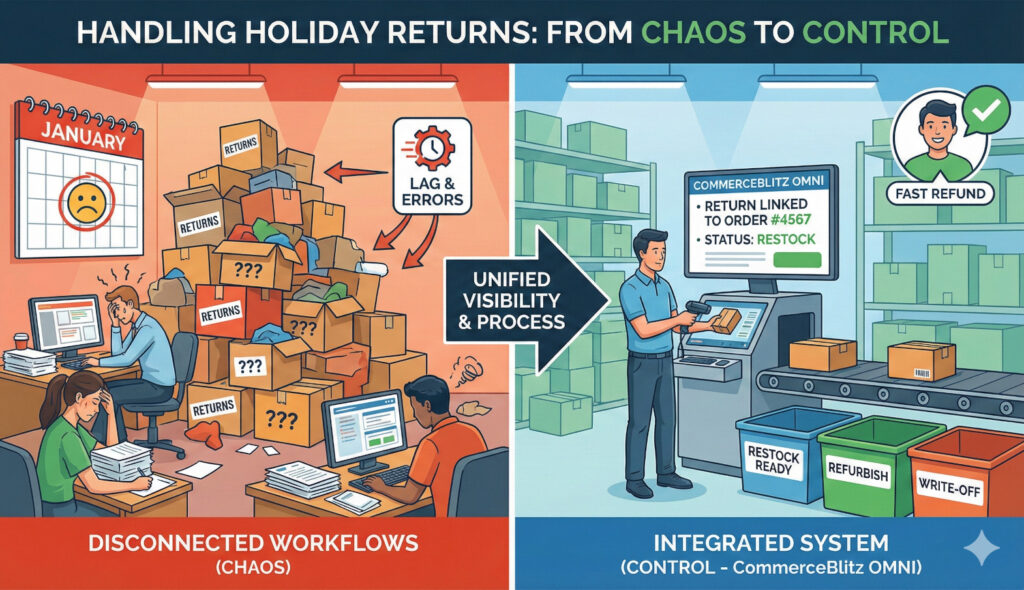
This is why treating returns as a disconnected process is so dangerous. Returns should not live in spreadsheets, inboxes, or side tools. They need to be part of the same operational system that handles orders, inventory movements, and fulfillment logic. When returns are processed inside the same workflow framework, inventory updates happen consistently, order states stay aligned, and teams are not forced to reconcile data after the fact.
CommerceBlitz OMNI is built with this exact post holiday reality in mind. Instead of treating reverse logistics as an exception, it keeps returns connected to core order and inventory workflows. When a return is received, inventory updates are handled in context, not manually patched together later. This reduces lag, prevents double handling, and gives both merchants and 3PLs a clear view of what is actually happening on the warehouse floor.
Another often overlooked issue during holiday returns is multi-channel complexity. Products sold across marketplaces, direct-to-consumer stores, and wholesale channels often come back through different paths. Without a unified view, the same SKU can appear as multiple mismatched records, making restocking and reporting unreliable. This is where synchronized product and inventory data becomes critical. If the system cannot confidently identify what came back and where it belongs, workflows slow down immediately.
Teams that survive post-holiday returns best are not the ones with the most staff or the longest hours. They are the ones with workflows designed to absorb volatility. Clear order linkage, structured inventory statuses, and real-time updates remove decision-making from moments where speed is required. Instead of reacting, teams follow a process that scales.
January should be about stabilizing operations, not untangling the mess left behind by Q4. Returns will always be part of peak season. The difference is whether they become a manageable operational flow or a recurring disruption that drags into the new year.
Handling holiday returns without breaking your workflow is not about doing more. It is about building systems that expect pressure and respond with clarity. When returns are treated as a core operational function instead of an afterthought, teams regain control, inventory stays accurate, and customers get the experience they expect.
If you want to see how integrated order and inventory workflows can simplify post-holiday returns, you can schedule a demo to walk through the process in real time.