
How to Transition to a New WMS Without Disrupting Fulfillment
January is a quiet month in warehouses, but it is rarely a calm one.
After the dust of Q4 settles and the last returns are processed, many operations teams finally have the breathing room they did not have in November or December. This is usually when the uncomfortable truth surfaces. The warehouse survived peak season, but the systems did not scale gracefully. Orders required too much manual intervention. Inventory accuracy slipped. Reporting felt reactive instead of reliable. Somewhere between firefighting and improvising, the idea of switching to a new WMS stopped feeling like a future plan and started feeling urgent.
The challenge is not deciding whether to move to a new WMS. The real fear lies in how to do it without breaking fulfillment in the process.
A WMS migration touches everything. Orders, inventory, locations, people, workflows, integrations, and most importantly, customer expectations. Done poorly, it can slow shipping, increase errors, and overwhelm warehouse staff. Done right, it becomes one of the most stabilizing operational changes a business can make. The difference between those two outcomes is preparation.
Most disruptions during a WMS transition do not come from the software itself. They come from underestimating the complexity of daily warehouse reality. Fulfillment does not pause just because a new system is being implemented. Orders keep coming in. Inventory keeps moving. Customers still expect the same delivery speed and accuracy they had before. This is why January is actually the best possible time to transition, but only if the approach is deliberate.
The first mistake many teams make is treating a WMS migration as a technical project. It is not. It is an operational transformation that happens to involve technology. When the focus stays on features instead of workflows, things fall apart quickly once the system goes live.
A successful transition starts with understanding how your warehouse really operates, not how it looks on paper. Every workaround that existed in the old system needs to be identified, because those workarounds often hold the operation together. Ignoring them does not make them disappear. It only creates chaos later. Before a single product is migrated, the warehouse needs clarity. Which processes are critical on day one, which ones can evolve over time, and which data absolutely must be accurate from the start? Inventory, locations, SKU logic, and order flow should never be treated as an afterthought.
This is where many companies go wrong. They rush data migration to meet an internal deadline and assume corrections can be made later. In reality, bad data at go-live is one of the fastest ways to destroy trust in a new WMS. When warehouse teams lose confidence in inventory numbers or order statuses, they revert to manual tracking immediately.
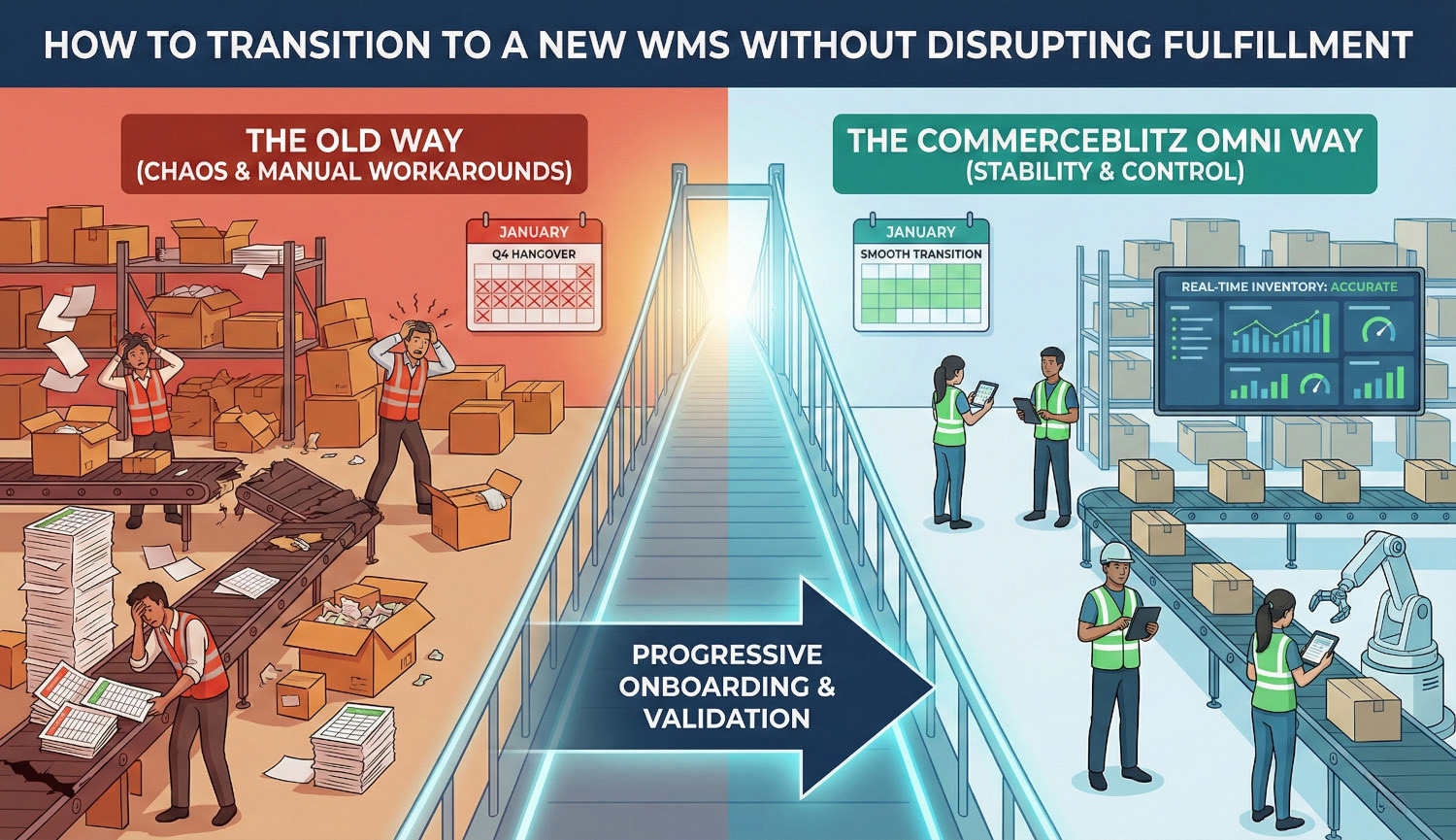
CommerceBlitz OMNI was designed with this reality in mind. Instead of forcing warehouses into a rigid structure from day one, OMNI supports progressive onboarding. Inventory, orders, and workflows can be validated step by step without shutting down fulfillment. This allows teams to test real scenarios using live data before fully committing.
Another major risk during a transition is trying to change everything at once. New system, new processes, new KPIs, new rules. While the intention is good, the impact is overwhelming. People do not resist new systems because they dislike technology. They resist them because uncertainty slows them down in high-pressure environments.
The smartest migrations introduce stability first, improvement second.
When teams move to CommerceBlitz OMNI, the initial focus is on maintaining fulfillment continuity. Orders flow as expected. Inventory updates in real time. Existing picking and packing logic is respected. Once confidence is established, optimization becomes easier and adoption increases naturally.
Running systems in parallel for a short period is another strategy that reduces risk. It gives teams the ability to validate results without fear. If something looks off, it can be investigated calmly rather than during a shipping cutoff window. Parallel operation also helps identify gaps in training early, before they impact customers. Training itself deserves far more attention than it usually gets. A WMS is only as good as the people using it. Rushed training leads to frustration, and frustration leads to resistance. Clear role-based onboarding, realistic scenarios, and simple interfaces make an enormous difference.

This is one area where OMNI consistently stands out. The system was built for operators, not just administrators. Views are intuitive. Data is visible without digging through layers of configuration. Warehouse teams can understand what they are seeing and why it matters. That confidence translates directly into smoother fulfillment.
Integrations are another silent source of disruption. Orders coming from multiple sales channels, marketplaces, or ERPs need to remain consistent throughout the transition. Any mismatch between systems creates delays that ripple across operations.
CommerceBlitz OMNI acts as a central operational layer, ensuring orders, inventory, and statuses remain synchronized even as backend systems change. This is especially important for businesses managing multiple warehouses or 3PL relationships, where a single inconsistency can impact multiple partners at once.
One of the most overlooked parts of a WMS transition is communication. Internal teams need to know what is changing and when. Clients, if fulfillment is outsourced, need reassurance that service levels will remain stable. Transparency prevents panic. Silence creates assumptions.
January is ideal for this kind of change precisely because volume is lower, teams are reflecting on the previous year, and leadership is actively planning improvements. The mistake is waiting until volume increases again before fully stabilizing the new system. A well-executed transition sets the tone for the entire year. It turns fulfillment from a reactive function into a controlled, measurable operation, gives teams confidence instead of stress, and replaces spreadsheets, guesswork, and manual fixes with visibility and accountability.
CommerceBlitz OMNI was built to support that transition without forcing businesses to gamble on their busiest days. It adapts to how warehouses operate today while providing a foundation for where they want to go next. That balance is what allows companies to move forward without disrupting what already works.
Switching to a new WMS will always feel like a big decision. The risk is real, but so is the cost of staying stuck with systems that no longer support growth. When the transition is planned with fulfillment continuity as the priority, the result is not disruption. It is a relief.
If you are considering a WMS change this year, now is the time to do it deliberately, with a system designed to grow alongside your operations rather than slow them down. CommerceBlitz OMNI makes that transition not just possible, but predictable. And predictability in fulfillment is everything.