
Billing Accuracy for 3PLs: Why Inventory and Order Data Must Match
Billing accuracy is one of those topics most 3PLs only truly appreciate when something goes wrong. Invoices get questioned, customers push back, margins quietly erode, and suddenly a process that seemed routine becomes a daily source of friction. At the center of nearly every billing dispute sits the same issue: inventory data and order data do not fully match. When those two sources of truth drift apart, billing stops being reliable and turns into guesswork.
In a 3PL environment, billing is not just about charging storage or fulfillment fees. It is a direct reflection of what happened operationally. How much inventory was stored, for how long, how many units moved, which services were applied, and when those actions occurred. If inventory records say one thing while order records say another, billing logic has no stable foundation. Even small discrepancies can compound over time, especially for high volume operations managing multiple clients across multiple warehouses.
Inventory accuracy is often discussed from an operational perspective, but its financial impact is just as significant. Every pallet count, unit adjustment, and location move feeds into how storage fees are calculated. When inventory counts are inflated, customers are overbilled and trust erodes. When counts are understated, revenue leaks quietly and repeatedly. Neither outcome is sustainable. Accurate inventory data ensures that billing reflects reality rather than assumptions.
Order data introduces a second layer of complexity. Orders carry the details that trigger fulfillment charges, pick and pack fees, value added services, and shipping costs. When order statuses are delayed, duplicated, or manually corrected outside the system, billing logic starts to fracture. An order that was picked but not marked as shipped may never be billed correctly. An order that was canceled operationally but still exists financially can result in charges that should never exist. Over time, these mismatches create invoices that require manual review, adjustments, and explanations that consume both time and credibility.
The real risk emerges when inventory and order data live in separate systems that are loosely connected or not connected at all.
Spreadsheets, manual uploads, delayed syncs, and partial integrations introduce timing gaps. Inventory may update at one cadence while orders update at another. Adjustments may be logged in one system but never reflected in the other. From a billing perspective, this creates conflicting narratives of what actually happened inside the warehouse.
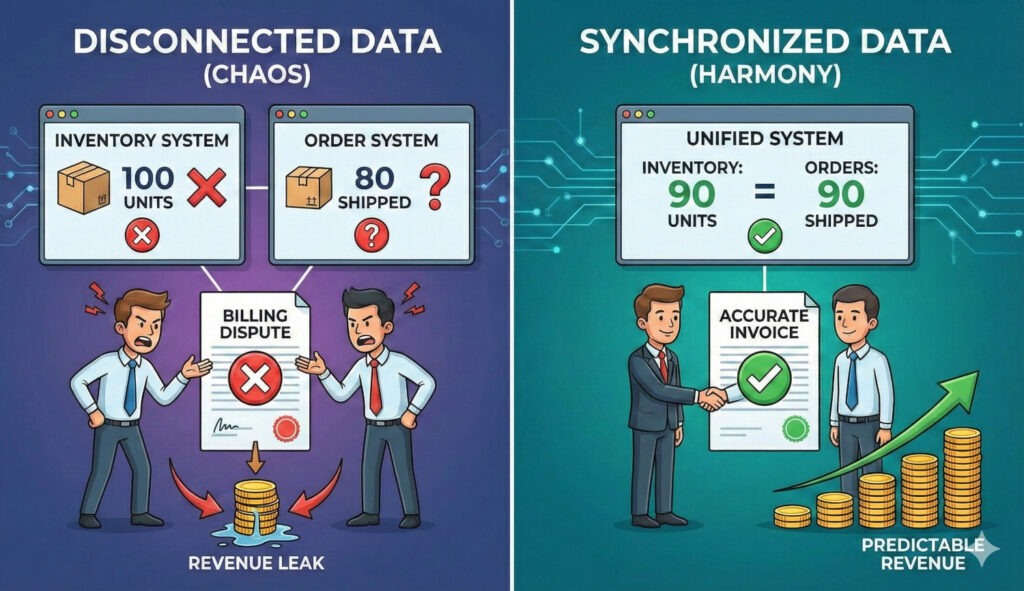
For 3PLs managing multiple clients, this problem scales fast. Each client brings unique billing rules, service agreements, and expectations. Without consistent data alignment, billing teams are forced to rely on workarounds. Manual reconciliations become normal. Exceptions become routine. Instead of focusing on growth and optimization, teams spend their energy defending invoices and correcting errors after the fact.
Accurate billing depends on one simple principle: inventory movement and order activity must tell the same story.
When a unit enters the warehouse, it must be visible to inventory tracking and eventually traceable to an order or adjustment. When a unit leaves, the system must reflect not only that it shipped, but why it shipped and which services were applied. Billing logic should never have to interpret or guess. It should simply calculate based on confirmed, synchronized events.
This is where modern 3PL operations benefit most from unified systems. When inventory management and order management operate within the same data model, discrepancies surface immediately instead of weeks later. Adjustments are visible in context. Orders cannot progress without updating inventory. Billing rules reference consistent data rather than fragmented records.
The result is not just cleaner invoices, but faster billing cycles and fewer disputes.
Clients notice the difference quickly. Invoices that align perfectly with operational activity build confidence. Questions become rare and straightforward. Transparency replaces suspicion. For 3PLs, this trust translates directly into stronger relationships and more predictable revenue. Billing accuracy stops being a defensive task and becomes a competitive advantage.
Platforms like CommerceBlitz OMNI are designed with this exact challenge in mind. By keeping inventory and order data fully aligned across warehouses, clients, and channels, OMNI removes the gaps that typically lead to billing errors. Every unit, every order, and every operational action is recorded once and reused everywhere it matters, including billing. This shared source of truth allows 3PLs to automate billing with confidence instead of caution.
Billing accuracy is not achieved by better spreadsheets or stricter reviews. It is achieved by building operations on data that stays in sync by design. When inventory and order data match at all times, billing becomes reliable, scalable, and defensible. For 3PLs looking to grow without increasing friction, that alignment is no longer optional.
If you want to see how synchronized inventory and order data can simplify billing and reduce disputes, you can schedule a CommerceBlitz OMNI walkthrough to explore the workflow in practice.