
How Poor Location Logic Slows Down Fulfillment
Fulfillment speed rarely breaks overnight. More often, it slows quietly, order by order, pick by pick, until teams begin to feel constant pressure without a clear reason why everything suddenly takes longer than it used to. In many warehouses, the root cause is not labor, volume, or even technology. It is location logic that no longer reflects how inventory actually moves through the operation.
At the beginning, most location structures are built with good intentions. Zones are created, shelves are labeled, and bin logic is defined based on expected workflows. When volumes are low and SKUs are manageable, this system often works well enough. Pickers learn where items live, walking paths make sense, and fulfillment feels predictable. The problem begins when the business grows but the location logic does not evolve with it.
As order volume increases, inventory naturally spreads. Fast-moving items may end up stored far from packing stations simply because space was available at the time. Slow movers might occupy premium locations because no one revisited the original placement rules. Over time, the warehouse layout starts telling a story that no longer matches reality. Pickers walk longer distances, revisit the same zones multiple times per order, and rely more on memory than on system guidance. What once felt efficient becomes fragmented.
Poor location logic also introduces inconsistency. Two identical products may exist in multiple zones without a clear priority rule, leaving the system unsure which location should be picked first. In these moments, fulfillment speed depends entirely on human decision making. Experienced staff might compensate, but new hires struggle, training takes longer, and errors increase. Mis-picks, short shipments, and last-minute order holds become more frequent, not because people are careless, but because the system is unclear.
The impact is not limited to picking alone. Packing teams feel the ripple effect when items arrive out of sequence or from unexpected zones. Supervisors lose visibility into true inventory availability when stock appears scattered or duplicated across locations. Reporting becomes unreliable because location data no longer reflects operational truth. At scale, these issues compound, slowing down order throughput and making same-day or next-day fulfillment harder to achieve.
What makes location logic especially dangerous is how invisible it can be. On paper, inventory exists. Orders technically flow. Nothing appears broken enough to trigger an urgent fix. Yet fulfillment teams feel constantly behind, leadership questions productivity, and the warehouse absorbs stress that could have been avoided with a clearer structure. The system becomes reactive instead of guiding work proactively.
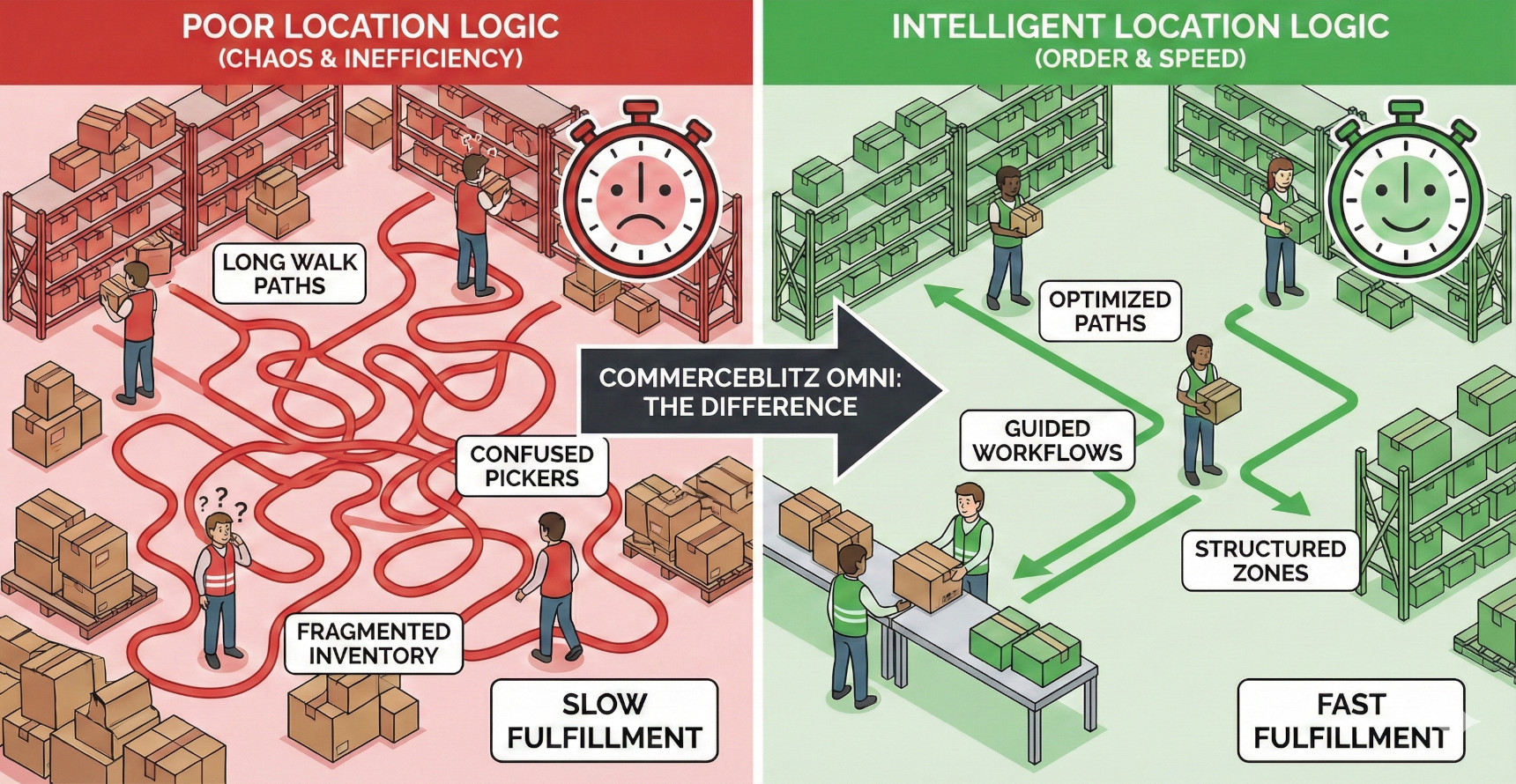
This is where modern warehouse logic needs to step in, not just as storage mapping, but as an active fulfillment strategy.
Location data should understand velocity, zone relevance, and pick priority, adjusting as inventory behavior changes. When location logic is intelligent, the system directs pickers through optimized paths, selects the most appropriate stock automatically, and reduces decision fatigue on the floor.
With CommerceBlitz OMNI, location logic becomes a living part of fulfillment rather than a static setup. Inventory is tied to structured zones, clearly defined locations, and real-time availability, allowing the system to guide picks based on operational rules rather than guesswork. Pick tickets, zone assignments, and label generation all align with how the warehouse actually functions, helping teams move faster without working harder.
As fulfillment complexity grows, clarity becomes the most valuable asset. When location logic is clean, accurate, and enforced by the system, fulfillment speed naturally improves. Walk times shrink, errors decrease, and teams regain confidence in the process. Orders flow with less friction, and scaling no longer feels like fighting the warehouse itself.
Poor location logic does not just slow fulfillment. It quietly drains efficiency, morale, and growth potential. Fixing it is not about reorganizing shelves once. It is about adopting systems that understand movement, adapt to change, and turn location data into a true fulfillment advantage.