
When “Good Enough” Systems Quietly Limit Your Growth
Most businesses do not fail because they make bad decisions. They stall because they make comfortable ones.
At some point in every growing operation, there is a moment where a system is chosen not because it is the best long-term option, but because it is “good enough for now.” It works. Orders go through. Inventory roughly matches reality. Reports exist, even if they take some effort to extract. Nothing is on fire, so nothing feels urgent.
And that is exactly how growth starts to slow without anyone noticing.
In the early stages, “good enough” systems are not only acceptable, they are necessary. Speed matters more than perfection. You need something that lets you launch, sell, ship, and survive. At that stage, manual work feels manageable. Fixing mistakes by hand feels normal. Visibility lives in someone’s head or in a spreadsheet that is updated every Friday afternoon.
But growth changes the rules quietly, long before teams realize the game has changed. What once felt flexible slowly turns fragile. What once felt efficient becomes exhausting. What once felt under control begins to depend on a few people who “just know how things work.”
The system still works. That is the dangerous part.
As order volume increases, complexity grows faster than revenue. New sales channels appear. New warehouses or 3PL partners are added. Clients want clearer reporting. Customer expectations tighten. Shipping windows shrink. Errors that used to be rare now happen daily, just spread thin enough that no single issue feels catastrophic.
Instead of one big problem, you get dozens of small ones.
Inventory starts drifting. Not enough to cause immediate stockouts, but enough to create constant manual adjustments. Orders are technically processed, but not always in the most efficient sequence. Teams spend more time checking than executing. Decisions are made based on partial data because pulling clean data takes too long.
The system still looks functional from the outside, but internally it is asking your team to compensate for its limitations every single day. This is usually the phase where businesses add workarounds instead of replacing foundations.
A new spreadsheet is introduced to track exceptions. Someone creates a manual process to reconcile inventory at the end of the day. Reports are exported, cleaned, and reassembled to answer basic operational questions. The knowledge of how things really work becomes tribal, passed between team members rather than documented or automated.
None of this feels like a crisis. It feels like being busy. But being busy is not the same as being scalable.
As the business keeps growing, these hidden frictions start to dictate what is possible. You delay adding new channels because syncing them feels risky. You hesitate to onboard new clients or partners because you know it will increase pressure on already stretched processes. You avoid changing workflows because too many things depend on fragile manual steps. At this point, growth is no longer limited by demand. It is limited by operational confidence.
The biggest warning sign is not frequent failures. It is hesitation.
When leadership starts asking, “Can we handle this?” instead of “How fast can we do this?” the system has quietly become the bottleneck.
This is where modern operations need to shift from survival tools to orchestration platforms.
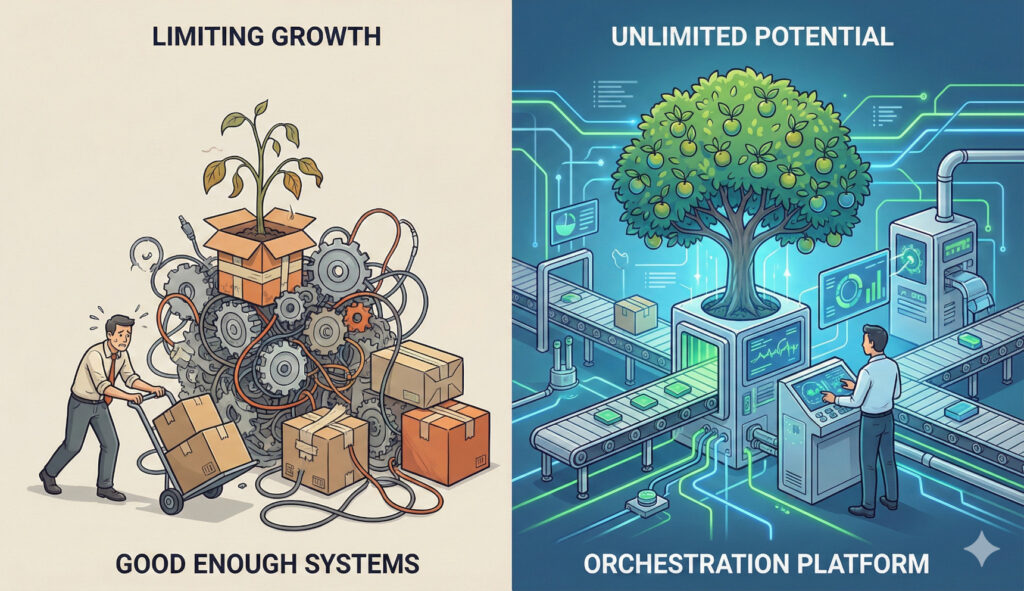
A system designed for growth does not just process orders. It creates clarity. It replaces guesswork with real-time visibility. It removes the need for heroics by making correct execution the default, not the exception.
Instead of teams compensating for missing functionality, the system itself becomes the source of truth. Inventory accuracy is maintained continuously, not repaired later. Orders flow through intelligent logic, not manual sequencing. Clients and partners see what is happening without needing to ask. Decisions are based on live data, not yesterday’s exports.
This is exactly where CommerceBlitz OMNI changes the conversation.
OMNI is not built to be “good enough.” It is built to remove the silent ceilings that traditional OMS and WMS setups impose on growing operations. It connects order management, inventory visibility, warehouse execution, and client transparency into a single operational reality.
The value is not just in automation, but in confidence. Confidence to scale volume without scaling chaos. Confidence to onboard new channels, clients, or warehouses without reinventing processes. Confidence to make decisions quickly because the data reflects what is actually happening, not what someone hopes is happening.
Most importantly, OMNI allows businesses to stop growing around their systems and start growing through them.
If any part of this sounds familiar, if your operation technically works but feels heavier than it should, that is not a failure. It is a signal. A sign that you have outgrown “good enough.” The next step is not another workaround. It is a foundation that is designed for where you are going, not where you started.
If you are ready to understand what your operation could look like without those quiet limitations, the CommerceBlitz OMNI team would love to show you. Ask for access, explore the sandbox, and see what growth feels like when your systems are no longer holding you back.