
Cycle Counting: The Secret to Accurate Inventory in Multi-Channel Operations
Inventory accuracy is the lifeblood of any business that touches physical goods, yet day-to-day perfection can feel out of reach. Whether you run a fast-moving e-commerce operation, a B2B distribution model, or a 3PL warehouse supporting multiple clients, you have probably experienced the same moment: the system says there are 12 units available, but the shelf shows 10. Or a channel shows “in stock,” while the warehouse team is already certain the item is gone. These gaps are rarely caused by one big mistake. They come from a reality every operator knows too well: inventory never stands still.
Stock moves constantly. Orders are picked and packed. Returns arrive unexpectedly. A pallet is staged in the wrong area. A box gets opened and split across multiple bins. Someone scans a case twice or misses one scan entirely. Sometimes an item is placed in the nearest empty slot instead of its assigned location because the shift is under pressure and the clock is ticking. Traditional inventory counting methods struggle to keep up with this pace, especially when businesses are expected to keep accurate availability across multiple sales channels at all times.
This article breaks down cycle counting in a practical, chronological way. We will cover what cycle counting is, how it differs from full physical inventory counts, why it matters even more in multi-channel environments, and how to implement it step by step. We will also show how CommerceBlitz OMNI can simplify cycle counting by making inventory accuracy a repeatable, scalable process across e-commerce, B2B, and 3PL operations.
The Problem with Traditional Inventory Counts
For many warehouses, the default approach to inventory accuracy has been the full physical count. Once or twice a year, operations slow down or stop altogether, and teams count everything. In theory, it sounds clean: pause, count, reset the system, and move forward. In practice, it is disruptive, expensive, and often frustrating.
A full count interrupts normal work. Receiving and shipping are delayed. Order queues grow. Labor is pulled from productive tasks into counting tasks. To keep customer commitments, teams often resort to overtime or weekend shifts. The count becomes a high-pressure event where speed is rewarded, and accuracy can suffer.
Even more frustrating is what happens after the “reset.” The moment operations resume, the warehouse returns to normal motion. Items are picked, replenished, transferred, and returned. Small recording errors start accumulating again. What felt like accuracy on Monday becomes uncertainty by Friday. In other words, the business pays a major operational cost for a count that quickly becomes stale.
Traditional inventory counts also amplify human error. Counting thousands of SKUs under time pressure creates fatigue. Fatigue leads to miscounts, skipped areas, double-counted bins, or inconsistent counting rules between team members. And when discrepancies are discovered months later, investigating the root cause becomes almost impossible. By that time, transactions have piled up, staff schedules have changed, and the warehouse layout may even look different. The business is left with a number, but not an explanation.
This challenge becomes even bigger for modern operations selling across Shopify, Amazon, Walmart, and additional channels, or for 3PLs managing multiple clients with different workflows. Customers and marketplaces expect accurate availability in real time. When inventory is wrong, the business risks overselling, forced cancellations, late shipments, and damaged brand trust. On the other side, it also risks underselling, leaving revenue on the table because the system says “zero” while product is physically present. In multi-channel commerce, inaccurate inventory does not stay contained. It spreads quickly.
What Is Cycle Counting (and How Is It Different from Full Counts)?
Cycle counting is an inventory auditing method that replaces the single massive inventory event with smaller, frequent counts performed throughout normal operations. Instead of counting everything at once, you count a subset of inventory on a recurring schedule, rotating through products, locations, or categories so that everything is verified within a defined period.
Think of cycle counting as a continuous discipline. It is designed to keep inventory aligned with reality week after week, rather than attempting a perfect reset once or twice a year. The result is not just better numbers, but better operational control.
The differences between cycle counting and full physical counts are straightforward:
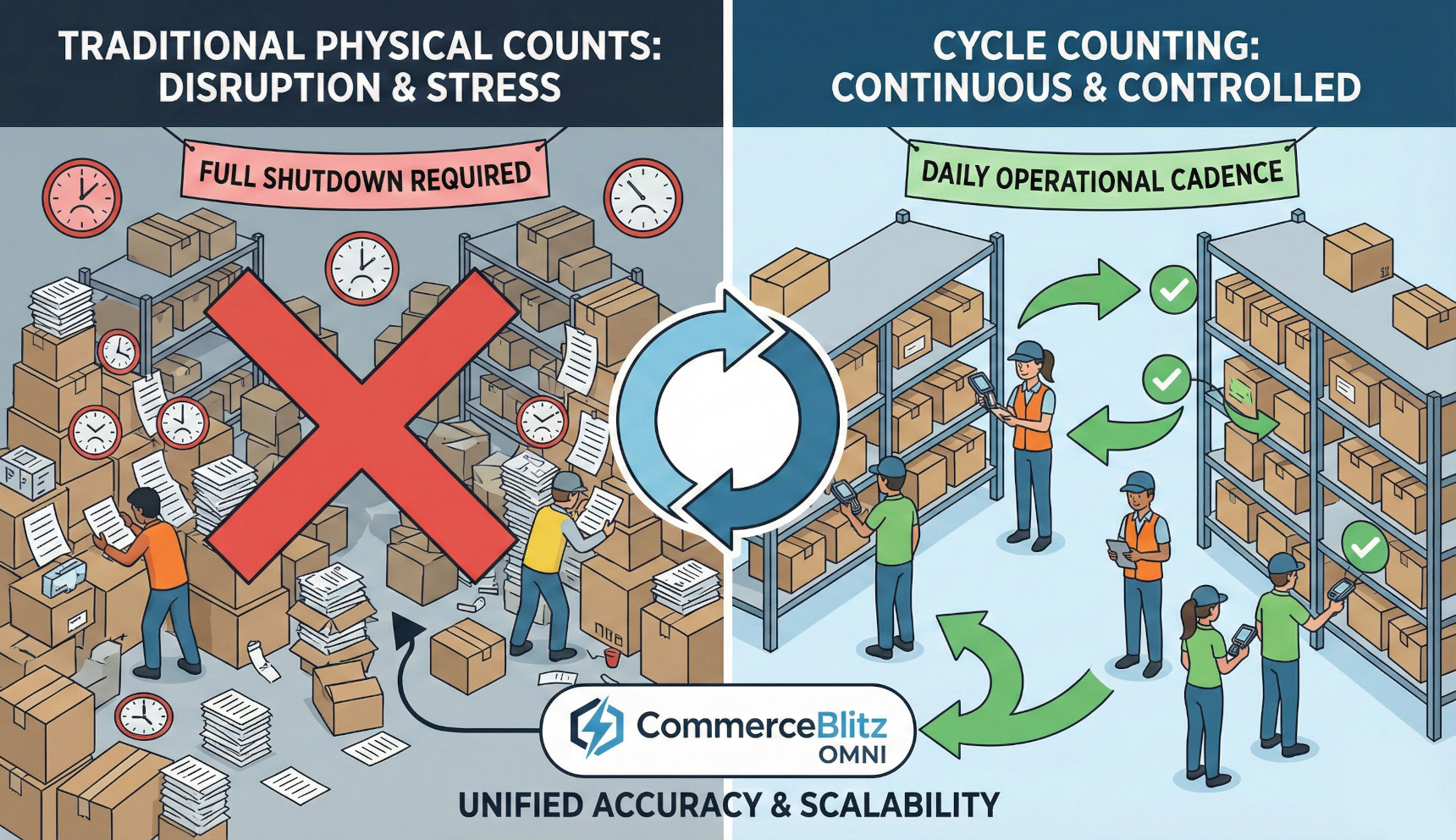
Cycle counting happens continuously, while full counts happen periodically. Cycle counting is embedded into daily operations, while full counts often require a shutdown or reduced throughput. Cycle counting focuses on a targeted subset, while full counts attempt to cover everything at once. Cycle counting catches and corrects discrepancies early, while full counts often discover errors long after they occurred. Cycle counting spreads labor evenly across time, while full counts concentrate labor into a costly, stressful spike.
A simple way to understand it is the difference between a snapshot and a live feed. A full count gives you a one-time picture of your inventory. Cycle counting gives you ongoing visibility and ongoing correction. Many operations still keep an annual count for compliance or accounting alignment, but the real stability comes from the cycle counting cadence that protects inventory accuracy all year long.
Why Cycle Counting Matters More in Multi-Channel, B2B, and 3PL Operations
Cycle counting is valuable in any warehouse, but it becomes essential when inventory is exposed to multiple demand sources. In a single-channel environment, an inventory error may stay relatively contained. In multi-channel environments, it multiplies.
If an item oversells on one channel, the operational damage often hits the whole business. Customer service has to explain cancellations. Marketplace performance metrics take a hit. The warehouse team scrambles for substitutions. The purchasing team rushes replenishment. The finance team deals with refunds. Over time, repeated inventory issues also erode internal confidence. Teams start building “workarounds,” maintaining side spreadsheets, holding extra safety stock, or manually buffering quantities per channel. Those workarounds create more complexity, and complexity creates more room for error.
For B2B, the stakes can be even higher because orders may be larger and tied to scheduled deliveries. A mismatch between system inventory and physical inventory can disrupt service-level agreements, delay replenishment for key accounts, or cause embarrassing “we do not actually have it” conversations when buyers expect reliability.
For 3PLs, accurate inventory is directly tied to trust. Clients want confidence that the warehouse system reflects what is physically present. They want clean reporting. They want fewer disputes. They want predictable fulfillment. A strong cycle counting program becomes a core part of service quality, because it proves control and prevents issues before they reach the client.
Benefits of Cycle Counting for Modern Operations
Cycle counting delivers a set of benefits that stack on each other over time.
First, it dramatically reduces disruption. Because cycle counting happens during normal operations, it avoids the painful stop-the-world inventory events that slow shipping and receiving. Counts can be planned around workload peaks, and they can be performed in short blocks that do not derail daily throughput.
Second, cycle counting improves accuracy with less stress. Smaller counts are easier to do well. Teams are less rushed, less fatigued, and more consistent. Instead of asking people to sprint through the entire warehouse, cycle counting asks them to be precise in a focused area.
Third, it improves root-cause discovery. When a discrepancy is found quickly, it is still possible to trace why it happened. Maybe a return was placed into a bin but not processed, maybe a pick was shorted and not adjusted, or maybe replenishment was staged but never put away. Catching these issues early makes them solvable, and solvable issues become training opportunities that prevent repeats.
Fourth, it protects multi-channel availability. When cycle count adjustments are applied consistently, system inventory becomes trustworthy. That trust reduces overselling, reduces cancellations, and improves customer outcomes. It also reduces underselling, because inventory that exists is available for sale instead of being “lost” in the system.
Fifth, it reduces cost. Inaccurate inventory quietly creates waste through emergency replenishment, expediting, extra labor to search for missing items, and unnecessary safety stock. Cycle counting reduces these expensive surprises. Over time, that makes purchasing and replenishment decisions more accurate, which improves cash flow and warehouse space utilization.
Finally, it strengthens accountability and warehouse culture. When inventory accuracy is treated as a daily habit, teams develop pride in maintaining control. It becomes normal to correct issues immediately, rather than waiting for the annual count to expose them. That cultural shift often becomes the hidden engine behind long-term accuracy.
Implementing Cycle Counting: A Chronological Process
A good cycle counting program is not just about counting. It is about building a consistent process that is sustainable, measurable, and integrated into operations.
1) Define the Counting Strategy
Start by deciding how you will group and prioritize inventory. Many operations use an ABC-style approach, where “A” items are counted most frequently, “B” items on a moderate cadence, and “C” items less often. The logic is simple: items with high velocity, high value, or high operational risk get more attention.
Another approach is zone-based cycle counting, where teams rotate through warehouse areas by aisle, shelf, or picking zone. Some businesses also add event-based triggers, such as counting items after a certain volume of picks, after receiving, or after a location moves.
The best strategy is the one that fits your operation. The goal is to ensure that all inventory is verified on a schedule that matches its risk level.
2) Set the Cadence and Ownership
Once the strategy is defined, set the cadence. Decide how many counts will be completed per day or week, and assign ownership. Cycle counting fails when it becomes “optional” or “when we have time.” It succeeds when it is treated as an operational requirement with clear accountability.
Choose times when counts are easiest to perform, such as early shifts, mid-day lulls, or between waves of picking. Make sure the rules are consistent: what counts as a unit, how to handle open cartons, how to treat damaged items, and what to do when an item is not found where the system expects it.
3) Execute Counts in the Flow of Work
Cycle counts should be performed without shutting down operations. The person counting goes to the assigned location or SKU group and verifies physical quantity. Using barcode scanning and mobile workflows reduces error and speeds up recording.
The most efficient programs integrate cycle counting into daily workflows. For example, a worker can count a bin immediately after picking from it, or a supervisor can verify a high-risk SKU during replenishment checks. The goal is to keep the effort small, focused, and repeatable.
4) Reconcile and Investigate Variances
After the count is recorded, reconcile it with the expected system quantity. If it matches, you have validated accuracy. If it does not match, the next step is not to adjust the number blindly. The next step is to investigate.
Start with the likely causes. Check recent receipts, picks, returns, and transfers. Look for common operational patterns: items placed in the wrong bin, putaway not completed, partial picks, or packaging changes that caused unit confusion. If the discrepancy is significant, a recount may be required for verification. This is also where good process discipline pays off. The faster you detect an issue, the more likely you are to find the reason behind it.
5) Apply Adjustments and Improve the Process
Once verified, apply the inventory adjustment so the system reflects reality. That adjustment should be logged and traceable, not hidden. Accuracy improves when adjustments are visible and consistent, because they become data points that highlight weak spots in the operation.
Use cycle count results to drive improvement. If a particular SKU repeatedly goes missing, investigate its storage method or handling flow. If a zone consistently shows variance, evaluate training, labeling, slotting, and scanning compliance. Cycle counting is both an audit method and a continuous improvement mechanism.
6) Track Performance and Keep the Program Alive
Cycle counting should have measurable outcomes. Track count completion rates, accuracy rates, variance frequency, and repeat-problem SKUs or zones. Over time, you should see variances shrink, confidence increase, and operational firefighting decrease.
The program stays alive when leadership treats it as a core operational practice and when the system makes it easy to execute consistently.
How CommerceBlitz OMNI Supports Cycle Counting at Scale
Cycle counting becomes dramatically easier when it is supported by a platform that treats inventory as a unified, real-time source of truth across channels, warehouses, and workflows. CommerceBlitz OMNI is built for exactly that kind of operational reality, where inventory accuracy is not a nice-to-have, but a requirement.
Smarter Planning and Prioritization
CommerceBlitz OMNI helps teams move beyond guesswork by supporting structured cycle counting programs that align with inventory risk and operational priorities. Fast-moving items, high-impact SKUs, and problematic zones can be scheduled for more frequent verification, while lower-risk inventory can follow a lighter cadence. This makes cycle counting strategic instead of random.
Structured Tasks and Operational Consistency
OMNI supports repeatable workflows that help teams stay consistent. When cycle counts are treated as tasks with ownership, they are more likely to be completed and completed correctly. Standardized processes reduce variation between shifts and reduce the tendency for teams to improvise under pressure.
Real-Time Inventory Confidence Across Channels
In multi-channel environments, inventory accuracy is only valuable if it stays consistent everywhere it is exposed. CommerceBlitz OMNI is designed to support operations where inventory flows between warehouse reality and sales channels. When cycle counting adjustments are made, the goal is simple: the business operates from one inventory truth, not multiple competing numbers. That reduces overselling risk, reduces customer service incidents, and supports cleaner channel operations across Shopify, Amazon, Walmart, and beyond.
Faster Variance Detection and Better Insight
Cycle counting improves accuracy, but it also creates data. OMNI can help teams see where variances cluster, which SKUs consistently drift, and which zones need process changes. That insight shifts cycle counting from a reactive correction tool into a proactive operational improvement engine.
A Unified Workflow for E-Commerce, B2B, and 3PL
Whether you operate your own brand, manage B2B orders, or run a 3PL supporting multiple clients, the fundamentals remain the same: inventory needs to be accurate, traceable, and actionable. CommerceBlitz OMNI supports those needs by keeping the cycle counting process tied to the broader operational flow, so you are not managing inventory accuracy in one tool and fulfillment in another. This is where real efficiency appears: fewer manual handoffs, fewer side spreadsheets, fewer “temporary fixes,” and more consistent control.
Make Inventory Accuracy a Daily Habit
Cycle counting is not just a counting method. It is a mindset shift. It moves inventory accuracy away from stressful annual events and into the rhythm of daily operations. For multi-channel commerce, B2B distribution, and 3PL services, that shift is often what separates “we hope the numbers are right” from “we know the numbers are right.”
When cycle counting is implemented with clear cadence, consistent rules, and continuous improvement, inventory accuracy becomes stable rather than fragile. Fewer surprises appear in picking. Purchasing decisions become easier. Customer promises become more reliable. And your team spends less time chasing problems that should not exist.
CommerceBlitz OMNI helps make that stability practical at scale. By supporting structured cycle counting workflows and reinforcing a unified view of inventory, OMNI turns cycle counting into something that is not only achievable, but sustainable. In a world where inventory moves constantly and customers expect immediate accuracy, cycle counting is the discipline that keeps operations grounded in reality, and OMNI is the platform that helps keep that discipline consistent.