
Delivery Speed Starts in Operations, Not in Marketing
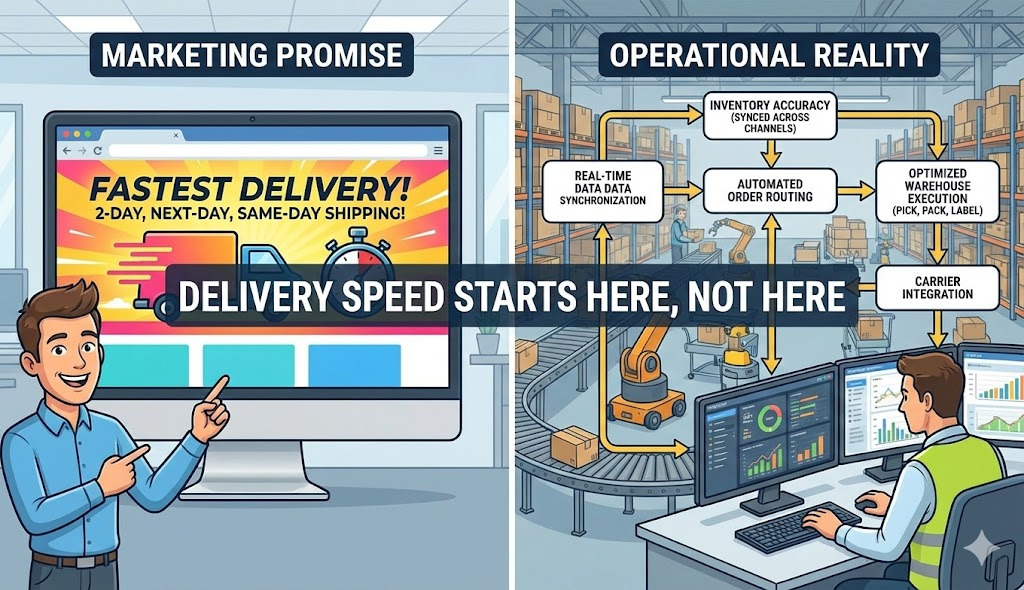
Delivery speed has become one of the most aggressively promoted promises in modern commerce. Brands advertise two-day, next-day, and even same-day shipping as if speed alone wins customer loyalty. Marketing teams amplify this expectation across campaigns, product pages, and marketplace listings. Yet performance does not originate in advertising copy. It originates inside operational workflows, warehouse layouts, inventory logic, and system architecture.
Customers see the promise on Shopify, Amazon, or Walmart. Operations teams carry the responsibility of fulfilling it. When inventory data is inaccurate, when order routing requires manual intervention, or when warehouse processes lack discipline, delivery speed collapses quickly. Marketing can amplify speed. Operations must build it.
True delivery performance starts long before checkout. It begins with data integrity, system synchronization, and structured execution. Without those foundations, speed becomes a fragile claim rather than a sustainable capability.
Inventory Accuracy as the Starting Point
Inventory accuracy represents the first operational milestone in the timeline of delivery speed. Every SKU displayed as available must correspond to a physical unit that can be located immediately. Multi-channel selling increases complexity dramatically, especially for 3PL providers who manage multiple merchants simultaneously. A single product might appear across Shopify storefronts, Amazon listings, and Walmart Marketplace catalogs at the same time.
If stock levels do not synchronize in real time, overselling becomes inevitable. Cancellations follow. Split shipments increase costs. Emergency transfers between facilities disrupt warehouse rhythm. Customer dissatisfaction grows. Speed deteriorates before the order even enters the picking queue.
High-performing 3PLs treat inventory visibility as a strategic discipline rather than a reporting function. They implement structured cycle counting, enforce barcode scanning standards, and ensure that system quantities reflect physical reality. Once inventory becomes reliable, fulfillment speed stops depending on luck and starts depending on process.
Order Orchestration and Real-Time Routing
Order ingestion forms the second critical layer. The moment a customer completes checkout, systems must interpret channel rules, shipping priorities, and client-specific SLAs. Manual exports, delayed API syncs, or spreadsheet-based reconciliation introduce latency. Small delays accumulate quickly and create operational bottlenecks.
Efficient operations remove ambiguity from this stage. Automated routing logic assigns orders to the correct warehouse instantly. Predefined rules determine service levels without human intervention. Prioritization occurs inside the system rather than inside inboxes.
CommerceBlitz OMNI plays a central role at this stage by unifying order management across channels and clients. Instead of navigating separate dashboards, teams operate from a centralized orchestration layer where routing logic applies consistently. Inventory remains synchronized. Order status updates flow automatically. Decision-making becomes systematic instead of reactive.
Speed improves because the system eliminates hesitation.
Warehouse Execution and Process Discipline
Warehouse execution transforms upstream clarity into physical movement. Even perfectly routed orders stall if picking paths are inefficient or bin locations are outdated. Operational discipline inside the warehouse directly influences dispatch time.
Structured storage logic reduces search time. Optimized picking sequences reduce walking distance. Clear replenishment thresholds prevent last-minute scrambling. Teams that maintain operational hygiene achieve faster dispatch without increasing pressure.
Delivery speed does not result from urgency alone. It results from predictable processes repeated consistently.
High-volume 3PL environments especially benefit from process standardization. When multiple clients share space and labor, chaos emerges quickly if workflows differ. A unified operational layer ensures that each order follows the same structured path regardless of sales channel.
Carrier Integration and Shipment Confirmation
The final operational checkpoint occurs at carrier integration. Once teams pack an order, they must select the correct service level, generate compliant labels, and update tracking information across every sales channel. Manual rate comparison or data re-entry introduces friction. Small inefficiencies compound and slow dispatch.
Integrated shipping logic removes that friction. The system selects predefined carrier rules automatically. Labels generate without manual input. Tracking numbers synchronize instantly with Shopify, Amazon, or Walmart. Customers receive confirmation in real time.
External perception of speed often depends on this moment. Even if physical transit time remains constant, immediate tracking confirmation reinforces trust and reliability.
Scalability Under Volume Pressure
Operational design reveals its strength during volume spikes. Promotional campaigns, marketplace algorithms, and seasonal demand can multiply order volume overnight. Systems that rely on manual intervention struggle to absorb sudden increases.
Automation absorbs growth more effectively than overtime. Real-time orchestration scales more reliably than spreadsheet coordination. Centralized visibility prevents backlog escalation.
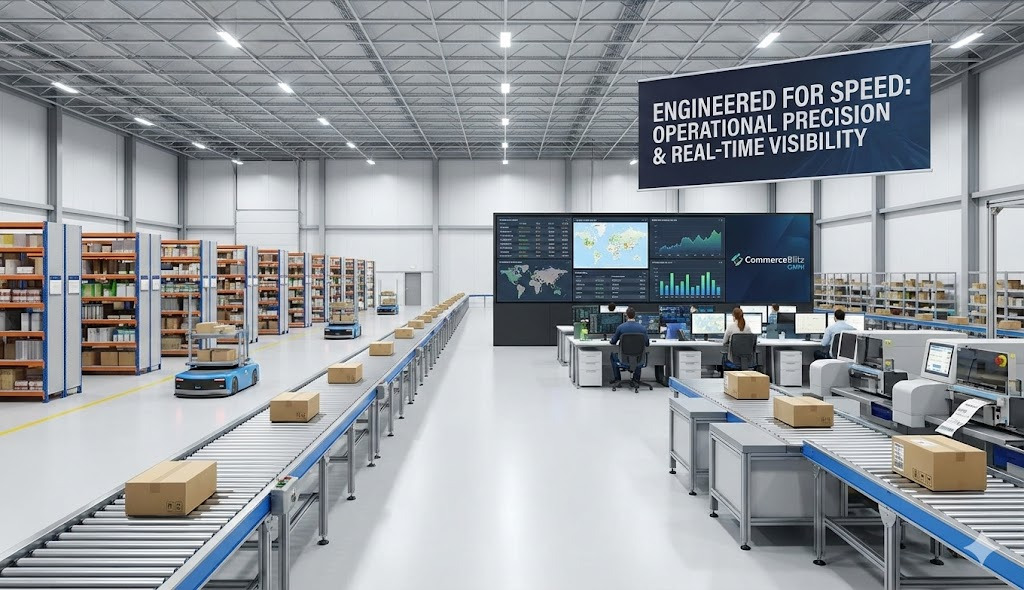
CommerceBlitz OMNI enables 3PL providers to manage multi-client growth without fragmenting workflows. Configurable routing logic, synchronized inventory, and structured warehouse integration allow operations to expand capacity logically. Delivery speed remains stable even when volume increases.
From Marketing Promise to Operational Capability
Customer expectations continue to accelerate. Competitive differentiation increasingly depends on consistent fulfillment performance rather than promotional messaging. Marketing teams can shape perception, but operations determine outcomes.
Sustainable delivery speed requires inventory integrity, automated order routing, warehouse discipline, and integrated carrier logic. Each stage builds upon the previous one. Weakness at any layer slows the entire system.
When 3PL providers treat delivery speed as an operational strategy, they protect margin, strengthen client relationships, and reduce service volatility. CommerceBlitz OMNI supports this transformation by centralizing complexity into a single orchestration environment where visibility, automation, and control replace fragmentation.
Delivery speed does not originate in advertising. It originates in structured execution. Organizations that invest in operational architecture rather than promotional claims build a foundation that marketing can confidently amplify.