
The Cost of Not Scaling: What Staying Small Actually Costs Growing Brands
Growth is usually seen as a positive signal. More orders, more customers, additional sales channels, and rising demand suggest that a brand is doing something right. Yet growth also introduces a powerful operational challenge that many businesses underestimate. Systems that worked perfectly when order volume was smaller often begin to show strain once a brand expands across multiple sales channels, such as Shopify, Amazon, Walmart, and other marketplaces.
Many companies believe they can continue operating the same way while simply working harder. At first, that approach appears reasonable. A few additional spreadsheets, some manual checks, and perhaps another employee seem like manageable adjustments. Over time, however, the real cost of not scaling infrastructure becomes increasingly visible. Operational friction grows, visibility decreases, and the customer experience begins to suffer in subtle but meaningful ways. What initially feels like staying lean and efficient can quietly evolve into something far more expensive.
The Illusion of Stability
For early-stage brands, simplicity can feel like control. Orders remain manageable, inventory counts are straightforward, and customer service requests are relatively limited. In those early months or years, a handful of manual processes can handle most operational needs without creating noticeable problems.
Growth changes the environment quickly. A brand selling exclusively through Shopify may decide to expand into Amazon to capture marketplace demand. Walmart Marketplace may follow shortly after, and wholesale or retail partnerships may begin to appear as the brand gains visibility. What once operated as a single-channel business gradually evolves into a multi-channel ecosystem where orders arrive from several platforms simultaneously.
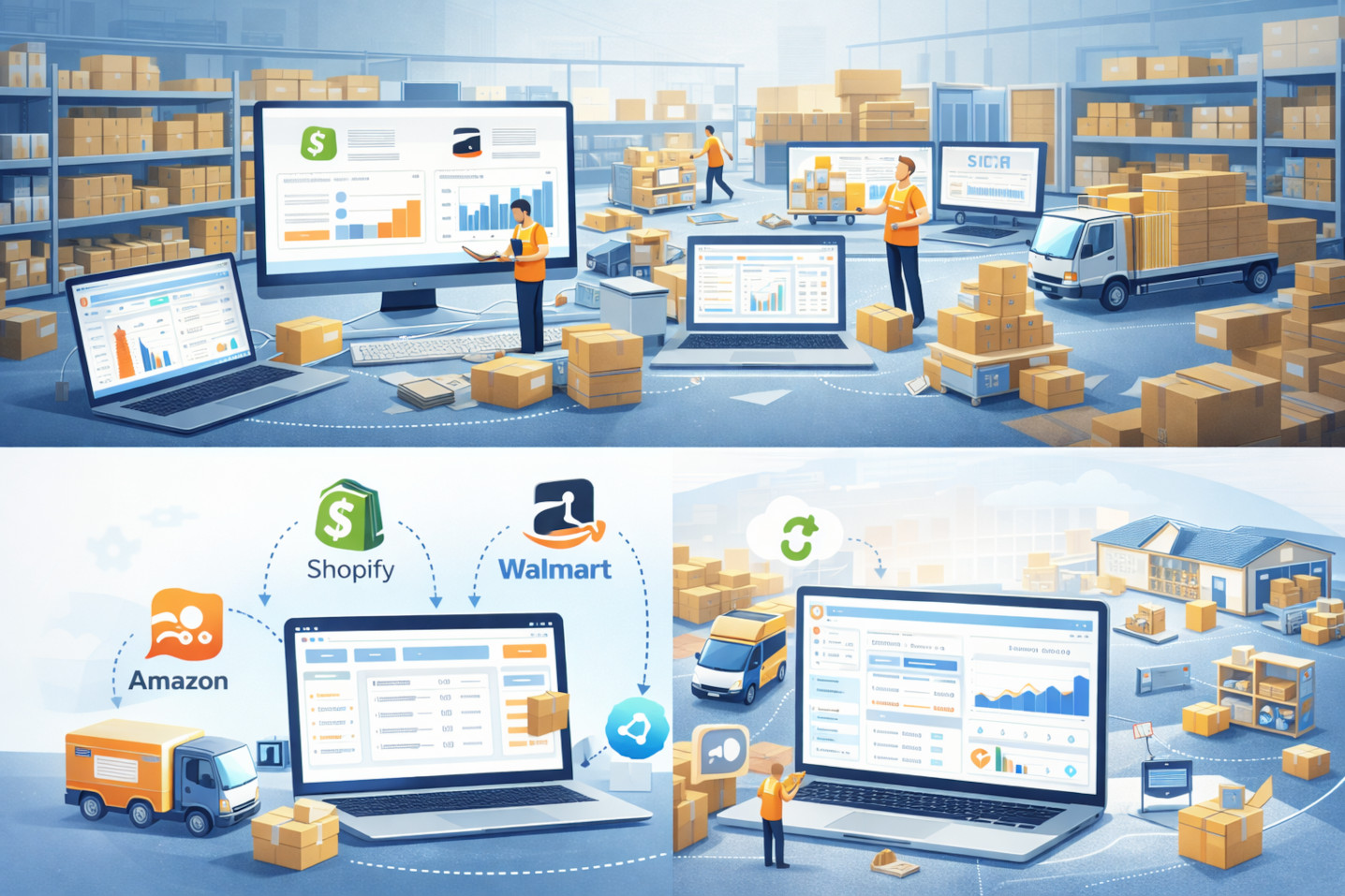
As this expansion happens, operational complexity increases dramatically. Inventory must remain synchronized across platforms, order data must move accurately between systems, warehouse teams must fulfill shipments quickly while maintaining accuracy, and financial reporting becomes more complicated as sales activity spreads across multiple marketplaces. Without scalable infrastructure, businesses often attempt to manage this complexity manually, and that approach rarely holds up as order volume continues to grow.
Operational Friction Becomes a Daily Cost
Operational friction rarely appears overnight. Instead, it develops gradually through small inefficiencies that accumulate over time and quietly drain productivity from every department. Warehouse teams may spend valuable time reconciling inventory numbers between multiple disconnected systems, while customer support agents struggle to locate order details because the information exists across several dashboards or spreadsheets.
Finance teams frequently face similar challenges when attempting to generate accurate reports. Data must often be pulled from multiple sales channels and then merged manually before meaningful analysis can even begin. Each additional step consumes time and introduces the possibility of error.
Manual workflows also tend to create duplicated effort across teams. One department may update inventory within a warehouse management system while another manually adjusts stock levels within marketplace dashboards. Even small inconsistencies can lead to overselling, delayed shipments, or canceled orders that damage both revenue and customer trust.
Scaling operational infrastructure is therefore not only about supporting higher-order volume. It is equally about removing friction that quietly grows as businesses expand and begin operating across multiple systems.
Inventory Accuracy Starts to Break Down
Inventory management is often the first area where scaling limitations become visible. A brand selling through Shopify alone may find it relatively easy to track stock levels, but once additional channels enter the picture, synchronization becomes significantly more complex. Orders from Amazon, Walmart, direct website sales, and wholesale partners may all draw from the same inventory pool.
Without centralized coordination, discrepancies can emerge quickly. One platform may still display available units that have already been sold elsewhere, creating the risk of overselling and canceled orders. Warehouse staff may unknowingly ship items that were allocated to another order, especially if inventory updates lag behind real-time activity.
Inventory errors ripple across the entire organization. Customer support teams handle complaints and refund requests. Finance teams process returns and reconcile discrepancies. Marketing teams struggle to promote products confidently when availability becomes unpredictable. Accurate inventory management, therefore, requires more than basic tracking. It requires orchestration across systems, warehouses, and sales channels.
Multi-Channel Selling Multiplies Complexity
Modern commerce rarely happens in a single place. Shopify storefronts allow brands to build direct relationships with customers, while Amazon offers access to massive product discovery traffic. Walmart Marketplace continues to expand its reach, and additional channels often emerge as brands pursue broader distribution.
Each platform introduces its own requirements, workflows, and data formats. Order information must be captured accurately and routed to the correct fulfillment process, inventory availability must remain synchronized across every platform, and shipping updates must be reflected consistently so customers receive accurate tracking information.
Managing these processes manually becomes increasingly risky as order volume grows. Even small delays can create problems. A product that sells out on Amazon but still appears available on another marketplace can trigger overselling. A shipment confirmation that fails to update quickly may lead to customer inquiries or negative reviews.
A scalable operational backbone allows brands to expand across multiple channels without losing control of inventory, order flow, or customer experience.
The Hidden Cost of Delayed Decisions
Growth produces a large amount of operational data, but that data is only valuable if it can be accessed and interpreted quickly. Sales trends often shift across platforms, seasonal demand patterns change from year to year, and marketing campaigns may trigger sudden spikes in product demand.
Without centralized visibility, decision-making becomes reactive rather than strategic. Executives may struggle to identify which products are performing best across channels, while inventory replenishment decisions may rely on outdated or incomplete reports. Marketing teams may unknowingly promote items that are already approaching stock limits, which can create customer frustration and operational stress.
Unified data visibility allows brands to respond to demand signals quickly and make confident decisions about purchasing, promotions, and expansion. When operational data remains fragmented across multiple systems, valuable insights often remain hidden until it is too late to act on them effectively.
Customer Experience Suffers First
Customers rarely see the internal operational challenges that brands face. Instead, they experience the results. Delayed shipments, incorrect items, canceled orders, or inconsistent tracking updates can damage brand reputation quickly.
Brands that struggle to scale their operational systems often see customer experience decline just as demand for their products begins to grow. Shipping timelines become less predictable, inventory availability becomes unreliable, and customer support teams may become overwhelmed with inquiries related to order status or product availability.
In an environment where online reviews and social media feedback spread quickly, even a small number of fulfillment problems can influence public perception. Growth should strengthen a brand’s reputation, yet without scalable operations it can have the opposite effect.
3PL Partnerships Require Operational Alignment
Many growing brands partner with third party logistics providers to expand fulfillment capacity and reach customers faster. A well-structured 3PL network allows businesses to reduce shipping times, distribute inventory across regions, and support expansion into new markets.
Outsourcing fulfillment does not remove operational complexity. 3PL partners still require accurate order data, synchronized inventory counts, and clear routing instructions. When internal systems remain fragmented, coordination with external warehouses becomes difficult and operational visibility decreases.
Orders may arrive incomplete or delayed, inventory updates may not reflect real-time stock levels, and reporting across multiple fulfillment locations can become difficult to reconcile. Successful partnerships between brands and logistics providers, therefore, depend on strong operational orchestration that keeps systems aligned.
CommerceBlitz OMNI helps address these challenges by creating a centralized operational environment where orders, inventory, and fulfillment data remain synchronized across channels and warehouses. Instead of juggling disconnected systems, teams gain a unified platform designed specifically for multi-channel commerce and distributed fulfillment networks.
The Financial Impact of Staying Small
Operational inefficiencies often remain hidden within daily workflows, yet their financial impact accumulates steadily over time. Manual reconciliation consumes employee hours that could otherwise support growth initiatives, while inventory errors lead to refunds, reshipments, and lost customer trust.
Marketing campaigns may also suffer when inventory data is inaccurate, because products promoted heavily may suddenly become unavailable. In addition, brands that hesitate to expand into new channels due to operational limitations may miss significant revenue opportunities.
Retail partnerships, international expansion, or additional marketplace integrations may remain out of reach if fulfillment infrastructure cannot support larger order volumes. The cost of staying small rarely appears as a single line item in financial reports. Instead, it manifests as missed opportunities, rising operational overhead, and slower strategic progress.
Building Infrastructure That Supports Growth
Scaling does not mean abandoning efficiency or simplicity. Instead, it involves designing systems that maintain efficiency even as operational complexity increases. A scalable operational architecture typically includes centralized order management, real time inventory visibility, and dynamic fulfillment routing that can adapt to changing demand patterns.
CommerceBlitz OMNI was built to support exactly this type of environment. By aggregating data from multiple sales channels and coordinating fulfillment workflows across warehouses and 3PL partners, the platform creates a unified operational foundation for growing brands.
With the right infrastructure in place, businesses can expand into new channels such as Shopify, Amazon, and Walmart without losing visibility or control. Growth becomes a strategic opportunity rather than an operational risk.
Scaling Early Prevents Costly Corrections Later
Many brands wait until operational problems become severe before addressing infrastructure limitations. Unfortunately, retrofitting scalable systems into a chaotic environment can be far more difficult than building the right foundation early.
Teams may need to unwind manual workflows, reconcile inconsistent historical data, and retrain staff on new operational processes. Warehouse networks may require restructuring, and customer expectations may need rebuilding after service disruptions.
Scaling earlier allows brands to avoid these painful corrections. Operational visibility improves, fulfillment becomes more predictable, and teams can focus on strategic growth instead of daily troubleshooting.
The True Cost of Standing Still
Growth inevitably places pressure on every system within a business. Processes that once felt sufficient gradually become obstacles, and teams that once operated comfortably may begin to struggle with rising complexity.
The decision not to scale infrastructure rarely feels dramatic in the moment, yet the accumulated costs become undeniable over time. Operational inefficiencies expand, customer experience weakens, and strategic opportunities disappear.
Brands that invest in scalable operational systems position themselves to grow confidently across platforms like Shopify, Amazon, Walmart, and additional marketplaces. With the right infrastructure in place, complexity becomes manageable and growth becomes sustainable.
CommerceBlitz OMNI provides the centralized orchestration needed to support this transition, helping businesses transform fragmented operations into coordinated, data-driven commerce networks where growth strengthens the brand instead of overwhelming it.