
Multi-Warehouse Fulfillment: When One Warehouse Is No Longer Enough
There is a moment in almost every growing operation when the warehouse that once felt like a competitive advantage begins to feel like a limitation. At the beginning, one warehouse makes everything simple. Inventory lives in one place. Orders flow from a single origin. Teams know where products are stored, and reporting feels straightforward. For a while, this centralized model works well, especially when order volumes are manageable and customer locations are relatively close to the fulfillment point.
Over time, however, growth changes the equation. Orders begin traveling farther. Shipping costs slowly increase, not because of sudden rate changes, but because more shipments cover longer distances. Delivery timelines stretch in certain regions, and customer expectations do not relax simply because geography makes fulfillment harder. Instead, the pressure increases. Customers expect fast delivery regardless of where inventory is stored, and marketplaces reward businesses that can deliver quickly and consistently.
At first, the signs are subtle. A few delayed shipments here and there. Slight increases in transportation costs. Customer service teams handling more delivery-related inquiries. Warehouse teams working harder to maintain throughput without clear gains in efficiency. None of these signals alone feels urgent, but together they form a pattern. That pattern usually leads to a realization: the business has outgrown the advantages of a single warehouse, and continuing with one location may limit growth more than support it.
The Signs That One Warehouse Is Reaching Its Limits
Most businesses do not wake up one morning and decide to operate multiple warehouses. Instead, the decision emerges from repeated operational pressure. One of the earliest indicators appears in shipping performance. Orders destined for distant regions begin taking longer to arrive, even when they leave the warehouse on time. Carriers do their best, but distance is distance. A shipment traveling hundreds or thousands of kilometers will always carry more risk than one traveling locally.
Shipping cost patterns are another early signal. As order distribution spreads geographically, average shipping costs increase. The finance team may notice that transportation expenses are rising faster than revenue growth. This trend is rarely caused by a single decision. It is the result of incremental growth pushing shipments into zones that were never originally planned as primary delivery regions.
Warehouse congestion also becomes more visible. As product catalogs expand and demand increases, storage areas become crowded. Overflow locations appear in corners, staging areas, or temporary rack spaces. Picking paths grow longer and more complicated. Teams spend additional time navigating around obstacles that did not exist in earlier phases of operation. The warehouse still functions, but the friction increases, and friction reduces productivity.
Customer experience provides another strong signal. Customers located far from the warehouse begin experiencing longer delivery windows compared to customers closer to the facility. In competitive markets, that difference becomes noticeable. When competitors can offer faster delivery in those regions, customer loyalty begins to shift. What once felt like a reliable fulfillment operation starts showing geographic imbalance.
Multi-channel businesses feel these pressures faster than single-channel operations. When selling across Shopify, Amazon, Walmart, and additional channels, inventory exposure increases dramatically. Orders may originate from customers across wide geographic areas. Without regional distribution support, a single warehouse becomes responsible for serving everyone, regardless of distance. The operational load intensifies quickly.
Why Businesses Expand to Multiple Warehouses
The decision to expand into multi-warehouse fulfillment is often driven by the need to improve delivery speed and reduce shipping costs. Placing inventory closer to customers shortens transit distances and stabilizes delivery timelines. When products travel shorter distances, the likelihood of delays decreases, and customer satisfaction improves naturally.
Geographic expansion is not the only motivation. Capacity constraints frequently play a role. A growing product catalog requires additional storage space, and sometimes expanding the existing building is not practical or financially reasonable. Leasing or building a second warehouse allows operations to continue growing without forcing inventory into overcrowded conditions.
Regional demand patterns also influence the decision. Some products may sell heavily in specific regions, creating localized inventory demand. Storing those items closer to their primary markets reduces replenishment cycles and improves order responsiveness. Instead of shipping every unit from a distant warehouse, inventory becomes strategically positioned where it is most likely to be needed.
B2B distribution environments often expand into multiple warehouses to maintain service-level commitments. Business customers rely on predictable delivery windows, especially when inventory replenishment is tied to production schedules or retail operations. A second warehouse placed near key accounts transforms delivery reliability from uncertain to dependable.
For 3PL providers, geographic reach becomes a competitive advantage. Clients frequently expect fulfillment partners to operate across multiple regions. A 3PL limited to a single location may struggle to secure contracts that require regional distribution coverage. Expanding into additional warehouses increases service flexibility and strengthens client confidence.
The Hidden Complexity of Multi-Warehouse Operations
While adding a second warehouse solves certain problems, it introduces new ones that require careful management. The most significant shift occurs in inventory control. With one warehouse, inventory exists as a single physical reality. With multiple warehouses, inventory becomes distributed across locations, and maintaining accuracy requires synchronized processes.
Inventory allocation becomes one of the first strategic challenges. Deciding which products belong in each warehouse is not a one-time decision. Demand patterns shift, product popularity changes, and seasonal trends influence consumption rates. Without thoughtful allocation, some warehouses may run out of critical items while others accumulate excess stock.
Order routing introduces another layer of complexity. Each incoming order must be assigned to the most appropriate warehouse. The closest warehouse to the customer may not always have the required inventory. The warehouse with available stock may not be the most cost-efficient fulfillment point. Routing logic must balance proximity, availability, and operational workload.
Inventory transfers between warehouses become a regular part of operations. Products frequently move from one location to another to rebalance stock levels or support demand surges. Without clear transfer processes, inventory visibility quickly becomes unreliable. A product in transit between warehouses must remain visible and traceable to prevent duplication errors or false availability.
Operational consistency across locations also becomes critical. Each warehouse must follow the same handling standards, labeling methods, and scanning protocols. Differences between locations create discrepancies that compound over time. What appears as a minor inconsistency can evolve into a persistent source of inventory variance.
Common Multi-Warehouse Mistakes That Create Chaos
Many organizations underestimate the planning required to support multiple warehouses. One common mistake is duplicating inventory blindly without understanding demand distribution. Simply dividing inventory equally between locations rarely produces optimal results. Demand patterns vary by region, and allocation should reflect those differences.
Another frequent issue appears when systems fail to provide real-time visibility across all warehouses. When inventory updates lag behind physical movement, discrepancies multiply. Orders may be routed to warehouses that do not actually have available stock. Teams then scramble to transfer products or reroute shipments, creating unnecessary delays.
Lack of standardized workflows creates additional risk. If each warehouse operates independently, procedural differences accumulate. Receiving, picking, and packing processes may evolve differently at each location, leading to inconsistent outcomes. Over time, these variations create reporting challenges and operational confusion.
Some businesses also overlook the importance of transfer management. Inventory moved between warehouses must follow structured processes with clear documentation. Without defined transfer workflows, products may disappear into transit gaps, leaving both locations uncertain about true stock levels.
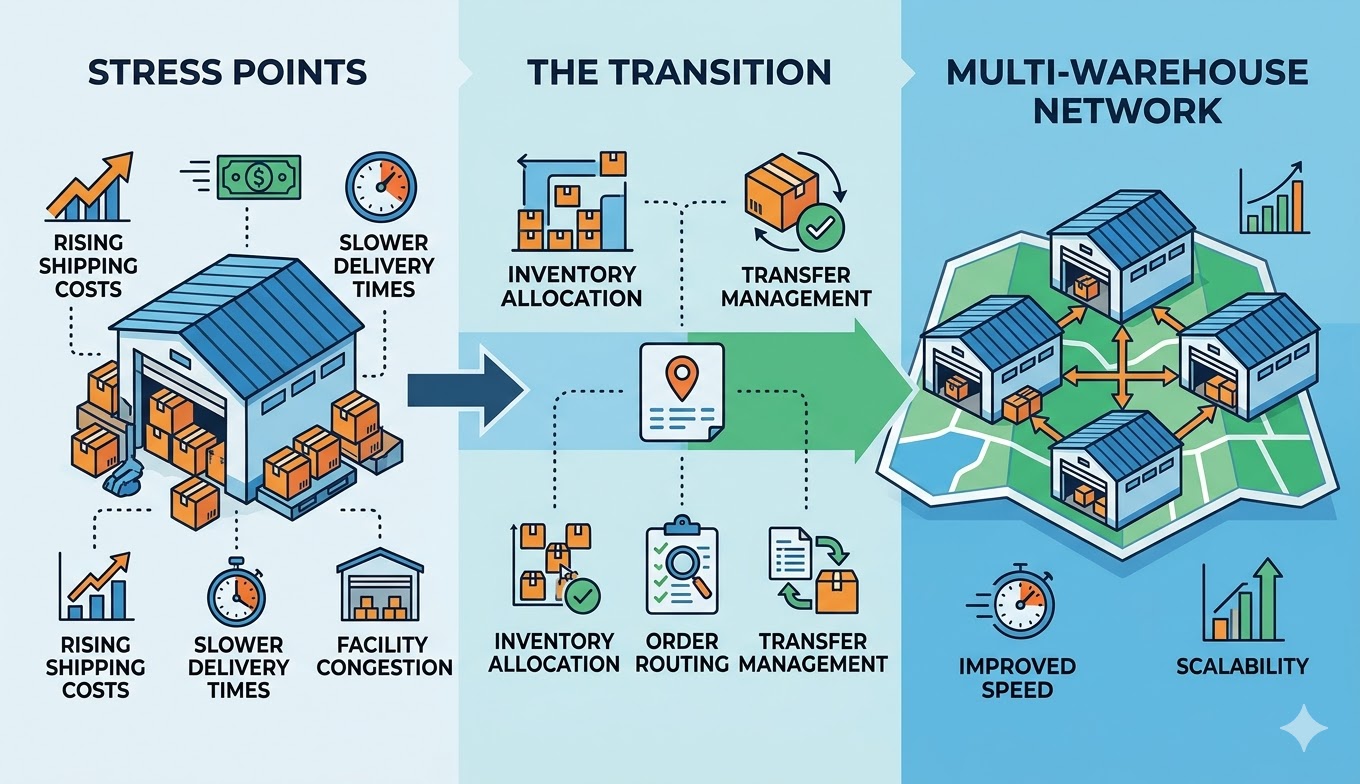
Implementing Multi-Warehouse Fulfillment: A Chronological Process
A successful transition to multi-warehouse fulfillment follows a structured progression. Attempting to expand without clear sequencing often results in operational instability. The following chronological process outlines the foundational steps that support sustainable multi-location operations.
1) Define Warehouse Roles
Each warehouse should have a defined operational purpose. Some locations may function as regional fulfillment centers, while others serve as bulk storage hubs or specialized handling facilities. Defining roles prevents overlap and clarifies inventory responsibilities across the network.
2) Plan Inventory Allocation
Inventory distribution should align with demand patterns. High-velocity items should be positioned closer to regions where demand is strongest. Slower-moving products may remain centralized until consistent regional demand emerges. Allocation should remain flexible, adapting to seasonal changes and growth patterns.
3) Establish Order Routing Logic
Routing decisions should consider proximity, availability, and operational capacity. Automated routing systems help reduce manual decision-making and maintain consistency across order flows. Routing logic should be tested regularly to ensure performance remains aligned with operational goals.
4) Manage Transfers Between Warehouses
Inventory transfers should follow defined workflows with clear scanning and confirmation steps. Each transfer must remain visible from origin to destination. Tracking in-transit inventory prevents loss of visibility and ensures accurate reporting throughout the movement cycle.
5) Monitor Performance Across Locations
Performance metrics should be tracked at each warehouse individually and collectively. Shipping times, picking accuracy, and inventory variance rates provide valuable insights into operational stability. Monitoring these metrics allows leadership to identify weaknesses before they expand into systemic problems.
6) Refine the Network Over Time
Multi-warehouse fulfillment is not static. As demand evolves, network structure must evolve with it. Adding new locations, adjusting allocation strategies, and refining routing logic are natural steps in maintaining operational balance. Continuous improvement ensures that growth does not outpace control.
How CommerceBlitz OMNI Supports Multi-Warehouse Fulfillment
Managing multiple warehouses requires more than physical infrastructure. It requires a system capable of maintaining unified visibility across all locations. CommerceBlitz OMNI supports multi-warehouse fulfillment by providing a centralized platform where inventory remains synchronized regardless of where it is stored.
Unified inventory visibility allows teams to see accurate stock levels across all warehouses in real time. Instead of relying on fragmented reporting or manual reconciliation, operations gain confidence that system inventory reflects physical reality. This clarity supports faster decision-making and reduces operational hesitation.
Order routing capabilities help ensure that each order is assigned to the most efficient fulfillment location. By evaluating availability and location data, OMNI supports intelligent routing decisions that balance delivery speed with operational efficiency. This reduces manual intervention and prevents routing conflicts.
Transfer management tools help maintain visibility during inventory movement between warehouses. Tracking transfers ensures that products remain accounted for throughout transit, preventing inventory gaps that can disrupt fulfillment accuracy.
Performance insights across warehouses provide leadership with a comprehensive view of network health. Identifying recurring issues in specific locations supports targeted improvement efforts. Instead of reacting to problems after they escalate, teams can address root causes proactively.
When Multi-Warehouse Fulfillment Becomes a Competitive Advantage
Expanding into multiple warehouses is often viewed as a logistical necessity, but when implemented correctly, it becomes a strategic advantage. Businesses capable of fulfilling orders from multiple locations gain flexibility that single-location operations cannot easily match. Delivery timelines stabilize. Shipping costs become more predictable. Customer expectations are met with greater consistency.
The transformation from single-warehouse fulfillment to multi-warehouse coordination is not simply about adding space. It is about building a network capable of supporting growth without sacrificing accuracy or reliability. Organizations that approach this transition thoughtfully discover that multiple warehouses create new opportunities rather than new complications.
As operations scale, the ability to maintain synchronized inventory, reliable routing, and consistent workflows determines long-term stability. CommerceBlitz OMNI supports that stability by connecting warehouses into a unified operational structure, allowing businesses to grow geographically while maintaining operational control. In an environment where customer expectations continue to tighten and delivery speed defines competitiveness, multi-warehouse fulfillment becomes more than an operational upgrade. It becomes a defining capability for businesses ready to move beyond the limits of a single location.