
Why Inventory Availability Across Shopify, Amazon, and Walmart Is Harder Than It Looks
When businesses first expand beyond a single sales channel, inventory availability still feels like something that can be handled with simple logic. A product exists in the warehouse, a quantity sits inside a system, and that number is shared with customers through listings on platforms like Shopify, Amazon, or Walmart. At this early stage, inventory feels like a static concept. You count what you have, subtract what you sell, and repeat the cycle.
The simplicity lasts only as long as order volume stays predictable and sales remain concentrated in one place. The moment inventory begins serving multiple channels at the same time, availability stops behaving like a fixed number and starts behaving like a moving process. That transition is subtle at first, but it becomes increasingly visible as growth accelerates and operational pressure begins to spread across the warehouse, fulfillment workflows, and customer-facing platforms.
Many brands enter multichannel selling with the expectation that integration alone will solve availability challenges. Connecting Shopify, Amazon, and Walmart into the same environment feels like the logical next step toward scaling revenue. Listings become visible across new marketplaces, customers begin placing orders from different directions, and leadership teams often interpret this expansion as confirmation that their operations are now more sophisticated.
What usually remains invisible at this stage is the fact that inventory is no longer serving one demand stream. It is now supporting several competing ones, each with its own timing, rules, and expectations. The same physical unit inside the warehouse suddenly belongs to multiple digital storefronts at the same time, and each of those storefronts assumes access to that unit until the system says otherwise.
This is the point where inventory availability begins to behave differently than most teams expect.
The Illusion of Shared Inventory
In theory, multi-channel inventory behaves as a single shared pool. A product listed on Shopify, Amazon, and Walmart should reflect the same availability across all platforms. When an order is placed on one channel, the remaining quantity should decrease everywhere else. That expectation is technically correct, but it ignores how real-world systems communicate and how real-world operations move.
In practice, synchronization always involves timing. Orders do not wait for updates to complete before being placed. Systems do not update every platform at the exact same moment. Even small delays between order placement and inventory updates can create windows where availability appears higher than reality.
Those windows are rarely noticeable when daily order volume remains low. A handful of orders can be manually reviewed, corrected, or absorbed without significant consequences. But as volume grows, those small timing gaps become operational risks that repeat hundreds or thousands of times per day.
Imagine a scenario where a product shows ten units available across Shopify, Amazon, and Walmart. A customer on Shopify places an order for four units. Before that update fully propagates to the other platforms, customers on Amazon and Walmart place additional orders for the same product. Within seconds, the system has promised more units than physically exist.
The warehouse team usually discovers the problem only when picking begins. At that moment, availability stops being theoretical and becomes physical. The shelf contains fewer items than expected, and someone must decide which order gets fulfilled and which one gets canceled.
What appeared to be a synchronization issue inside a system quickly turns into a customer experience problem.
Marketplace Behavior Changes the Rules
Another reason inventory availability becomes harder than expected is that Shopify, Amazon, and Walmart do not behave like identical environments. Each platform introduces its own operational pressure, and those differences shape how inventory must be managed.
Shopify typically operates as a controlled storefront environment where brands have flexibility in managing fulfillment timing, customer communication, and inventory presentation. Adjustments can be made quickly, and customer expectations are often shaped by the brand itself rather than marketplace policy.
Amazon, on the other hand, operates under strict performance expectations. Late shipments, cancellations, or inventory discrepancies do not simply inconvenience customers. They directly affect seller metrics, visibility, and long-term marketplace performance. Inventory inaccuracies on Amazon are rarely isolated events. They create measurable operational consequences that extend beyond a single order.
Walmart introduces its own operational discipline, especially around listing reliability and fulfillment consistency. Inventory discrepancies can affect listing health and platform trust in ways that are not immediately visible but gradually reduce marketplace performance over time.
Managing inventory across these platforms requires more than technical integration. It requires operational alignment that respects the expectations of each marketplace while maintaining consistency across all of them.
Warehouse Reality Is Always More Complex Than System Logic
Inventory systems assume accuracy. Warehouses operate in environments where accuracy must be constantly defended.
Products move. Items are received late. Returns arrive unexpectedly. Damaged goods must be removed from sellable stock. Cycle counts reveal discrepancies that did not previously exist. Human handling introduces variability that software alone cannot eliminate.
These operational realities matter because inventory availability depends on more than total quantity. It depends on verified, sellable, and accessible stock.
Consider how returns affect availability across multiple channels. A returned product may be scanned into the system, increasing inventory count. However, the item itself may still require inspection before it can be shipped again. If that inspection reveals damage or missing packaging, the product cannot be resold immediately.
Yet during the time between system registration and physical verification, marketplaces may already display that unit as available inventory. Orders may be placed against stock that technically exists but is not operationally ready to ship.
The gap between digital availability and physical readiness becomes one of the most underestimated sources of inventory conflict in multi-channel environments.
Order Competition Creates Invisible Pressure
As businesses grow, demand from multiple channels begins to compete for the same physical inventory. This competition rarely appears on dashboards in a visible way, yet it shapes fulfillment outcomes every day.
A Shopify order placed seconds before an Amazon order might claim the last available unit. Meanwhile, Walmart may still display the same item as available because the update has not reached that platform yet. Customers experience availability based on what they see at the moment of purchase, not what exists inside the warehouse.
From the customer perspective, availability feels reliable. From the warehouse perspective, availability feels fragile.
This difference between perception and reality becomes more pronounced during periods of increased demand. Promotions, seasonal campaigns, and product launches all accelerate order velocity. When multiple channels experience simultaneous traffic spikes, inventory competition intensifies without warning.
Warehouse teams feel this pressure first, followed by customer service teams who must explain delays or cancellations. Customers encounter the consequences last, often without understanding how the underlying process created the conflict.
Inventory availability begins to feel less like a number and more like a negotiation between competing demand streams.
Growth Multiplies Synchronization Complexity
Many businesses assume that inventory complexity increases gradually. In reality, complexity often multiplies faster than expected.
Each additional product introduces new synchronization events, while new warehouse locations add layers of coordination that did not previously exist. Fulfillment partners bring their own communication pathways into the workflow, expanding the number of touchpoints where delays or mismatches can quietly develop over time.
A catalog containing fifty SKUs behaves differently than one containing five hundred. A warehouse handling dozens of daily orders behaves differently than one processing thousands. At scale, synchronization events happen continuously, not occasionally.
What once felt like a manageable workflow evolves into a continuous operational balancing act. Inventory must remain accurate while orders move in multiple directions and warehouse activity continues without interruption.
This stage of growth often reveals that availability is not simply a technical setting. It is an operational discipline that requires structured visibility and coordinated decision-making.
Visibility Changes How Inventory Is Managed
True inventory availability depends on visibility across the entire fulfillment lifecycle, not just within isolated systems.
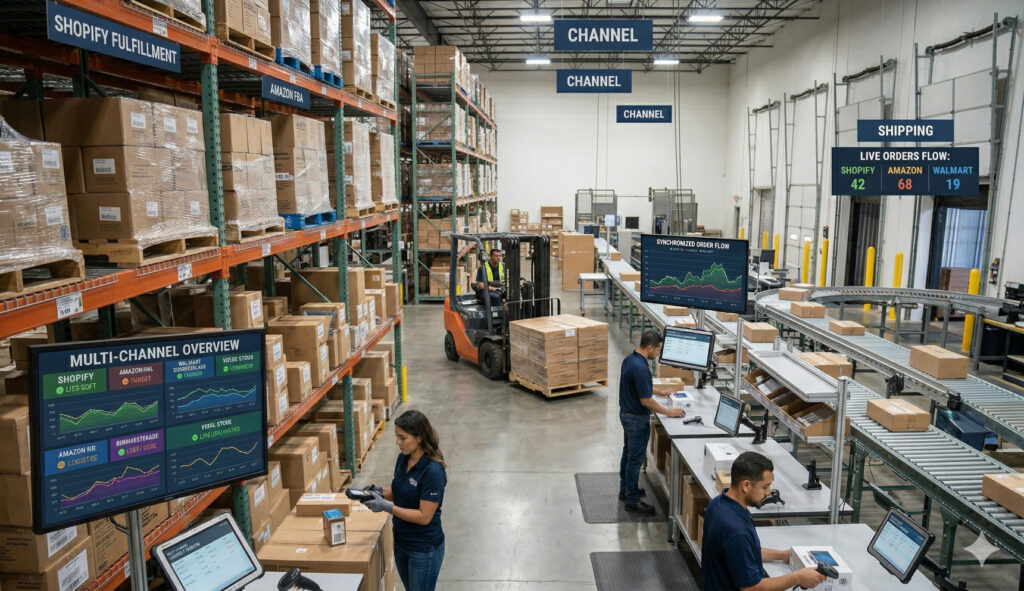
Teams need to understand what inventory exists, what inventory has been reserved, what inventory has already been committed to orders, and what inventory remains physically accessible. Without that level of visibility, decision-making becomes reactive rather than proactive.
When inventory movement is visible in real time, teams gain the ability to anticipate shortages instead of discovering them too late. Allocations can be adjusted before overselling occurs. Orders can be routed intelligently based on available stock. Fulfillment workflows can adapt to changing demand patterns.
Visibility transforms availability from a static number into an operational flow.
That transformation represents one of the most important shifts in modern multi-channel fulfillment.
Why Centralized Inventory Logic Becomes Essential
As businesses mature, many discover that passing numbers between systems is not enough to maintain reliable availability. Each platform continues to operate according to its own rules, interpreting inventory changes independently. Without centralized logic, synchronization remains reactive and fragmented.
Centralized inventory orchestration introduces structure into this environment. Instead of allowing Shopify, Amazon, and Walmart to respond independently, inventory decisions occur within a unified operational framework. Orders reserve stock before conflicts occur. Allocation logic adapts to demand patterns. Inventory availability reflects real operational conditions rather than delayed updates.
This approach does not eliminate complexity, but it organizes it into predictable workflows.
Solutions like CommerceBlitz OMNI are designed to support this level of coordination by maintaining centralized visibility across connected sales channels and fulfillment operations. Rather than simply transmitting inventory numbers, the system supports controlled allocation and consistent availability logic across Shopify, Amazon, and Walmart environments.
That difference becomes increasingly valuable as order volume grows and fulfillment complexity expands.
Availability Is Not a Number, It Is a Process
Inventory availability across Shopify, Amazon, and Walmart appears simple only when viewed from a distance. Inside operational environments, availability behaves as a continuous process shaped by demand timing, warehouse activity, marketplace expectations, and fulfillment readiness.
Businesses that treat availability as a static number often struggle with overselling, cancellations, and customer dissatisfaction. Those that treat availability as a managed process build systems capable of adapting to growth without sacrificing reliability.
As multi-channel commerce continues to expand, the difference between these two approaches becomes more visible. Inventory accuracy stops being a technical detail and becomes a foundation for sustainable scaling.
And once that foundation is understood, inventory availability no longer feels unpredictable. It becomes something that can be managed deliberately, supported by visibility, coordinated logic, and operational discipline that grows alongside the business itself.