
Inventory Drift: Why Warehouse Data Slowly Becomes Unreliable
Inventory accuracy is one of the most misunderstood operational metrics in modern e-commerce. Many brands assume inventory problems happen because of one large mistake, a failed integration, a warehouse move, a software outage, or a major fulfillment issue that suddenly throws the entire operation into chaos. In reality, most inventory problems develop slowly. They build silently over weeks and months until the business reaches a point where nobody fully trusts the numbers anymore.
This gradual loss of accuracy is what many operations teams experience as inventory drift.
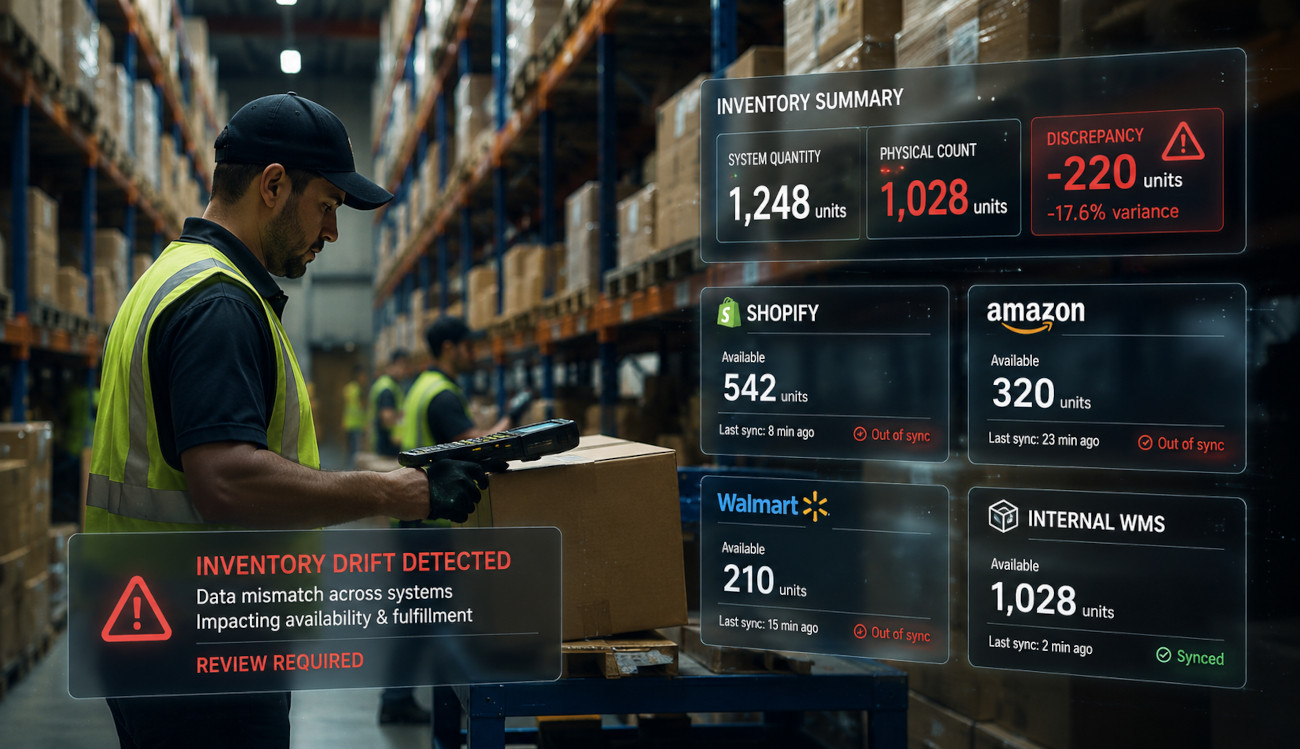
Inventory drift happens when the inventory shown inside operational systems slowly separates from physical warehouse reality. At first, the discrepancies are small enough to ignore. A missing unit here, an incorrect return there, a delayed sync between systems, or a warehouse adjustment that never gets logged correctly. Individually, these problems rarely look serious. Collectively, they compound into an operational environment where every team starts questioning the data they rely on every day.
The dangerous part is that inventory drift rarely announces itself immediately. Most businesses continue operating normally while the reliability of their data quietly degrades underneath them. Orders still flow. Products still appear available online. Warehouse staff still pick and pack shipments. The systems technically continue functioning. The problem only becomes obvious once the operational consequences start reaching customers, finance teams, purchasing departments, and marketplace performance metrics.
By the time leadership notices the issue, the drift has usually existed for a long time.
Inventory Drift Rarely Starts With One Major Failure
One of the biggest misconceptions about inventory accuracy is the idea that warehouse data only becomes unreliable after catastrophic operational events. Most of the time, inventory drift begins through small operational inconsistencies that appear harmless in isolation.
A picker substitutes one SKU but the change is not properly reflected in the system. A damaged item gets removed physically but never adjusted digitally. Returns arrive in the warehouse but remain stuck in inspection queues for several days before inventory becomes available again. Marketplace orders import late during peak volume periods. A warehouse worker manually corrects a quantity without understanding how the adjustment affects reserved stock across multiple sales channels.
None of these situations seem severe enough to create major concern. The business adapts temporarily and continues moving forward. Over time, however, the accumulated impact of these inconsistencies slowly weakens the integrity of warehouse data.
This is where many operations teams begin developing dangerous habits. Once employees stop fully trusting the system, they start creating manual workarounds. Teams rely on spreadsheets, handwritten notes, Slack messages, side calculations, or memory instead of centralized operational data. At that point, the problem expands beyond inventory itself. The business starts operating with multiple competing versions of reality.
The warehouse believes one number. Customer support sees another. Purchasing relies on different data entirely. Marketplace listings display quantities that may no longer exist physically. Finance teams struggle to reconcile inventory valuation because adjustments happen inconsistently across systems.
Inventory drift stops being a warehouse issue and becomes a business-wide reliability problem.
Multi-Channel Selling Accelerates Inventory Drift
The complexity becomes even more dangerous when businesses expand across multiple sales channels.
Selling on Shopify alone already requires disciplined operational processes. Adding Amazon, Walmart, eBay, retail partners, or multiple warehouse locations increases synchronization complexity exponentially. Every additional integration introduces new timing dependencies, reservation logic, cancellation flows, return paths, and inventory synchronization risks.
Many growing brands underestimate how fragile multi-channel inventory accuracy becomes once operational scale increases.
A single delayed sync can oversell products across marketplaces. A failed acknowledgment from one platform may reserve inventory incorrectly. An integration timeout during high order volume may create duplicate reservations or delayed stock updates. If warehouse adjustments are not propagated correctly across every connected channel, inventory drift begins accelerating almost immediately.
This becomes especially problematic during promotional periods or seasonal demand spikes. High order velocity exposes weaknesses that remain hidden during slower operational periods. Businesses that appear operationally stable during normal weeks suddenly experience overselling, backorders, missing inventory, and fulfillment delays once volume increases.
The issue is not always the warehouse itself. Often, the operational ecosystem surrounding the warehouse becomes too fragmented to maintain reliable inventory synchronization consistently.
This is one reason why many scaling brands eventually realize spreadsheets and disconnected tools are no longer sustainable. Operational growth increases system interdependency, and inventory accuracy becomes heavily dependent on orchestration quality across the entire commerce infrastructure.
The Human Side of Inventory Drift
Technology alone does not create inventory reliability problems. Human operational behavior plays an equally important role.
Warehouse environments operate under constant pressure. Teams move quickly to hit shipping deadlines, clear inbound deliveries, process returns, replenish shelves, and maintain throughput expectations. Under these conditions, small process shortcuts naturally emerge over time.
Employees may skip scans to save seconds. Temporary staging areas become permanent unofficial inventory locations. Returns get placed aside “for later.” Manual adjustments happen without standardized reasoning codes. Cycle counts are delayed because outbound volume takes priority.
None of these actions necessarily come from negligence. Most are attempts to maintain operational speed under pressure. The problem is that inventory systems only remain reliable when operational discipline remains consistent.
As organizations grow, maintaining that consistency becomes increasingly difficult unless operational workflows are intentionally designed around accountability and visibility.
This is where many warehouse teams unintentionally create long-term operational debt. The business focuses heavily on fulfillment speed while slowly sacrificing inventory integrity behind the scenes. Initially, this tradeoff appears successful because outbound order volume continues increasing. Eventually, however, the hidden cost surfaces through stockouts, customer dissatisfaction, purchasing mistakes, and operational firefighting.
Inventory drift is often the operational equivalent of technical debt. The consequences accumulate quietly until the environment becomes unstable.
Why Traditional Inventory Audits Are No Longer Enough
Historically, many businesses relied on periodic physical inventory counts to correct discrepancies. While audits still matter, they no longer solve the underlying problem in modern commerce environments.
Today’s inventory ecosystems move too quickly for infrequent reconciliation processes to maintain long-term accuracy. By the time a full warehouse count is completed, inventory conditions may already be changing again across multiple channels and locations.
Traditional counting approaches also tend to identify symptoms rather than causes.
A business may discover that several hundred units are missing during a physical count, but the count itself does not explain why the discrepancy developed in the first place. Without visibility into operational workflows, adjustment history, sync timing, user actions, and warehouse movement patterns, businesses remain stuck in reactive correction cycles.
This is why modern operations increasingly prioritize continuous inventory validation instead of occasional reconciliation events.
Cycle counting programs, real-time warehouse visibility, structured exception handling, automated synchronization monitoring, and centralized inventory orchestration have become essential for maintaining long-term operational reliability.
The goal is no longer simply correcting inventory after problems occur. The goal is reducing the conditions that allow inventory drift to develop continuously in the background.
Operational Visibility Becomes More Important Than Raw Inventory Counts
As businesses scale, operational visibility becomes more valuable than isolated inventory snapshots.
Knowing current inventory levels matters, but understanding why inventory changes occur matters even more. Reliable operations require traceability across the entire inventory lifecycle.
Teams need visibility into inbound receiving accuracy, warehouse movements, reservation logic, returns processing, marketplace synchronization timing, adjustment history, fulfillment exceptions, and user activity across systems. Without this visibility, inventory problems become extremely difficult to diagnose because discrepancies may originate from dozens of operational touchpoints.
This is where centralized operational platforms increasingly play a major role for scaling brands and 3PL environments.
Systems like CommerceBlitz help businesses reduce inventory drift by centralizing inventory orchestration, warehouse visibility, order synchronization, and operational monitoring across multiple sales channels and warehouse environments. Instead of relying on disconnected operational tools that create fragmented inventory logic, businesses gain a more unified operational structure capable of identifying discrepancies before they escalate into larger fulfillment problems.
The objective is not perfection. No warehouse operation maintains flawless inventory accuracy indefinitely. The real objective is maintaining enough operational visibility and process discipline to prevent small discrepancies from evolving into systemic operational instability.
Inventory Reliability Directly Impacts Customer Trust
Customers may never see the warehouse itself, but they experience the consequences of inventory drift constantly.
An oversold product creates cancellation emails. Delayed fulfillment damages marketplace seller metrics. Incorrect inventory availability frustrates repeat customers. Partial shipments increase support tickets. Purchasing mistakes lead to stockouts on high-performing products while slow-moving inventory accumulates unnecessarily.
From the customer perspective, these problems appear disconnected. Internally, however, many originate from the same root issue: unreliable operational data.
This is why inventory accuracy should not be viewed as a purely warehouse-focused KPI. It directly affects customer experience, revenue predictability, operational scalability, and brand reputation across every sales channel.
Businesses often invest heavily into acquisition, advertising, marketplace expansion, and storefront optimization while underestimating how quickly weak operational data can undermine those investments behind the scenes.
Reliable inventory is not just a warehouse concern anymore. It is foundational infrastructure for scalable commerce operations.
The Slow Drift Is What Makes It Dangerous
The most difficult aspect of inventory drift is that it rarely feels urgent at the beginning.
The operational breakdown develops gradually enough that teams normalize the inconsistencies. Workarounds become part of daily operations. Manual verification becomes expected. Employees learn which numbers not to trust. Teams adapt to the instability instead of eliminating its source.
Over time, however, operational confidence erodes.
Once a business reaches the point where inventory data is routinely questioned, scaling becomes significantly harder. Every operational decision starts requiring additional verification, additional communication, and additional manual intervention. Efficiency declines because trust in the system disappears.
That is the true cost of inventory drift.
The problem is not simply missing inventory. The problem is losing operational confidence in the data that drives the business itself.
For growing e-commerce brands, warehouses, and 3PL operations, preventing inventory drift requires more than counting products more frequently. It requires operational systems, workflows, and visibility structures specifically designed to maintain data integrity as complexity increases.
Without that foundation, warehouse data rarely fails all at once. It simply drifts further away from reality until the business can no longer ignore it.