
The Operational Science Behind Accurate Warehouse Put Away
Warehouse putaway is often treated as a basic step between receiving and picking, but in practice, it is one of the most important control points in warehouse operations. The way inventory is placed after arrival directly affects how easily it can be found, picked, replenished, counted, and shipped later. When that process is handled casually, even a well-organized warehouse can begin to experience inventory drift, wasted labor, and avoidable fulfillment delays.
At first glance, putaway may seem simple. Product arrives, the receiving team checks it in, and the inventory is moved to storage. However, the operational impact of that decision reaches far beyond the receiving dock. Every putaway action creates a connection between physical stock and system data. If that connection is accurate, the rest of the warehouse can move with confidence. If it is wrong, teams may not discover the issue until an order is already waiting to ship.
That is why accurate warehouse putaway is not just a matter of keeping shelves organized. It is a discipline that combines space planning, inventory velocity, system accuracy, labor efficiency, and fulfillment strategy.
Put away Accuracy Starts Before Inventory Reaches the Shelf
A strong putaway process begins before a product is physically placed into a bin, rack, or storage zone. Receiving teams need clear information about what arrived, what condition it is in, where it belongs, and whether it should be stored as reserve stock, forward-pick inventory, or something requiring special handling. Without that structure, putaway becomes dependent on individual judgment, which can vary from person to person and shift to shift.
This is where many warehouse accuracy issues begin. Inventory may be received correctly at the item level, but if the product is placed in the wrong location or stored without an immediate system update, the warehouse has already created a future exception. The quantity may appear correct in the WMS or ERP, yet the location-level accuracy is no longer reliable. For a picker, that difference matters. It is not enough to know that stock exists somewhere in the building; fulfillment depends on knowing exactly where the correct inventory is available.
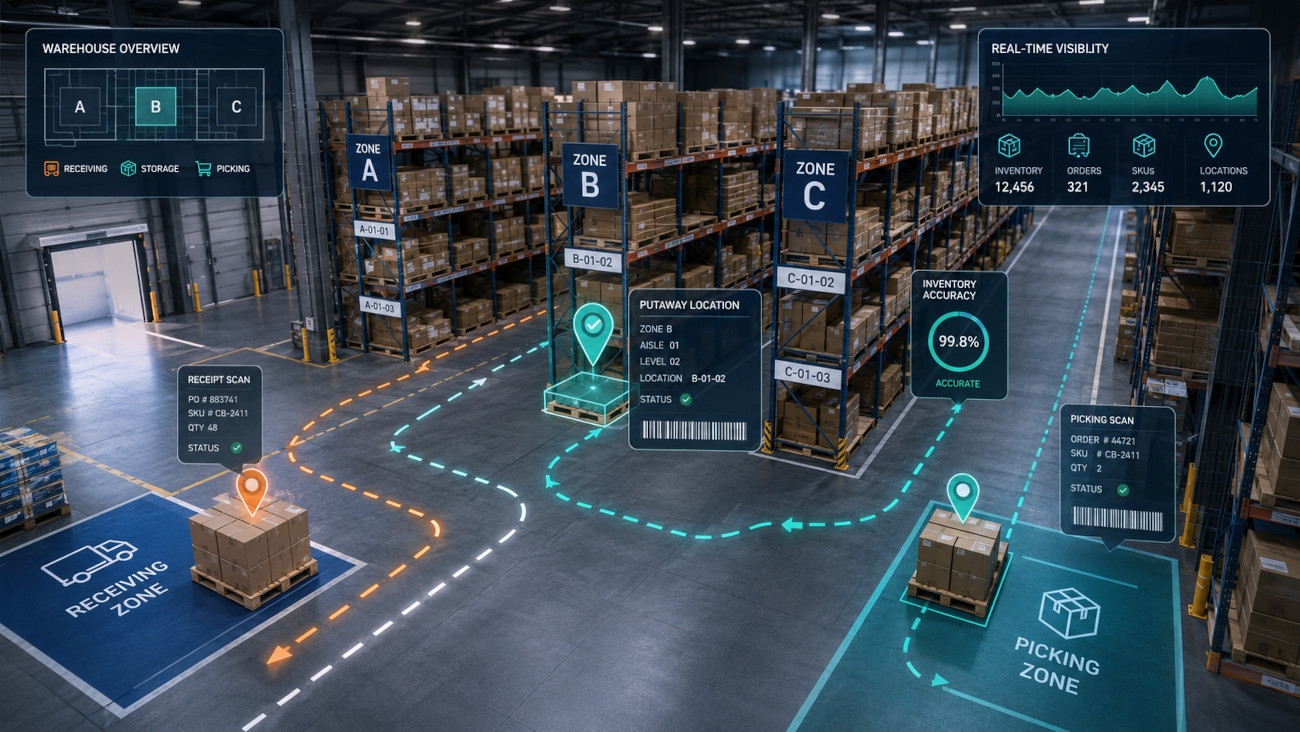
Accurate putaway protects the link between what the system says and what is physically true on the warehouse floor. When that link is strong, teams can trust inventory data, reduce unnecessary searches, and move orders through the operation with fewer interruptions.
The Best Put away Decisions Are Based on Operational Logic
In busy warehouses, open space can quickly become the default answer. If a location is available, the product goes there, and the team moves on to the next task. While that may feel efficient in the moment, random storage decisions often create hidden costs later in the fulfillment process.
A better putaway strategy considers how inventory will move after it is stored. Fast-moving items usually need to be closer to picking and packing workflows, while slower-moving SKUs may be better suited for reserve or less accessible locations. Heavy or oversized products require different placement logic than small, high-velocity items. Seasonal products, fragile goods, expiration-sensitive stock, and items with lot or serial tracking all need rules that support both accuracy and efficiency.
This is where putaway becomes more than warehouse housekeeping. It becomes an operational science. The goal is not simply to find an empty location, but to place inventory where it creates the least friction for every process that follows.
When putaway rules are aligned with order volume, product movement, and storage requirements, the warehouse gains speed without sacrificing control. Teams spend less time searching, replenishment becomes easier to manage, and pick paths become more predictable.
Poor Put away Creates Problems That Look Like Picking Problems
Many fulfillment issues are blamed on picking, but the root cause often begins earlier. A picker may arrive at a location and find the wrong item, an empty bin, a mixed SKU, or a quantity that does not match the system. From the outside, this looks like a picking delay. Operationally, it is often a putaway failure that has finally surfaced.
The challenge is that putaway errors can remain hidden for hours, days, or even weeks. A misplaced case may not become urgent until it is allocated to an order. A product stored in the wrong zone may not create visible friction until replenishment is needed. A pallet placed without accurate location confirmation may pass through receiving successfully, only to become a problem during cycle counting or order fulfillment.
By the time the issue is discovered, the warehouse is no longer solving one small putaway mistake. It is dealing with delayed orders, manual searches, inventory adjustments, customer service pressure, and unnecessary labor costs.
Improving warehouse putaway accuracy helps prevent these problems before they reach the picking team. Instead of treating exceptions as isolated fulfillment issues, operations leaders can address the process that allowed the exception to happen in the first place.
System Updates Must Match Physical Movement
One of the most common causes of putaway inaccuracy is a delay between physical movement and system confirmation. If inventory is moved to a location but the system is updated later, the warehouse creates a temporary gap between reality and visibility. In a slow-moving environment, that gap may not seem serious. In a high-volume operation, even a short delay can cause confusion.
Real-time confirmation matters because warehouse decisions are constantly being made based on available inventory data. Allocation, replenishment, picking, cycle counting, and customer-facing availability all depend on system information being current. When the system lags behind the floor, teams may make decisions using data that is already outdated.
Barcode scanning, mobile workflows, directed putaway, and location validation all help reduce that gap. These tools do not replace warehouse expertise, but they give teams a more reliable way to confirm that the right product went to the right place at the right time.
The strongest putaway processes make accuracy part of the workflow instead of something that has to be corrected later.
Accurate Put away Improves Space Utilization
Warehouse space is expensive, and poor putaway makes it even more costly. When inventory is placed without a consistent strategy, facilities often end up with underused locations, overcrowded pick faces, unnecessary travel time, and products stored in areas that do not match their movement profile.
Accurate putaway supports better space utilization because it gives the operation a clearer view of where inventory should live and how storage capacity is being used. Instead of relying on habit or guesswork, teams can make placement decisions based on actual product behavior and warehouse layout.
For example, high-velocity SKUs may need to be prioritized in easily accessible forward-pick zones, while bulk inventory can be stored in reserve locations that support replenishment. Products with similar handling requirements can be grouped logically, and items that create congestion can be placed in ways that reduce bottlenecks.
Over time, this creates a warehouse that is easier to manage. Space is not just filled; it is used intentionally.
Put away Rules Need to Evolve With the Business
A putaway strategy that worked six months ago may not be the right strategy today. Product velocity changes, new sales channels are added, order profiles shift, and warehouse volume increases. If putaway rules do not evolve with those changes, the warehouse may continue placing inventory based on outdated assumptions.
This is especially important for growing ecommerce brands, distributors, and 3PL operations. As order complexity increases, warehouse teams need more than static location assignments. They need visibility into how inventory moves, which products require priority placement, and where storage decisions are creating unnecessary work.
Regular review of putaway performance can reveal patterns that are easy to miss during daily operations. If pickers frequently search for certain SKUs, if replenishment is constantly interrupting order flow, or if cycle counts repeatedly expose location-level discrepancies, the putaway strategy may need to be adjusted.
The most efficient warehouses treat putaway as a living process, not a one-time setup.
Technology Makes Put away More Consistent
Even experienced warehouse teams struggle to maintain accuracy when processes rely too heavily on memory, manual notes, or informal habits. As volume grows, small inconsistencies become harder to control. One team member may know where a product usually goes, while another may choose a different location because the usual spot is full. Without system-guided rules, both decisions may seem reasonable, but the operation loses consistency.
A warehouse management system can help standardize putaway by guiding users to the right location based on item rules, space availability, inventory velocity, and operational priorities. When putaway is directed through the system, teams do not have to rely on guesswork, and managers gain better visibility into how inventory is being stored.
This does not mean every warehouse needs a rigid, overly complex process. The best approach is practical and scalable. Teams need enough structure to prevent errors, while still keeping workflows flexible enough to handle real-world exceptions.
CommerceBlitz OMNI helps warehouse and fulfillment teams connect inventory movement with real-time operational visibility across receiving, putaway, picking, and fulfillment. With better control over location tracking and inventory workflows, teams can reduce the disconnect between system data and physical stock before it turns into delayed orders, manual searches, or costly inventory adjustments.
Put away Accuracy Is a Foundation for Fulfillment Performance
Fulfillment speed depends on more than how quickly a picker can move through the warehouse. It depends on whether the inventory is where the system says it is, whether locations are organized logically, and whether stock can move from receiving to storage to shipment without unnecessary friction.
Accurate warehouse putaway creates that foundation. It helps prevent inventory drift, improves picking confidence, supports better space utilization, and reduces the number of exceptions that slow down daily operations.
For growing operations, putaway should not be treated as an afterthought after receiving. It should be viewed as one of the earliest opportunities to protect inventory accuracy and improve fulfillment performance.
With CommerceBlitz OMNI, warehouse teams can strengthen that foundation by connecting real-time inventory visibility with the workflows that move products from receiving to storage to shipment.
When every item is placed with intention, the warehouse becomes easier to trust, easier to manage, and easier to scale.