
Order Orchestration: The Missing Layer in Modern E-Commerce Operations
Modern e-commerce operations rarely fail because a business does not have enough software. In most cases, the opposite is true. Growing brands, distributors, and 3PLs are already running on multiple platforms: sales channels, marketplaces, warehouse systems, shipping tools, accounting workflows, reporting dashboards, spreadsheets, and custom integrations that were added one problem at a time.
At first, that structure may appear connected. Orders enter the system, inventory updates, warehouse teams pick and pack, labels are generated, and customers receive tracking information. But as volume grows, the cracks become harder to ignore. The order may exist in one system, the warehouse task in another, the shipping decision somewhere else, and the billing logic in a spreadsheet or a manual end-of-month process.
That gap is exactly where order orchestration becomes critical.
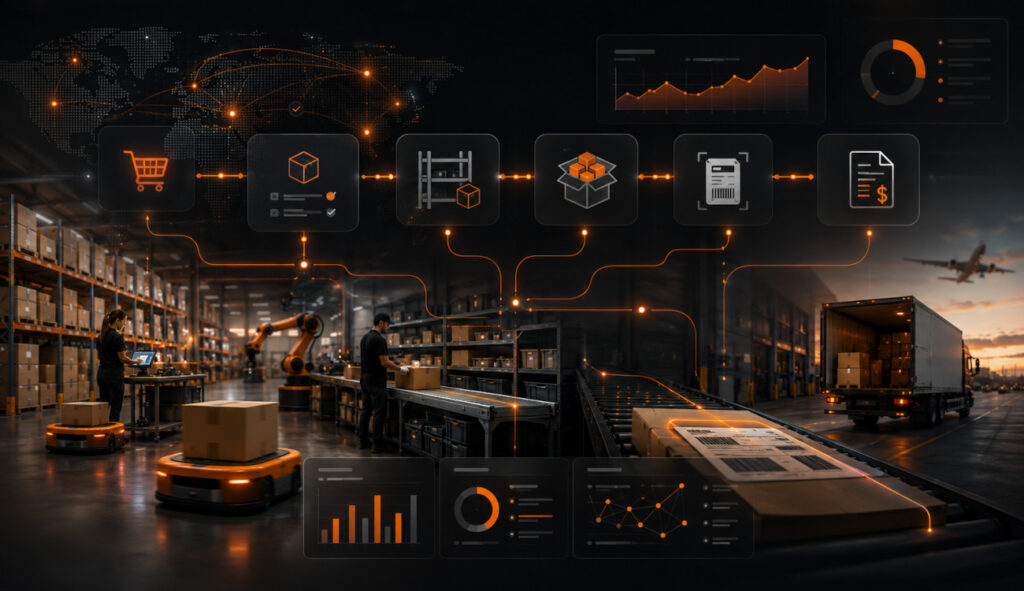
Order orchestration is the operational layer that connects the full journey of an order, from the moment it is received to the moment it is fulfilled, shipped, reported, and billed. It does not replace an OMS, WMS, shipping platform, or accounting system. Instead, it coordinates the decisions that need to happen between them so the business is not relying on manual workarounds to keep operations moving.
For modern e-commerce teams, this layer is quickly becoming the difference between having tools that process orders and having an operation that can actually scale.
Why E-Commerce Operations Have Outgrown Simple Order Management
A few years ago, order management was often treated as a relatively straightforward process. A customer placed an order, the business confirmed stock, the warehouse picked the item, a label was created, and the package shipped. There were still exceptions, but the basic operational path was predictable.
That version of e-commerce no longer reflects how most growing businesses operate.
Today, one company may sell across Shopify, Amazon, Walmart, TikTok Shop, wholesale portals, retail partners, and direct B2B accounts at the same time. The same SKU may be stored in multiple warehouses, sold as part of a kit, reserved for a specific channel, attached to different shipping rules, or tied to a customer-specific fulfillment agreement. A single order can trigger inventory allocation, warehouse labor, packaging requirements, carrier decisions, client reporting, and billable activity before it ever reaches the customer.
For 3PLs, the complexity is even more demanding because every client may bring a different operational model. One client may bill by pick and label, another may require kitting and special packaging, while another may need storage charges, returns handling, custom reporting, or project-based work. The warehouse is not simply fulfilling orders. It is executing many different business rules under one roof.
When that complexity is managed without orchestration, teams usually compensate with human knowledge. A manager remembers which client needs special handling. A billing person checks a spreadsheet. A warehouse lead confirms exceptions manually. Customer support follows up when something does not look right. The process may still function, but it becomes dependent on people catching problems instead of the system guiding the work correctly from the start.
That is not a sustainable way to scale.
What Order Orchestration Really Means
Order orchestration is often confused with order routing, but routing is only one part of the picture. Routing decides where an order should be fulfilled. Orchestration manages the broader operational logic that determines how the order should move through the business.
A true orchestration layer evaluates the order in context. It considers where inventory is available, whether that inventory is sellable or already committed, which warehouse should fulfill the order, whether the order contains kits or bundles, what shipping logic applies, what exceptions should hold the order, which warehouse tasks need to be created, and which activities should become billable events.
The value is not only in moving data from one system to another. The value is in making sure each operational decision is connected to the next one.
Without orchestration, an order may be imported successfully but still create problems downstream. It may be released before inventory is truly available, assigned to the wrong warehouse, picked without all kit components being validated, shipped with the wrong service level, or completed without capturing the full cost of the work performed. None of these failures necessarily mean the OMS or WMS is broken. They usually mean there is no central operational layer controlling the journey between order intake, warehouse execution, shipping, inventory, and billing.
This is why order orchestration matters. It gives the business a way to manage the full order lifecycle instead of reacting to problems after each separate system has already done its part.
The Operational Gap Between OMS, WMS, Shipping, and Billing
Most growing e-commerce operations eventually reach a frustrating middle stage. The business has invested in systems, integrations, and automation, but the team still feels like too much work is being handled manually.
The OMS knows the order exists, but it may not fully understand the warehouse reality behind that order. The WMS can direct picking and packing, but it may not always understand channel promises, client-specific service rules, or downstream billing terms. The shipping platform can generate labels, but it does not always determine whether the order should have been released, split, held, reallocated, or reprioritized. Accounting can invoice for services, but only if the billable activity was captured accurately in the first place.
The most expensive issues often happen in the space between these systems.
An order may look clean when it enters the OMS, but the warehouse discovers that one component of a kit is missing. A rush order may technically sync to the warehouse, but the priority does not carry through clearly enough to change the pick sequence. A client may require additional labeling or special packaging, but the work is tracked outside the main system. A shipping label may be created, but the charge is not connected automatically to the client’s billing rule. A team may complete the work correctly and still lose revenue because the activity was not captured at the moment it happened.
These are not isolated operational mistakes. They are symptoms of a missing orchestration layer.
When each system only sees its own part of the process, the business has to rely on people to interpret what should happen next. That creates delays, inconsistency, and hidden cost. As order volume grows, the problem does not scale gradually. It compounds.
Why Manual Workarounds Become Revenue Leakage
Manual workarounds are easy to justify when volume is low. A spreadsheet can handle a few special billing rules. A manager can review exceptions in the morning. A customer service person can check delayed orders manually. A warehouse lead can remember which client needs special packaging or kitting instructions.
The danger is that these workarounds often become permanent. They are treated as small operational habits rather than structural weaknesses.
At higher volume, manual workarounds create a quiet form of leakage. Orders take longer to process because decisions are waiting for review. Inventory becomes less reliable because updates happen after the fact. Warehouse work becomes harder to audit because not every task is connected to the order record. Billing becomes vulnerable because the business depends on memory, delayed reconciliation, or manual calculations to capture what actually happened.
For 3PLs, this is especially risky because operational work is directly tied to revenue. Every pick, kit, label, return, storage movement, special project, or value-added service may represent a billable event. If that event is not captured at the time of execution, the business may perform the work without ever charging for it correctly.
That is why billing cannot be treated as something separate from order operations. In a modern fulfillment environment, billing is created by operational activity. The moment a warehouse team picks an item, builds a kit, generates a label, or performs a client-specific service, that action should be connected to the appropriate billing logic.
When billing is handled later, the business is forced to reconstruct the truth after the work is already done. That is slower, less accurate, and much harder to defend when a client questions an invoice.
Billing That Runs With the Operation, Not Behind It
This is where order orchestration connects directly to one of the most important CommerceBlitz principles: billing that runs itself.
The idea is simple, but powerful. Every pick, kit, and label should be priced as it happens, rather than calculated manually after fulfillment is complete. When billing logic is connected to operational execution, the business no longer has to wait until the end of the week or month to understand what should be invoiced.
That shift changes billing from an administrative cleanup process into part of the operational flow.
For 3PLs, this means warehouse activity can become billing activity automatically. If a client’s agreement includes pick fees, kit fees, label charges, storage fees, or special handling rules, those charges should be triggered by the work itself. The team should not have to export activity logs, match them against spreadsheets, calculate rates manually, and hope nothing was missed.
For brands and distributors, the same principle improves cost visibility. Fulfillment is not just a warehouse function; it is a financial event. When order activity, inventory movement, shipping decisions, and billing logic are connected, the business has a clearer view of what each order actually costs to process.
This is one of the reasons order orchestration is so important. It does not only make fulfillment faster. It makes the business more financially accurate.
Why Visibility Alone Is Not Enough
Many systems promise visibility, and visibility is important. Teams need to see order status, inventory availability, warehouse progress, shipment updates, and billing data. But visibility on its own does not solve the operational problem.
A dashboard can show that orders are delayed, but it may not prevent the wrong orders from being released. A report can show that inventory is off, but it may not correct the workflow that caused the mismatch. A billing review can reveal missed revenue, but only after the business has already absorbed the loss.
Order orchestration is different because it acts during the workflow, not only after it.
It gives the business a way to apply rules before an order moves forward, create the right warehouse tasks automatically, flag exceptions at the right moment, connect shipping decisions to fulfillment logic, update inventory as work happens, and capture billable events while the operational context is still fresh.
That difference matters because scaling businesses cannot manage complexity only by reviewing dashboards. They need systems that guide the work as it happens.
The 3PL Perspective: Orchestration Protects Margin and Trust
For 3PLs, order orchestration is not just an internal efficiency improvement. It directly affects margin, client trust, and the ability to grow without adding unnecessary administrative labor.
A 3PL may serve clients with very different needs, but those differences cannot live only in someone’s memory. Client-specific rules need to be built into the operational flow. If one client requires branded packaging, another requires kitting, and another has complex billing terms, the system needs to recognize those rules at the order level and carry them through fulfillment, shipping, reporting, and invoicing.
Without orchestration, the 3PL becomes vulnerable in two directions.
Operationally, the warehouse team has to interpret too much manually, which increases the chance of mistakes. Financially, the business may fail to capture the full value of the work being performed, especially when services are small, frequent, and spread across many orders.
This is how missed revenue hides in plain sight. One unbilled label or kit fee may not seem significant. Across thousands of orders, multiple clients, and repeated value-added services, those small misses become real margin loss.
Order orchestration helps prevent that by connecting client rules, warehouse execution, and billing logic in one operational flow. The result is not only better automation. It is a cleaner relationship between the service provided and the revenue captured.
Connecting Order Flow With Warehouse Execution and Billing
This is where order orchestration becomes more than a fulfillment concept. For modern e-commerce operations, the real value comes from connecting order intake, warehouse execution, inventory movement, shipping activity, reporting, and billing in one coordinated operational flow.
Instead of treating each step as a separate process, CommerceBlitz OMNI helps keep order activity connected from start to finish. Orders can move through fulfillment with the right inventory logic, warehouse tasks can stay tied to the order record, and billable actions such as picks, kits, labels, storage, and special handling can be captured as the work happens.
That connection matters because scaling operations do not only need faster order processing. They need cleaner execution, fewer manual reviews, better exception control, and financial visibility that reflects what actually happened inside the warehouse.
For 3PLs, this is especially important. Client-specific rules, service agreements, and billing structures can become difficult to manage when they are spread across spreadsheets, inboxes, and disconnected systems. CommerceBlitz OMNI helps reduce that gap by connecting operational activity with the rules that determine how work should be fulfilled, tracked, and billed.
In that sense, order orchestration is not only about moving orders forward. It is about making sure every order carries the right operational context from start to finish.
What Strong Order Orchestration Should Deliver
A strong order orchestration layer should not make operations feel more complicated. It should make complexity easier to control.
When an order enters the system, the business should be able to determine whether it can be fulfilled, where it should be fulfilled from, what inventory should be committed, what warehouse tasks should be created, what exceptions should stop the order, what shipping logic applies, and what billing events should be captured. Those decisions should happen consistently, based on rules the business can trust.
This does not mean every order should move without human involvement. Exceptions still matter, and experienced operators still need visibility and control. The difference is that people should be focused on the orders that genuinely require judgment, not manually guiding every routine order through the same predictable steps.
Good orchestration removes unnecessary decision-making from repetitive work while giving teams better control over the exceptions that matter.
That is the foundation of scalable operations.
Why Order Orchestration Is Becoming the New Operational Standard
E-commerce growth used to be measured mainly by sales volume. Today, growth also depends on operational control. A business can increase orders quickly, but if fulfillment logic, inventory accuracy, warehouse execution, shipping, billing, and reporting do not scale together, that growth becomes difficult to sustain.
This is why order orchestration is becoming a necessary layer in modern operations. It connects the systems a business already uses and gives those systems a shared operational structure. It helps teams move from reactive problem-solving to controlled execution.
For brands, that means fewer delays, cleaner fulfillment, better inventory accuracy, and stronger cost visibility. Distributors gain stronger control across channels, warehouses, and customer-specific requirements, while 3PLs benefit from more reliable client execution, cleaner billing, and less revenue leakage.
The businesses that invest in orchestration are not simply trying to automate more tasks. They are trying to make sure every order moves through the business with the right logic, the right timing, and the right financial visibility.
The Missing Layer Is No Longer Optional
Modern e-commerce operations are too complex to be managed by disconnected tools and manual workarounds. Orders now carry too many decisions, dependencies, and financial consequences to rely on systems that only understand one part of the process.
Order orchestration brings those pieces together.
It connects order intake with fulfillment logic, warehouse execution with inventory movement, shipping decisions with service expectations, and operational activity with billing. Most importantly, it helps the business stop treating each order as a series of disconnected tasks and start managing it as one complete operational journey.
That is the missing layer CommerceBlitz OMNI is built to support.
For teams that want to scale without losing control, order orchestration is no longer optional. It is becoming one of the most important operational foundations to get right.