
What Happens When Order Volume Outgrows Your Fulfillment System
Growth is usually viewed as a sign that an eCommerce operation is moving in the right direction. More customers are placing orders, revenue is increasing, and the business has more opportunities to expand into new products and sales channels.
However, growth can also reveal weaknesses that were easy to overlook at a lower volume.
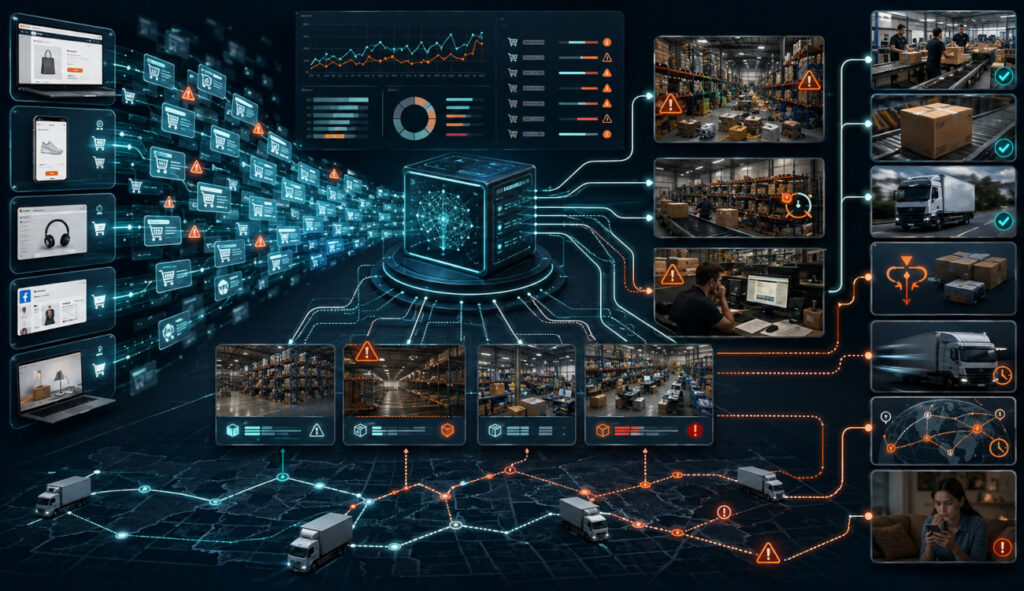
When order volume outgrows your fulfillment system, the operation may still appear functional from the outside. Orders continue entering the system, warehouse teams keep working, and shipments continue leaving the building. Behind the scenes, however, small delays and manual workarounds begin accumulating.
Inventory becomes harder to trust. Picking takes longer. Customer service receives more delivery questions. Warehouse employees spend more time solving exceptions than completing standard tasks.
Eventually, the fulfillment process stops scaling with the business.
Why Fulfillment Problems Often Appear During Growth
Many fulfillment systems are built around the needs of the business at the time they are implemented. They may work well when the company processes a few hundred orders per day through one warehouse and a limited number of sales channels.
As order volume increases, the environment becomes more complicated.
The business may add marketplaces, regional warehouses, third-party logistics partners, new shipping services, or additional product lines. Each expansion creates more inventory locations, order rules, carrier decisions, and possible fulfillment paths.
A process that once relied on a few simple decisions may suddenly require the system to evaluate inventory availability, warehouse capacity, delivery speed, shipping cost, order priority, and customer location at the same time.
If the technology cannot process those decisions quickly and consistently, employees begin filling the gaps manually.
That is often the first sign that the fulfillment system is no longer keeping pace.
Order Processing Begins to Slow Down
One of the earliest effects of rising order volume is a longer delay between order placement and warehouse release.
At lower volumes, employees may be able to review orders manually, resolve inventory issues, and assign fulfillment locations without creating noticeable delays. As order counts increase, the same process becomes a bottleneck.
Orders may sit in queues while the system waits for inventory updates, payment confirmation, fraud checks, or warehouse assignment. Some orders may require manual review because the system cannot automatically determine the best fulfillment location.
These delays reduce the amount of time the warehouse has to pick, pack, and ship each order before the carrier cutoff.
Even when warehouse productivity remains stable, late order releases can lead to missed same-day shipping targets and longer customer delivery times.
The warehouse may appear to be the problem, while the actual bottleneck exists earlier in the order flow.
Inventory Accuracy Becomes More Difficult to Maintain
Higher order volume also places more pressure on inventory accuracy.
Every new sales channel and fulfillment location creates another source of inventory activity. Orders reserve stock, cancellations release it, returns add items back into availability, and warehouse adjustments change the recorded quantity.
When these updates do not happen in real time, multiple channels may continue selling the same inventory.
The result is overselling, split shipments, backorders, and cancelled orders.
Employees may begin checking warehouse systems manually before approving orders. Customer service teams may contact customers to offer substitutions. Warehouse workers may search for products that the system says are available but cannot be found at the expected location.
These activities create additional work without increasing the number of orders that can be fulfilled.
A scalable fulfillment system should maintain a reliable view of available inventory across warehouses and channels. When inventory information becomes delayed or fragmented, every downstream process becomes harder to manage.
Warehouse Bottlenecks Become More Visible
Rapid order growth does not affect every warehouse process equally.
Receiving may continue operating normally while picking becomes overloaded. Packing stations may have enough employees but not enough physical space. One warehouse may have available capacity while another receives most of the order volume.
These imbalances are difficult to correct when orders are routed using static rules.
For example, a system may always assign orders to the warehouse closest to the customer. That decision may reduce distance, but it does not account for current warehouse capacity, labor availability, carrier pickup times, or the cost of splitting the order.
As volume rises, the same location may receive more work than it can process while another facility remains underused.
A more flexible order management process can evaluate several fulfillment factors before releasing the order. CommerceBlitz, for example, can help centralize order and inventory information so fulfillment decisions are based on current operational conditions rather than isolated channel data.
The goal is not simply to send each order to the nearest warehouse. The goal is to select the location that can fulfill it accurately, on time, and at a reasonable total cost.
Manual Exceptions Begin to Control the Workday
Every fulfillment operation has exceptions.
An item may be damaged, a carrier service may become unavailable, or inventory may not be found in the expected bin. These situations are manageable when they represent a small percentage of total orders.
Problems begin when normal order growth creates more exceptions than the team can resolve efficiently.
Employees may spend their day moving orders between warehouses, correcting addresses, releasing inventory holds, combining duplicate orders, or deciding how to handle partially available stock.
These manual decisions may keep orders moving temporarily, but they also make the process dependent on individual knowledge.
One employee may know which warehouse usually has additional stock. Another may understand how to force an order through a specific carrier service. If those employees are absent, fulfillment slows down.
A system that depends on constant intervention is difficult to scale because every increase in order volume creates a similar increase in administrative work.
Automation should reduce repetitive decisions while still allowing employees to step in when a genuine exception requires human judgment.
Shipping Costs Can Increase Faster Than Revenue
When fulfillment processes become strained, businesses often pay more to protect delivery promises.
Orders that miss warehouse cutoffs may require expedited shipping. Poor inventory visibility may cause products to be shipped from a distant warehouse. Split shipments may send several packages to the same customer instead of one complete order.
Each decision may solve an immediate problem, but the additional cost accumulates across thousands of orders.
Fulfillment expenses can therefore increase even when carrier rates have not changed.
The business may also lose access to the most cost-effective shipping services because orders are released too late in the day. Instead of selecting the best service based on price and delivery time, the operation must choose whichever option can still meet the promised date.
This is why fulfillment performance should not be measured only by whether the order was shipped.
The business must also understand how much manual work, additional packaging, split shipping, and carrier upgrading were required to ship it.
Customer Experience Starts to Become Inconsistent
Customers may not know that a fulfillment system is struggling, but they experience the results.
Some orders ship immediately, while others remain in processing for several days. Tracking information may arrive late. Items shown as available may be cancelled after purchase. Two customers ordering the same product may receive very different delivery estimates.
Inconsistent fulfillment damages trust because customers cannot predict what will happen after checkout.
Customer service teams usually feel the impact first. They receive more questions about order status, missing packages, cancelled items, and delayed deliveries.
As inquiry volume rises, response times may also increase. A fulfillment problem then becomes a customer service problem as well.
Reliable customer communication depends on reliable operational information. When the order management system cannot provide an accurate status, customer service employees must contact the warehouse or carrier manually before they can answer the customer.
This increases the cost of every fulfillment error.
Signs That the Current System Has Reached Its Limit
A fulfillment system rarely fails all at once. More often, its limitations appear through a series of operational warning signs.
Order release times become longer during peak periods. Inventory discrepancies happen more frequently. Employees rely on spreadsheets to track exceptions. Customer service receives more questions about delays. Shipping costs rise even though average order value remains similar.
The business may also notice that adding more employees no longer produces the expected improvement.
Additional labor can help with physical warehouse tasks, but it cannot fix slow data synchronization, poor order routing, or fragmented inventory visibility.
When teams spend more time managing the system than the system spends supporting the teams, capacity has already become a technology issue.
Building a Fulfillment Process That Can Scale
A scalable fulfillment process requires more than faster warehouse equipment or additional staff.
The order management layer must be able to coordinate inventory, orders, warehouses, carriers, and sales channels as one connected operation.
Inventory updates should be shared across channels quickly enough to prevent competing orders from reserving the same stock. Orders should be routed according to current availability and capacity rather than fixed assumptions. Exceptions should be identified early and sent to the appropriate team without delaying every other order.
The system should also provide enough visibility to explain why an order was routed, held, split, or upgraded.
This information helps operations teams identify recurring problems rather than treating every delayed order as an isolated event.
Scalability does not mean eliminating every exception. It means ensuring that normal growth does not turn standard orders into exceptions.
Growth Should Not Create Operational Chaos
Increasing order volume is valuable only when the fulfillment operation can support it.
When order volume outgrows your fulfillment system, the consequences reach far beyond the warehouse. Inventory accuracy declines, shipping costs rise, customer communication becomes less reliable, and employees spend more time correcting problems manually.
The business may continue growing, but the cost and complexity of processing each order also increase.
Recognizing the warning signs early gives operations teams time to improve order visibility, routing, inventory synchronization, and exception handling before fulfillment performance begins affecting customer retention.
A fulfillment system should not simply survive higher order volume. It should help the business manage that growth without sacrificing accuracy, delivery performance, or operational control.