
Why Scaling an E-Commerce Brand Breaks Operations Before It Breaks Marketing
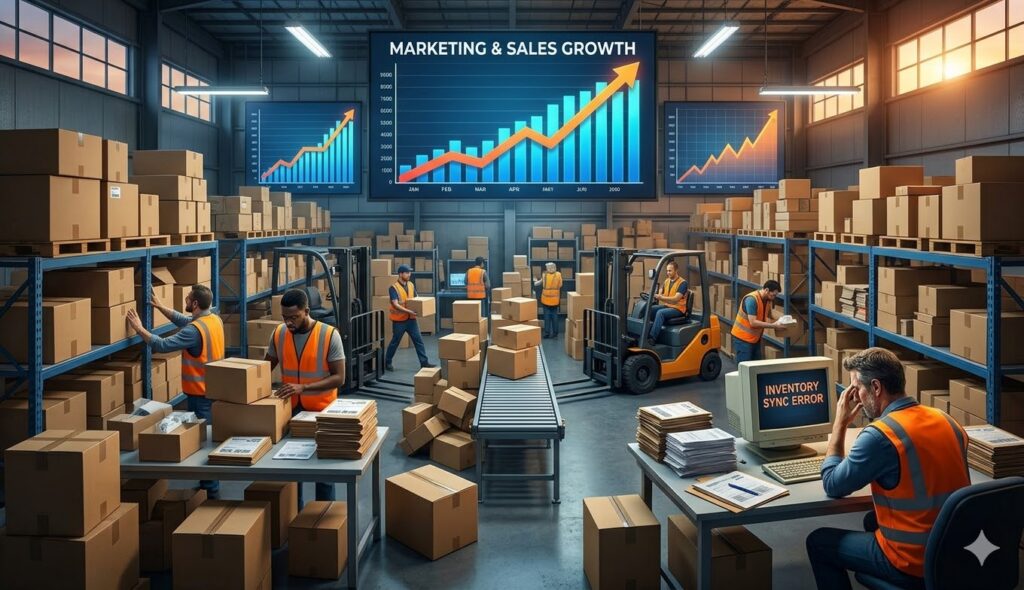
Growth is often treated as the ultimate goal in e-commerce. More traffic, more orders, more revenue. On the surface, it looks like success is accelerating exactly as planned. Marketing campaigns perform well, customer acquisition increases, and new channels open faster than ever.
But beneath that momentum, something else is happening. Something less visible, but far more dangerous.
Operations begin to crack long before marketing shows any signs of slowing down.
This is one of the most common and least discussed realities in modern e-commerce. Brands assume that if marketing works, the business is healthy. In reality, marketing can continue driving growth while operations quietly break under pressure. By the time those operational issues become visible, the damage has already been done.
Growth Feels Like Progress Until It Exposes the System
At the beginning, everything feels manageable. Order volumes stay low enough to track manually. Teams adjust inventory with simple updates. Communication happens through messages, spreadsheets, and quick fixes. Mistakes happen, but they stay small and easy to recover from.
As demand increases, those same processes start to stretch. What worked for ten orders per day begins to struggle at fifty. What worked across one channel starts to fail across three. Small inefficiencies stack up, and each manual step becomes a potential point of failure. The system stays the same. Only the pressure on it changes.
That pressure reveals everything.
Marketing Scales Faster Than Operations Ever Can
Marketing is built to scale.
Teams can increase ad spend overnight. They can launch new campaigns within hours. Expanding into new marketplaces requires relatively little friction. The tools support speed, and feedback comes quickly.
Operations do not move at that pace.
Inventory still needs to stay accurate. Orders still need correct fulfillment. Warehouse processes still depend on precision. Every increase in volume multiplies the complexity behind the scenes.
This difference in speed creates a dangerous imbalance. Marketing accelerates growth. Operations absorb the consequences.
The First Signs Are Easy to Ignore
Operational breakdown rarely happens all at once. It starts with small signals. Inventory counts begin to drift out of sync. A product appears available on one channel but is actually out of stock. Orders take longer to process. Customer service receives more questions than usual.
At this stage, everything still feels under control. Teams compensate manually. They fix issues as they appear. They rely on experience and effort to keep things moving. From the outside, nothing seems wrong.
Internally, however, the workload increases while the margin for error shrinks. These early signs are not temporary issues. They point to structural limits.
Volume Turns Small Errors Into Big Problems
As order volume grows, the impact of every small mistake increases.
A single inventory mismatch at low volume might affect one order. At scale, that same issue can affect dozens or hundreds. Overselling becomes more frequent. Stockouts become harder to predict. Delays begin to cascade across fulfillment.
What used to feel like a minor inconvenience turns into a recurring operational problem.
Each issue also becomes more expensive. Refunds increase. Cancellations grow. Negative reviews appear more often. Customer trust starts to weaken.
At this point, marketing may still perform well. Campaigns continue to drive traffic. Sales numbers can still look strong.
The experience behind those numbers, however, starts to decline.
Visibility Becomes the Breaking Point
One of the biggest challenges during scaling is not the volume itself. It is the loss of visibility.
When data spreads across multiple systems, channels, and workflows, teams struggle to understand what is happening in real time. Inventory accuracy drops because updates lag or conflict. Teams make decisions based on incomplete information. Decisions become reactive instead of proactive.
Without clear visibility, operations shift into constant firefighting. Teams spend more time fixing problems than preventing them. The system starts depending on human intervention instead of structured workflows. This is the moment when scaling begins to feel chaotic.
Customer Experience Is the First Casualty
Customers do not see internal processes. They only see results. They notice whether their order arrives correctly. They notice whether the delivery happens on time. They notice whether the product they purchased was actually available.
When operations start to break, the customer experience reflects it immediately. Orders arrive late. Items go missing. Communication becomes inconsistent. Trust begins to erode.
Once that trust is lost, rebuilding it becomes significantly harder and more expensive.
At this stage, marketing no longer amplifies growth. It amplifies operational weaknesses.
Why Most Brands Realize It Too Late
This pattern repeats across e-commerce brands for a simple reason. Marketing performance is visible. Operational health is not.
Dashboards show revenue, conversion rates, and campaign performance in real time. These metrics create a sense of progress and control. When they trend upward, everything appears to work.
Operational issues build quietly.
They hide in delayed updates, manual fixes, and growing internal workload. They do not appear clearly in dashboards until they start affecting revenue or customer experience.
By then, the system is already under strain.
Scaling Requires Operational Infrastructure, Not Just Demand
Growth is not just about generating more orders. It is about handling them consistently, accurately, and efficiently. That requires a shift in how teams manage operations.
Instead of relying on manual processes and disconnected systems, scaling brands need centralized control over orders, inventory, and fulfillment. They need real-time visibility across all channels. They need workflows that reduce reliance on manual intervention.
Without that foundation, growth creates instability instead of progress.
Where CommerceBlitz OMNI Fits In
This is where operational platforms become critical.
CommerceBlitz OMNI gives e-commerce brands and 3PL providers a single, unified view of their operations. Teams manage orders, inventory, and workflows in one place, with real-time synchronization across channels.
Instead of reacting to issues after they happen, teams gain the visibility and control needed to prevent them.
As order volume increases, the system scales with it. Inventory stays aligned. Fulfillment processes remain consistent. Teams spend less time fixing problems and more time improving performance.
Growth stops feeling like pressure and starts becoming sustainable.
Scaling Does Not Break Businesses. Weak Operations Do.
Growth does not create problems on its own. It reveals the problems that already exist.
The difference between brands that scale successfully and those that struggle is not marketing performance. It is operational readiness.
When operations can support growth, marketing becomes a true driver of expansion. When they cannot, marketing accelerates the breakdown.
Understanding this early separates controlled growth from reactive scaling.
If you are preparing to scale, the real question is not how much demand you can generate.
It is whether your operations are ready to support it.
If you want to see how CommerceBlitz OMNI can support that foundation, schedule a demo and explore how unified operations transform the way e-commerce businesses scale.