
Bin Locations vs Dynamic Storage: Which Works Better for Modern Warehouses?
In every warehouse, inventory needs a home. The only real question is whether that home should stay fixed or change depending on what the operation needs today.
For decades, many warehouses relied on traditional bin locations. Every SKU had an assigned place. Workers knew where to go. The warehouse map stayed familiar. It was easy to understand, easy to train, and easy to manage when the business was smaller, the product catalog was stable, and order volume followed a predictable rhythm.
But modern warehousing does not always move that neatly anymore.
Today, eCommerce brands sell across Shopify, Amazon, Walmart, wholesale portals, retail partners, and direct customer channels at the same time. 3PLs manage inventory for multiple clients with different rules, different seasonal curves, and different fulfillment expectations. Product catalogs change faster. Promotions create sudden demand spikes. Returns come back in unpredictable condition. Warehouses need to move faster without losing accuracy.
That is where the conversation between bin locations and dynamic storage becomes important. It is not just a question of where products sit on the shelf. It is a question of how much flexibility the warehouse has when volume changes, when space gets tight, and when speed becomes a competitive advantage.
Why Bin Locations Became the Standard
Traditional bin locations are easy to understand because they create structure. A product belongs in a specific aisle, rack, shelf, or bin. When a worker needs to pick that item, they go to its assigned location. When receiving puts inventory away, the team places the item back where it belongs.
This approach works well when inventory is predictable. If a warehouse sells the same SKUs throughout the year, keeps relatively steady stock levels, and does not have frequent product turnover, fixed bin locations can keep the operation simple. Workers can memorize the warehouse. Managers can visually inspect shelves. Training can be straightforward because every product has an expected place.
For smaller warehouses, this can feel efficient. A team may know that a certain item is always in aisle B, shelf 3, bin 12. If the warehouse has limited SKU complexity, that familiarity can reduce confusion. It also makes sense for products that need special handling, such as temperature-sensitive goods, hazardous materials, oversized inventory, fragile items, or products that must stay in a controlled zone.
The problem begins when the warehouse outgrows the simplicity that made fixed bins attractive in the first place.
As order volume increases, fixed locations can become restrictive. A slow-moving SKU may occupy valuable space near the packing area, while a fast-moving SKU may sit far away because that was the original assigned location. A seasonal item may need more room for only eight weeks of the year, but the fixed-bin system may not adjust quickly enough. New products may get placed wherever space can be found, creating informal workarounds that slowly break the original logic of the warehouse.
Over time, the fixed map starts to look organized on paper but less efficient in practice.
Where Fixed Bin Locations Start To Struggle
The biggest weakness of fixed bin locations is that they assume inventory behavior will remain relatively stable. Modern fulfillment rarely works that way.
A SKU that barely moved last month might suddenly become a bestseller after a social media mention, marketplace promotion, or seasonal campaign. Another product may slow down without warning. A warehouse that relies too heavily on fixed bins may not react quickly enough to these changes because the physical layout is tied to historical assumptions.
This creates wasted travel time. Pickers may walk farther than necessary because high-volume items are not positioned where they should be. It also creates wasted space. Some assigned bins may sit half-empty while overflow products pile up in temporary locations. When those temporary locations are not tracked properly, the warehouse starts depending on memory, notes, or tribal knowledge.
That is when accuracy starts to suffer.
A worker may know that extra inventory was placed on a nearby shelf last week, but another worker may not. A product may appear out of stock in the system even though it exists in an overflow area. A picker may go to the fixed location, find it empty, and trigger an exception. The inventory may still be somewhere in the building, but the order is now delayed because the system and the physical warehouse no longer match perfectly.
For a single-brand warehouse, this is frustrating. For a 3PL, it can become a client-facing problem.
Clients expect their 3PL to know exactly what is available, where it is stored, and how quickly it can ship. When bin locations become outdated or overflow storage is not controlled, the 3PL loses the visibility that clients depend on. A simple storage decision can quickly affect fulfillment speed, inventory confidence, and customer trust.
What Dynamic Storage Changes
Dynamic storage takes a different approach. Instead of permanently assigning every SKU to one fixed location, the warehouse management system decides where inventory should go based on available space, product movement, rules, and operational priorities.
In a dynamic storage environment, the product does not need one permanent home. It needs a trackable home.
That distinction matters.
When inventory arrives, the system can direct receiving teams to the best available location. A fast-moving item may be placed closer to picking or packing zones. A slower-moving item may be stored farther away. If a certain area has open capacity, the system can use it. If demand shifts, the warehouse can adapt instead of forcing the operation to follow an outdated layout.
This does not mean products are randomly scattered. Good dynamic storage depends on rules. The system still needs logic for product type, size, weight, handling requirements, expiration dates, lot tracking, client ownership, and pick path efficiency. Dynamic does not mean chaotic. It means the storage strategy can change while the system maintains control.
For modern warehouses, that flexibility can be powerful.
A 3PL can onboard a new client without redesigning the entire warehouse map. An eCommerce brand can handle seasonal inventory without permanently sacrificing prime locations. A warehouse can use space more efficiently because it is not reserving fixed bins for products that may not need that much room all year.
Most importantly, dynamic storage helps the warehouse respond to real demand instead of old assumptions.
The Role Of Warehouse Visibility
Dynamic storage only works when the warehouse has strong inventory visibility. Without accurate system tracking, dynamic storage becomes risky very quickly.
If workers place items wherever space is available but the system does not capture the exact location, the warehouse loses control. The team may move faster during receiving, but picking becomes slower later because nobody knows where everything is. That is not dynamic storage. That is disorganized storage with a nicer name.
This is why software matters.
A modern WMS needs to track each movement from receiving to putaway, replenishment, picking, packing, and shipping. It needs to know which SKU is in which location, how much is there, who moved it, and when it changed. It also needs to connect that warehouse activity with orders and inventory availability across sales channels.
CommerceBlitz OMNI is designed around that kind of operational visibility. For warehouses managing eCommerce fulfillment, multi-channel inventory, or 3PL client operations, the value is not only in storing products. The value is in knowing where inventory is, what it is available for, and how quickly it can move through the fulfillment process.
That visibility is what makes dynamic storage practical. Without it, a fixed-bin system may feel safer because at least the team knows where things are supposed to be. With it, dynamic storage becomes a controlled strategy that can improve space usage, picking efficiency, and inventory accuracy.
When Bin Locations Still Make Sense
Dynamic storage is often more flexible, but fixed bin locations are not outdated in every situation.
Some warehouses still benefit from fixed storage, especially when products have strict requirements. Heavy items may need to stay in lower rack positions. Fragile items may need controlled handling zones. Regulated goods may require specific storage areas. High-value products may need secure locations. Food, cosmetics, supplements, medical products, or other date-sensitive goods may need careful lot, batch, or expiration control.
Fixed locations can also help in very small operations where the product catalog is limited and the team already has strong physical familiarity with the warehouse. In that case, a fixed-bin strategy may be enough, especially if order volume is manageable and storage space is not under pressure.
The mistake is assuming that fixed locations will continue working forever just because they worked at the beginning.
As the warehouse scales, the cost of rigid storage often becomes more visible. Picking routes get longer. Receiving gets harder. Overflow becomes common. Inventory exceptions increase. Managers spend more time solving location problems manually. The team may still know the warehouse well, but the warehouse itself may no longer support the pace of the business.
Fixed locations work best when stability is the priority. Dynamic storage works best when flexibility, space utilization, and speed become more important.
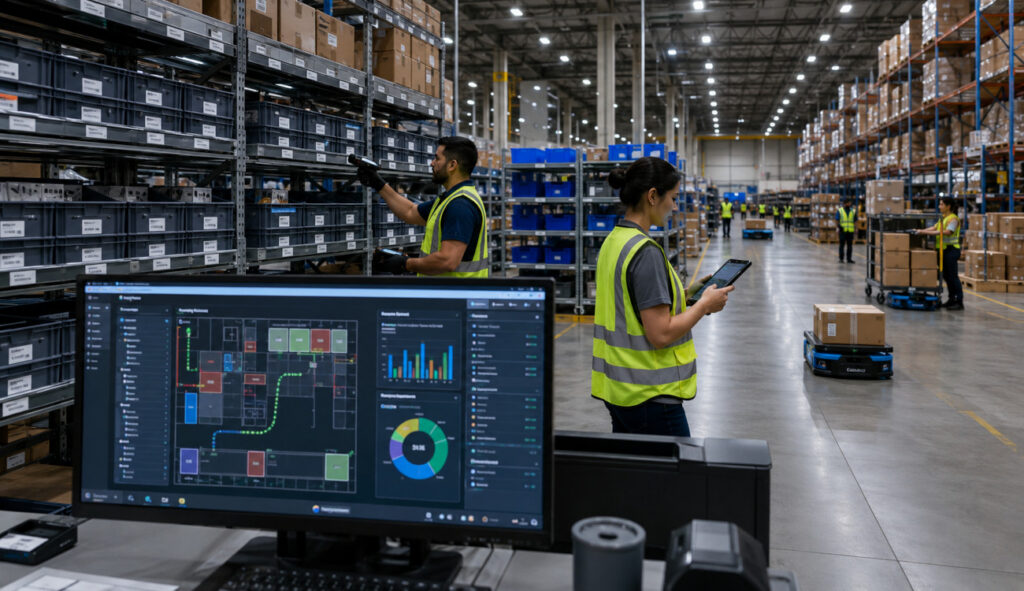
Why Modern Warehouses Often Need A Hybrid Approach
The strongest answer is not always fixed bin locations or dynamic storage. For many modern warehouses, the best approach is a hybrid model.
A hybrid storage strategy allows certain products or zones to remain fixed while other inventory moves dynamically. For example, fast-moving SKUs may be assigned forward-pick locations near packing, while reserve stock can be stored dynamically in available space. Oversized products may stay in fixed zones, while standard items move through a more flexible putaway strategy. High-value or regulated inventory may remain controlled, while everyday eCommerce products benefit from dynamic slotting.
This gives the warehouse structure where structure matters and flexibility where flexibility creates value.
A hybrid approach also makes the transition easier. Warehouses do not always need to change everything overnight. They can start by improving location tracking, separating forward pick from reserve storage, reviewing slow-moving inventory, and using data to identify where fixed locations create unnecessary travel or wasted space.
Over time, the warehouse can become more dynamic without losing control.
This is especially useful for 3PLs because every client may have different storage needs. One client may require strict lot control. Another may have seasonal promotional inventory. Another may sell small, fast-moving accessories. A rigid location strategy can make it harder to serve all of them efficiently. A flexible system allows the warehouse to build rules around each operational reality.
The Picking Efficiency Question
One of the most important differences between bin locations and dynamic storage is how each strategy affects picking.
In a fixed-bin setup, pickers may learn where products are, but the layout may not reflect current demand. If a fast-moving item sits far from the packing station, workers repeat that inefficient walk all day. The warehouse may not notice the cost at first because each individual walk seems small. But multiplied across hundreds or thousands of orders, travel time becomes one of the biggest hidden expenses in fulfillment.
Dynamic storage can reduce that problem when it supports smarter slotting. High-velocity products can move closer to active pick areas. Related items can be stored in ways that support better pick paths. Reserve inventory can stay out of the way until replenishment is needed.
However, this only works when the system guides the picker clearly. Workers should not need to guess where a product is located. They should receive a clear pick path, exact location, quantity, and order priority. The system needs to turn dynamic storage into a simple action for the warehouse team.
That is the real goal. The operation behind the scenes can be sophisticated, but the work on the floor should feel clear and direct.
Space Utilization Matters More Than Ever
Warehouse space has become too valuable to waste. Even when a business is not paying for a larger facility yet, poor space usage still creates cost. It slows movement, increases clutter, complicates receiving, and makes inventory harder to control.
Fixed bin locations can waste space because they reserve areas for specific products, even when those products do not need the space at that moment. A SKU may have a large assigned location because it once had high volume. If demand drops, that location may sit underused while another product needs overflow storage.
Dynamic storage helps the warehouse use open space more intelligently. Products can be placed where capacity exists, as long as the system tracks the location accurately. This can delay the need for expansion, reduce aisle congestion, and make receiving more efficient.
For growing brands, this can be the difference between feeling ready for the next sales season and feeling like the warehouse is already full before the season begins. For 3PLs, it can affect profitability because every square foot needs to support client inventory, fulfillment activity, or revenue-generating services.
A warehouse that uses space well has more room to grow. A warehouse that uses space poorly starts paying for inefficiency before it pays for expansion.
Inventory Accuracy Is The Deciding Factor
The debate between bin locations and dynamic storage ultimately comes back to inventory accuracy.
A fixed-bin warehouse can still be inaccurate if workers do not scan movements, if overflow locations are not tracked, or if inventory adjustments happen manually without clear reason codes. A dynamic warehouse can be extremely accurate if every movement is system-directed and every location update happens in real time.
The storage model is only as good as the discipline behind it.
Modern warehouses need inventory accuracy at the location level, not just the SKU level. It is not enough to know that there are 40 units of a product somewhere in the warehouse. The system needs to know where those units are, whether they are pickable, whether they are reserved for orders, whether they belong to a specific client, and whether they are available to sell across channels.
That level of detail becomes even more important in multi-channel fulfillment. If Shopify, Amazon, Walmart, and wholesale orders all depend on the same inventory pool, location mistakes can quickly become order mistakes. The warehouse may oversell, undersell, delay orders, or lose confidence in its own numbers.
CommerceBlitz OMNI helps support this kind of operational control by connecting inventory, orders, warehouse workflows, and fulfillment visibility in one system. For businesses that are moving beyond simple storage and into true multi-channel execution, that connection matters.
Which Storage Model Works Better?
For small, stable, low-complexity warehouses, fixed bin locations can still work well. They provide familiarity, structure, and simplicity. If the product catalog does not change often and order volume is manageable, fixed bins may be the right choice.
For modern warehouses dealing with growth, multi-channel selling, 3PL clients, seasonal demand, fast product turnover, or space pressure, dynamic storage usually provides more long-term flexibility. It helps the warehouse adapt to changing demand, use space more efficiently, and support faster fulfillment when backed by the right WMS.
But the best answer for many operations is a thoughtful hybrid model.
Fixed locations should protect the products and workflows that need consistency. Dynamic storage should support the areas where flexibility creates speed, better space usage, and better fulfillment performance. The warehouse should not choose a storage model because it sounds modern. It should choose the model that supports how inventory actually moves.
The real difference is not whether a product has a permanent shelf. The real difference is whether the warehouse can trust the system to know where that product is at every moment.
Building A Storage Strategy For The Warehouse You Are Becoming
Warehouse storage decisions should not only reflect today’s operation. They should reflect where the business is going next.
If the company plans to add sales channels, increase SKU count, onboard more clients, expand fulfillment volume, or prepare for seasonal growth, storage flexibility becomes more important. A fixed-bin system may feel comfortable today but create friction tomorrow. A dynamic or hybrid strategy can give the operation more room to adapt.
The transition does not need to be overwhelming. The first step is visibility. Warehouses need accurate location tracking, clean SKU data, disciplined receiving, consistent scanning, and a system that connects storage decisions to order fulfillment. Once the foundation is in place, storage strategy becomes less about guesswork and more about operational intelligence.
Modern warehousing rewards teams that can move quickly without losing control. Bin locations provide order. Dynamic storage provides flexibility. The best warehouses learn how to combine both in a way that supports speed, accuracy, and growth.
CommerceBlitz OMNI gives growing eCommerce operations, warehouses, and 3PLs the tools to manage inventory with greater visibility across locations, orders, and fulfillment workflows. If your team is ready to improve warehouse control, reduce manual work, and build a smarter foundation for multi-channel growth, schedule an OMNI demo to see how the system can support your next stage of warehouse operations.