
The Hidden Cost of Slow Order Processing During the Holiday Season
Every holiday season brings the same promise for commerce driven brands. Higher demand, increased traffic, and a rare window where customers are ready to buy without hesitation. Yet for many operations, this same season quietly exposes a costly weakness that often goes unnoticed until it is too late. Slow order processing does not always show up as a single dramatic failure. More often, it reveals itself through missed delivery expectations, growing customer frustration, internal stress, and revenue that disappears without a clear explanation.
During peak holiday periods, speed is not a luxury. It is an operational requirement. Customers place orders with a heightened sense of urgency, driven by gifting deadlines, promotional campaigns, and seasonal expectations shaped by years of fast delivery standards. When fulfillment operations cannot keep pace, the impact extends far beyond delayed shipments. It touches customer trust, operational costs, and long term brand perception.
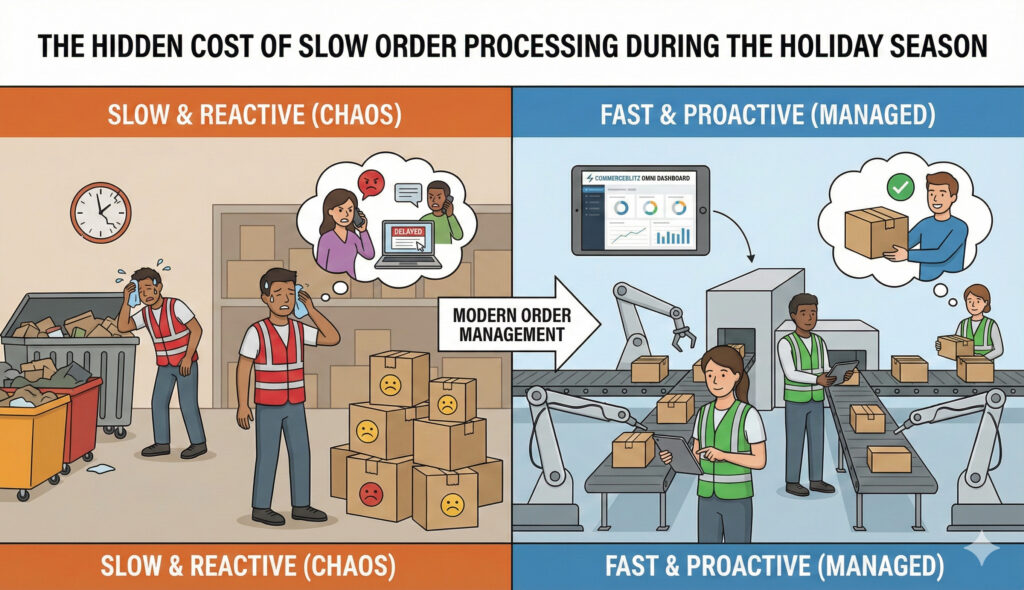
One of the most underestimated consequences of slow order processing is the compounding effect of delays. A single order that takes too long to pick, pack, or ship does not exist in isolation. During high volume periods, small inefficiencies multiply quickly. Orders begin to stack up, warehouse teams shift into reactive mode, and visibility into what is actually happening inside the operation becomes blurred. Instead of flowing through a predictable process, orders start competing for attention.
This backlog creates pressure that leads to rushed decisions. Teams cut corners, accuracy suffers, and the likelihood of errors increases. Wrong items, incorrect quantities, or missed shipments generate support tickets that consume even more time and resources. The cost of fixing mistakes often exceeds the cost of preventing them, especially when customer expectations are already stretched thin.
Customer experience is where the damage becomes most visible. Holiday shoppers are less forgiving. A delayed order in November or December is rarely just an inconvenience. It can mean a missing gift, a ruined plan, or a broken promise. When customers reach out for answers and support teams lack real time order visibility, trust erodes quickly. Generic responses and vague timelines do little to reassure someone who is counting down the days to a holiday deadline.
What many brands overlook is that dissatisfied customers do not simply disappear quietly. They leave reviews, they share experiences, and they remember. A single poor holiday experience can undo months or even years of positive brand building. The hidden cost is not just the lost order, but the future revenue that never materializes because the customer chooses not to return.
Operational costs also rise sharply when order processing slows down. Overtime becomes unavoidable as teams attempt to catch up. Temporary labor is brought in, often with minimal training, increasing the risk of errors. Shipping costs climb as expedited services are used to compensate for internal delays. Each of these decisions feels necessary in the moment, yet collectively they erode margins at a time when profitability should be strongest.
Inventory accuracy is another silent casualty. When orders move slowly through the system, stock levels become unreliable. Products appear available when they are already allocated to unfulfilled orders. This leads to overselling, backorders, and last minute cancellations that frustrate customers and complicate reconciliation. Without clear synchronization between orders and inventory, teams are forced to manually intervene, further slowing the process.
The holiday season also puts pressure on integrations and workflows that may have worked adequately during slower periods. Manual order routing, fragmented systems, and disconnected sales channels reveal their limitations under volume. Orders coming from multiple marketplaces, storefronts, or B2B clients require coordination that cannot be managed efficiently through spreadsheets or disconnected tools. When systems do not talk to each other in real time, delays become inevitable.
This is where modern order management becomes less about convenience and more about survival. Platforms like CommerceBlitz OMNI are designed to handle the complexity and speed required during peak seasons. By centralizing orders across channels, automating workflows, and providing real time visibility into inventory and fulfillment status, operations regain control even as volume increases. Instead of reacting to problems, teams can proactively manage exceptions before they escalate.
Faster order processing is not just about moving boxes quicker. It is about creating a predictable, transparent flow of information across the entire operation. When warehouse teams know exactly what needs to be picked and when, when support teams can see order status instantly, and when leadership has clear performance metrics, decisions become grounded in data rather than urgency.
The hidden cost of slow order processing ultimately reveals itself after the holidays are over. Brands look back at the season and see strong demand but disappointing results. Margins are thinner than expected, customer satisfaction scores are lower, and internal teams are exhausted. The opportunity was there, but operational friction prevented the business from fully capturing it.
Holiday demand should be a growth accelerator, not a stress test that exposes systemic weaknesses. Investing in faster, more intelligent order processing is not about preparing for the worst case scenario. It is about ensuring that when demand peaks, your operation is ready to deliver on the promises your brand makes.
If you want to see how CommerceBlitz OMNI helps teams streamline order processing, maintain inventory accuracy, and scale confidently during peak seasons, you can schedule a demo to explore the platform in action.