
Why Inventory Accuracy Drops as You Scale (And How to Stop It)
Inventory accuracy rarely fails overnight. In most growing businesses, it erodes slowly, almost invisibly, until the symptoms become impossible to ignore. Orders start overselling. Stock reports stop matching physical reality. Customer support spends more time apologizing than solving problems. By the time leadership notices, the damage is already expensive.
This problem affects ecommerce brands, warehouses, and 3PLs alike. Scaling introduces complexity, and complexity exposes weaknesses in systems, processes, and data flows. Understanding when and why accuracy breaks down is the first step toward preventing it.
The early stage: accuracy is easy when volume is low
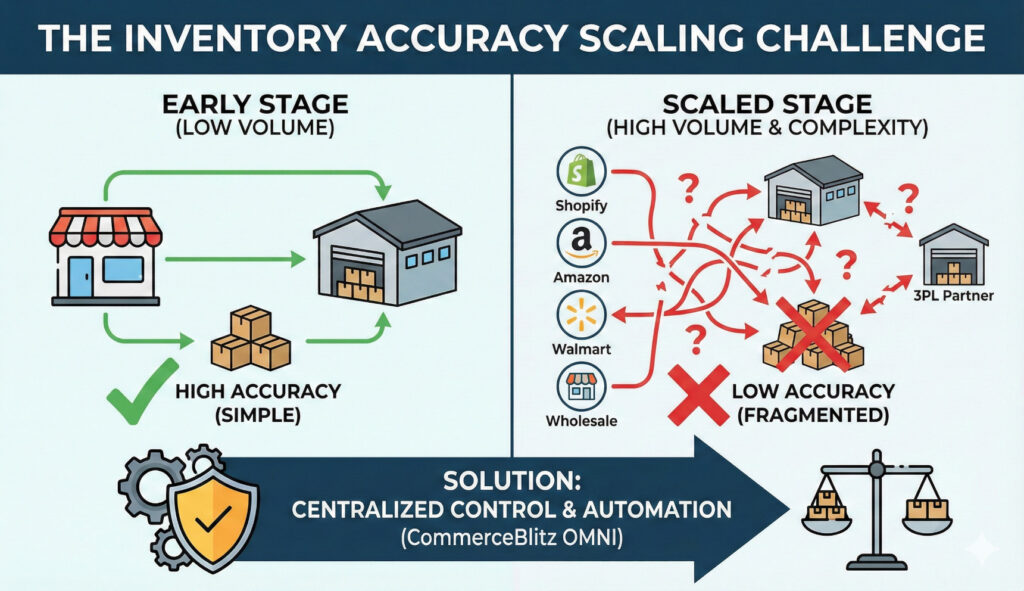
At the beginning, inventory accuracy feels simple. A single sales channel, one warehouse location, and a manageable SKU count make stock levels easy to track. Updates are often manual or semi-automated, and teams rely heavily on trust rather than validation.
During this phase, spreadsheets still work. Platform-level inventory tools inside Shopify or Amazon feel sufficient. Even minor discrepancies are easy to catch because volumes are small and product movement is slow.
The danger here is not failure, but false confidence. Early success creates the assumption that the same tools and workflows will scale indefinitely.
Growth introduces channel fragmentation
As soon as a business expands into multiple channels, inventory accuracy begins to degrade. Selling simultaneously on Shopify, Amazon, Walmart, and wholesale portals introduces parallel stock movements that must remain perfectly synchronized.
Each platform tracks inventory differently. Each one applies reservations, holds, and cancellations on its own timeline. Without a centralized inventory control system, updates become asynchronous. Stock may be deducted on one channel while still appearing available on another.
This is often the first point where overselling occurs. Not because teams are careless, but because systems are no longer speaking the same language at the same time.
Warehouse expansion multiplies risk
Adding a second warehouse or fulfillment partner dramatically increases complexity. Inventory is no longer just a number. It becomes location-based, conditional, and context-dependent.
Stock might exist physically, but not be available for sale. It could be reserved for outbound shipments, allocated to wholesale orders, or blocked due to quality issues. Without clear visibility, teams start making assumptions based on outdated snapshots.
For 3PLs, this problem compounds further. Managing inventory for multiple clients, each with unique rules, order flows, and channel integrations, demands absolute precision. Any delay or mismatch propagates across reports, invoices, and customer expectations.
At this stage, accuracy does not fail because of scale alone. It fails because systems were not designed for multi-location logic.
Manual processes do not survive operational pressure
As order volume increases, manual adjustments become a liability. Small errors that once felt harmless now scale alongside volume. A missed stock update. A delayed CSV import. A human correction applied to the wrong SKU.
Operational pressure accelerates these failures. Teams move faster. Training becomes inconsistent. Temporary workarounds become permanent habits.
Inventory accuracy collapses when humans are asked to compensate for system limitations. No team can outwork structural inefficiency.
Data latency becomes the silent killer
One of the least visible causes of inventory inaccuracy is timing. Data latency often goes unnoticed because reports still look correct at first glance.
When systems update inventory in batches instead of real time, discrepancies form in the gaps between events. Orders are placed before stock syncs. Returns are processed after availability is recalculated. Transfers complete physically but remain unreflected digitally.
Over time, trust in reports erodes. Teams stop believing what the system says and start relying on instinct. At that point, accuracy is no longer measurable.
Scaling exposes the limits of platform native tools
Marketplaces and e-commerce platforms were never designed to be full inventory control systems. Shopify, Amazon, and Walmart each excel at selling, not at orchestrating complex inventory logic across multiple channels and warehouses.
Native tools lack deep audit trails, cross-channel validation, and operational safeguards. They cannot reconcile physical stock against logical availability across multiple sources of truth.
As businesses scale, relying on platform-level inventory becomes increasingly risky. The system might be technically correct within its own boundaries, while still being operationally wrong.
How to stop inventory accuracy from collapsing
Preventing inventory accuracy loss requires a shift in mindset. Inventory must be treated as a core operational asset, not a byproduct of order processing.
Centralization is the foundation. A single system must act as the authoritative source of truth, controlling how inventory is received, allocated, reserved, adjusted, and released. All channels and warehouses should consume inventory data from this system, not compete to define it.
Automation replaces manual correction. Stock movements should be triggered by events, not by people. Orders, cancellations, returns, transfers, and adjustments must update inventory automatically and consistently.
Visibility restores trust. Teams need to see not just quantities, but reasons. Knowing why stock changed matters as much as knowing how much changed. Auditability is non-negotiable at scale.
This is where CommerceBlitz OMNI becomes critical. Instead of treating inventory as a static number, OMNI manages it as a dynamic operational flow. Inventory is synchronized across Shopify, Amazon, Walmart, warehouses, and 3PL operations from a centralized control layer. Location logic, order allocation, and inventory state transitions are handled systematically, not manually.
By separating inventory control from selling platforms, OMNI removes platform bias and timing conflicts. Accuracy is preserved because updates happen once, correctly, and propagate everywhere they are needed.
Accuracy is not a feature, it is a discipline
Inventory accuracy does not fail because businesses grow too fast. It fails because systems and processes stop matching reality.
Scaling demands stronger foundations, clearer ownership of data, and tools built for complexity rather than simplicity. When inventory is controlled intentionally, growth becomes predictable instead of chaotic.
Businesses that invest early in proper inventory control scale with confidence. Those who delay eventually pay for accuracy with customer trust, operational burnout, and lost revenue.
Stopping the drop is possible. It simply requires acknowledging that inventory accuracy is not automatic at scale. It must be designed, enforced, and continuously protected.