
When Marketplaces Outgrow Your Backend Systems
Marketplace growth usually feels like a win long before it feels like a problem. When a brand starts gaining traction across platforms like Shopify-powered stores, Amazon, Walmart, or regional marketplaces, the first signals are almost always positive: more orders coming in, more products moving, more customer activity appearing in dashboards that once felt quiet. In that phase, backend systems rarely look like a risk because, technically, everything still works. Orders are still exporting. Inventory files are still updating. Teams are still shipping.
What changes, though, is not whether the systems function, but how much effort it takes to keep them functioning.
In the early stretch of marketplace expansion, the pressure usually shows up in ways that are easy to dismiss. A reconciliation task that used to take ten minutes now takes half an hour because someone double-checks the numbers before releasing shipments. A product update that once moved cleanly across systems suddenly needs a second review because something did not sync correctly the first time. None of these moments feel dramatic enough to trigger concern, especially when the business is growing and revenue numbers look strong, so teams adapt quietly and move forward without stepping back to ask whether the underlying structure is still built for what the business has become.
The reality that often gets overlooked is that marketplace growth does not simply increase volume, it multiplies relationships between systems. Every new channel introduces its own expectations around catalog structure, listing behavior, inventory timing, and fulfillment logic, which means that what once felt like a single operational workflow slowly turns into a network of interconnected dependencies. At first, that network remains manageable because teams still remember how everything connects, but as the number of SKUs expands and marketplaces continue to stack on top of one another, that mental map becomes harder to maintain and easier to break.
Most teams do not notice the shift at the moment it begins. They notice it when daily routines start taking longer than they used to, even when the tools themselves have not changed. Inventory exports that once ran instantly begin to feel heavy. Product catalog uploads require more validation than before because the cost of mistakes is now higher. Order reconciliation starts creeping into hours that were previously reserved for planning, analysis, or optimization. None of this happens overnight, and that is exactly why it becomes dangerous, because slow degradation feels like normal growth until the day it no longer feels manageable.
The First Signs That Systems Are Falling Behind
The first real warning signs rarely arrive as system failures or visible outages. More often, they show up as operational friction that teams begin to normalize without realizing that the workload itself has fundamentally changed. A promotional campaign might generate more orders than expected, which is a good problem to have on paper, but the downstream effects start showing up in places that were never designed to absorb sudden spikes in activity. Picking teams begin waiting for updated inventory files before releasing batches. Customer service teams receive messages asking why tracking numbers have not been assigned yet. Warehouse supervisors start noticing that daily workflows feel more reactive than planned.
At the same time, product catalogs continue growing because marketplace competition demands variety and availability. Each new SKU adds another data point that must be synchronized across every connected system, and each additional marketplace increases the number of locations where those data points must remain accurate. The difference between managing fifty SKUs and managing five thousand is not simply scale, it is coordination. What once required a single confirmation step now requires multiple validation layers, especially when stock levels are shared across multiple sales channels that expect updates within strict time windows.
As synchronization activity increases, delays begin to compound in ways that are not always immediately visible. Inventory counts may appear correct in one marketplace while lagging in another, leading to situations where warehouse teams discover shortages only after picking begins. Customer service teams begin handling questions that sound small on the surface but reveal deeper structural strain, such as orders that remain in pending status longer than expected or shipments that require last-minute adjustments. Over time, these disruptions become part of the daily routine, even though they were never part of the original operational design.
One of the more subtle but dangerous consequences of this stage is the gradual loss of trust in system data. When teams begin double-checking numbers before acting on them, it usually signals that the system is no longer considered reliable enough to operate without supervision. That loss of trust introduces extra steps into nearly every workflow, and those extra steps rarely disappear once they are introduced. Instead, they accumulate, layer by layer, until the operation feels heavier than it should, even when the business itself is performing well.
When Visibility Starts Breaking Down Across Channels
As marketplace activity continues to expand, visibility is usually the first capability to weaken in ways that teams can feel but struggle to measure. In smaller operations, it is still possible to keep a reliable overview of inventory and order flow using spreadsheets or lightweight reporting tools, especially when order volume remains predictable and stock movement follows familiar patterns. Once multiple marketplaces begin updating inventory simultaneously, however, those same tools start showing their limits in ways that are difficult to ignore.
It often begins with small inconsistencies that require explanation. A product appears available on one channel but shows limited availability on another. A warehouse team picks an item that the system marked as in stock, only to discover that the last unit was already allocated to a different order that had not yet been reflected in the export file. These situations rarely look dramatic when viewed individually, but they create interruptions that break operational rhythm and force teams to pause work that would otherwise move continuously.
Over time, the absence of reliable visibility begins affecting planning decisions rather than just execution tasks. Purchasing teams hesitate before placing replenishment orders because they are unsure whether the reported stock levels reflect reality. Warehouse managers begin adjusting picking strategies based on experience rather than data, relying on memory and intuition to compensate for incomplete system outputs. Customer service representatives spend more time verifying order status before responding to customers, not because they lack tools, but because they no longer trust those tools to provide immediate clarity.
The real damage in this stage does not come from the individual discrepancies themselves, but from the growing hesitation they introduce into everyday workflows. When people start second-guessing system outputs, operations slow down even if no technical failure has occurred. Momentum becomes harder to maintain, and the business begins losing the operational speed that marketplaces were originally meant to enable.
Fulfillment Bottlenecks That Appear Without Warning
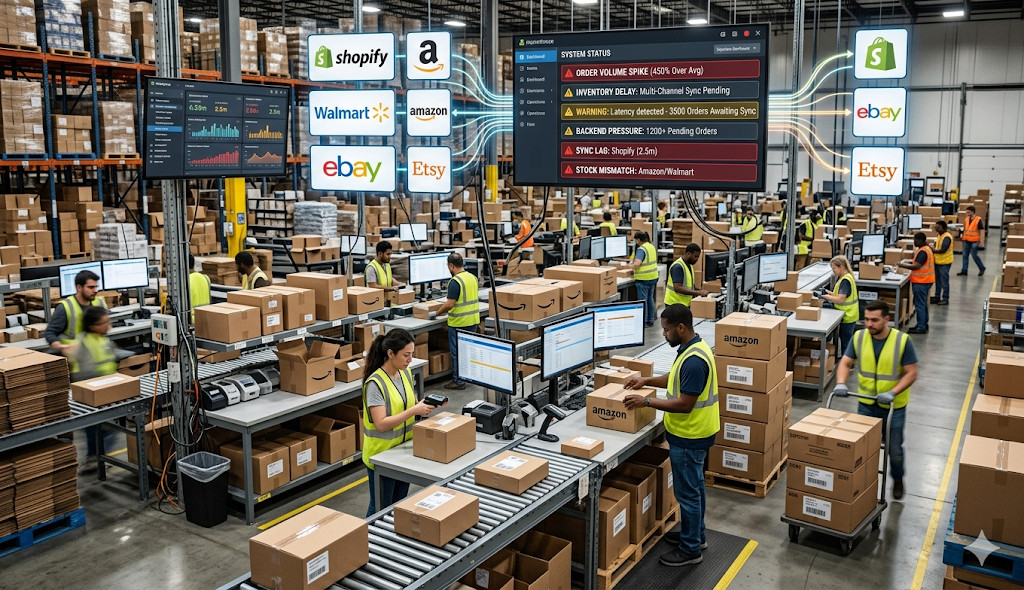
As backend strain increases, fulfillment workflows tend to absorb the impact first because they sit at the point where digital decisions turn into physical movement. Picking delays begin to stretch outbound timelines, especially when teams must wait for updated inventory confirmation before releasing orders into packing queues. In busy environments, even small delays can ripple across shifts, pushing work into later hours and creating backlogs that require additional staffing or overtime to resolve.
These bottlenecks rarely appear all at once. Instead, they creep into operations through small adjustments that gradually reshape how teams work. A warehouse supervisor might delay releasing large batches until inventory files finish updating. Packing teams may begin separating orders into smaller groups to reduce the risk of shortages. Shipping cutoffs that once felt comfortable start feeling tight, forcing teams to move faster under pressure while still managing uncertainty about stock accuracy.
What makes these situations particularly difficult to diagnose is that they often appear during periods of strong marketplace performance. Sales numbers look healthy, demand remains high, and customer acquisition continues to grow, which creates the impression that operational stress is simply the cost of success. In reality, fulfillment bottlenecks are often signals that backend systems are operating beyond their intended capacity, quietly struggling to maintain consistency across workflows that have grown more complex than originally planned.
Warehouse teams feel this shift in practical ways that dashboards rarely capture. A picker who once completed routes without interruption now spends extra time confirming product locations. A packer who once processed shipments continuously now pauses to resolve allocation conflicts. These interruptions may seem minor when measured individually, but across hundreds or thousands of daily orders, they accumulate into hours of lost productivity that are rarely attributed to system limitations.
Why Traditional Backend Tools Eventually Reach Their Limits
Many growing marketplace operations rely on tools that were never designed to support high-volume, multi-channel environments, particularly spreadsheets, disconnected order management tools, or custom workflows built during earlier phases of growth. These tools often perform well in controlled environments where product counts remain stable and channel activity remains predictable, but they struggle when the number of variables increases beyond what manual oversight can reliably manage.
At first, teams adapt creatively to these limitations. Additional validation steps are introduced to catch errors before they reach customers. Manual reconciliation processes are scheduled at the end of each day to correct discrepancies. Temporary scripts or workarounds are created to handle synchronization tasks that the original systems cannot manage automatically. Each of these adjustments solves an immediate problem, but collectively they introduce new layers of complexity that make the overall workflow harder to maintain.
Over time, the reliance on workarounds begins affecting not just efficiency, but also confidence in operational planning. Leadership teams find it increasingly difficult to forecast capacity because system outputs no longer provide consistent insight into workload requirements. Warehouse expansion plans are delayed because existing workflows cannot be scaled reliably. Technology investments become reactive rather than strategic, focused on fixing urgent issues instead of strengthening long-term infrastructure.
What once felt like a flexible operational setup gradually transforms into a fragile environment that depends heavily on human intervention to remain stable. At that stage, the cost of maintaining legacy tools begins exceeding the cost of replacing them, even if that shift is not immediately obvious in financial reports.
Restoring Control Through Integrated Operational Architecture
Eventually, most organizations reach a point where incremental fixes no longer produce meaningful results, and the focus shifts from patching workflows to rebuilding them in ways that support sustained marketplace growth. This transition typically involves moving toward integrated operational architecture, where order management, inventory visibility, and warehouse execution operate as connected components rather than isolated tools.
An integrated system changes how teams experience daily workflows because it restores confidence in the data that drives decisions. Inventory updates move in near real time, reducing the lag between stock movement and system visibility. Order flows become predictable because fulfillment logic is managed centrally rather than distributed across disconnected tools. Warehouse teams regain the ability to move quickly without relying on manual verification steps, allowing productivity to increase without sacrificing accuracy.
In environments where solutions such as CommerceBlitz OMNI are introduced, the operational shift often becomes visible within routine tasks rather than large strategic milestones. Teams notice that reconciliation tasks shrink from hours to minutes. Inventory discrepancies become rare rather than expected. Customer service responses become faster because accurate order data is available immediately, without requiring secondary confirmation. These changes do not eliminate complexity, but they make it manageable in ways that allow marketplace growth to continue without destabilizing backend operations.
Preparing for Marketplace Growth Before Systems Break
One of the most valuable lessons organizations learn through marketplace expansion is that backend readiness should be treated as a growth strategy rather than a maintenance task. Systems that perform well at small scale do not automatically perform well under heavy marketplace activity, especially when fulfillment timelines become tighter and customer expectations continue rising.
Preparing for growth does not always require immediate replacement of existing tools, but it does require honest evaluation of how those tools behave under stress. If teams spend increasing amounts of time verifying data rather than acting on it, the system is already signaling strain. If fulfillment workflows require frequent adjustments to maintain accuracy, operational architecture is likely approaching its limits. Recognizing these patterns early allows organizations to plan transitions deliberately rather than reacting to failures under pressure.
Marketplace success creates opportunity, but it also creates responsibility to maintain the operational foundation that supports that success. Businesses that treat backend systems as strategic assets rather than background utilities are more likely to sustain growth without sacrificing reliability, customer satisfaction, or team productivity.
When Growth Finally Feels Sustainable Again
There is a noticeable shift that happens when backend systems align with marketplace scale. Workflows begin flowing smoothly again, not because demand has decreased, but because the infrastructure supporting that demand has been strengthened. Teams spend less time reacting and more time planning. Decisions become faster because data becomes trustworthy again. Fulfillment regains its rhythm, allowing operations to keep pace with marketplace expectations rather than constantly chasing them.
That is the point where growth starts feeling sustainable rather than stressful.
Marketplace expansion will always introduce complexity, but complexity does not have to create chaos when the systems behind the operation are designed to handle scale from the beginning. Businesses that recognize when marketplaces begin outgrowing their backend systems, and act before those systems fail, position themselves to turn growth into long-term operational strength rather than short-term operational strain.