
Why Order Routing Matters More as You Add More Warehouses
Adding a second warehouse often feels like a straightforward way to improve fulfillment. Inventory can be stored closer to customers, delivery times may decrease, and the business gains additional space to support growth.
In practice, however, every new location also introduces another layer of operational decision-making.
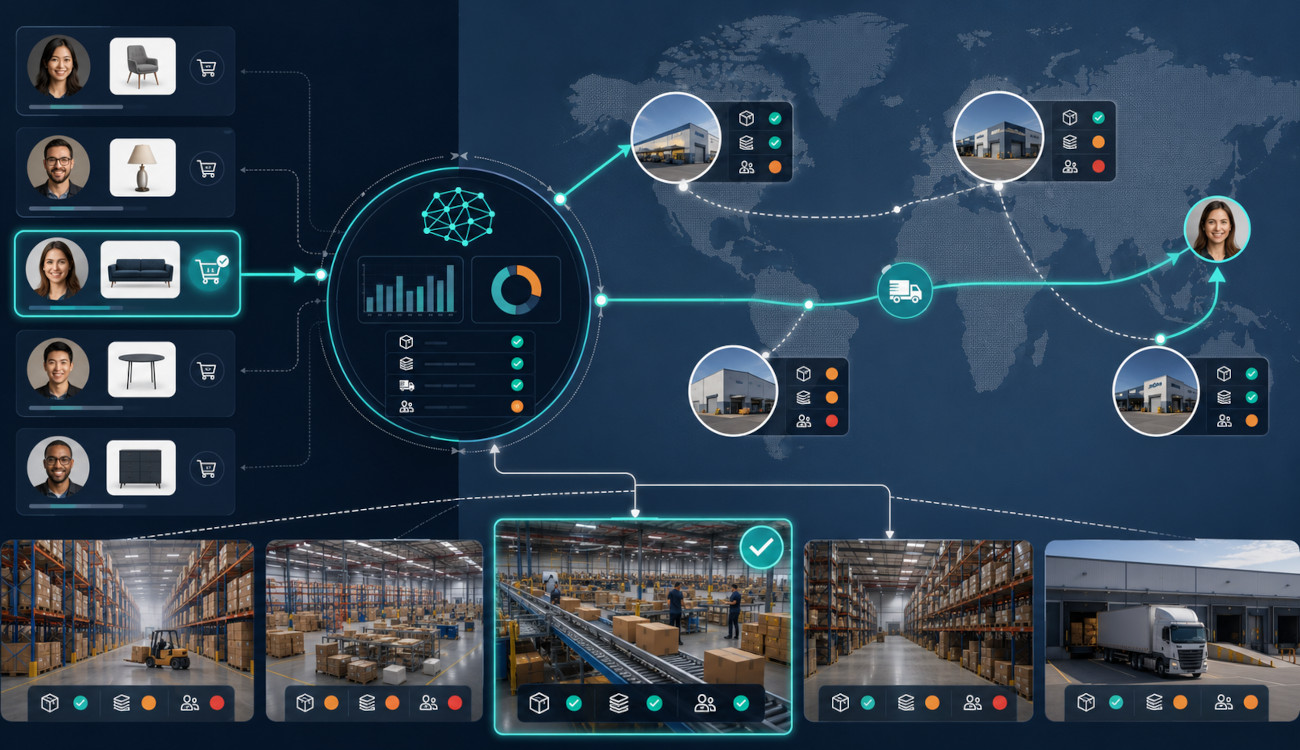
An order that once had only one possible fulfillment path may now be eligible for shipment from several warehouses. Stock might be available in more than one location, split across multiple facilities, or technically available but already committed to another sales channel. Shipping cost, delivery speed, warehouse capacity, inventory age, and order priority can all influence which location should handle the order.
This is why order routing across multiple warehouses becomes increasingly important as a fulfillment network expands. Without clear routing logic, additional locations can create more complexity than efficiency.
The goal is not simply to choose a warehouse that has the product. The goal is to select the best fulfillment path for each order while protecting inventory accuracy, controlling costs, and maintaining a consistent customer experience.
A Larger Warehouse Network Creates More Possible Decisions
With one warehouse, the order fulfillment process is relatively linear. A customer places an order, inventory is confirmed, and the warehouse prepares the shipment.
Once multiple locations are involved, the number of possible fulfillment decisions increases quickly.
Consider an order containing three products. Two items are available in Warehouse A, while all three are available in Warehouse B. Warehouse A is closer to the customer, but Warehouse B has lower current workload. One of the products in Warehouse B is also running low and may be needed for a higher-priority wholesale order later that day.
The cheapest decision may not be the fastest one. The closest location may not be the most operationally efficient. A warehouse showing available stock may not actually have enough usable inventory once open orders and allocations are considered.
Each order requires the business to balance several competing factors, including:
- Inventory availability
- Shipping distance and carrier cost
- Promised delivery date
- Warehouse workload
- Order priority
- Channel-specific inventory commitments
- Split-shipment risk
- Inventory aging
- Product handling requirements
- Location-specific service capabilities
When those decisions are made manually or through disconnected systems, the routing process becomes inconsistent. Different teams may apply different logic, while the systems involved may not have access to the same inventory or order information.
As volume grows, small inconsistencies can become expensive operational problems.
Inventory Availability Is Not the Same as Fulfillment Availability
One of the most common order-routing mistakes is assuming that any inventory shown as “in stock” is available to fulfill the next order.
That is rarely true in a complex fulfillment environment.
A warehouse may physically hold 100 units, but some of those units could already be committed to open orders, reserved for a marketplace, allocated to a wholesale customer, held for quality inspection, or unavailable because of damaged packaging.
The number that matters for routing is not simply the physical quantity. It is the inventory that can realistically be used for that specific order at that moment.
This distinction becomes more important when several systems are involved. An e-commerce platform may show one inventory number, the warehouse management system another, and a marketplace may continue accepting orders based on an outdated feed.
If the routing engine relies on incomplete or delayed inventory data, an order can be assigned to a warehouse that cannot actually fulfill it. The result is often a transfer request, shipment delay, cancellation, or manual intervention.
Reliable order routing across multiple warehouses depends on accurate, current, and usable inventory visibility. Routing rules can only be as effective as the data behind them.
The Closest Warehouse Is Not Always the Best Warehouse
Distance is an important factor in fulfillment, but proximity alone should not determine how every order is routed.
The warehouse closest to the customer may appear to be the obvious choice because it can potentially reduce shipping time and cost. However, that location may already be overloaded, short on labor, or missing one item from a multi-line order.
Sending the order there could create a split shipment, while another warehouse could ship the entire order in one package.
A more effective routing decision evaluates the complete operational impact.
For example, Warehouse A may be 100 miles closer to the customer, but it can only fulfill four of the five items. Warehouse B is farther away but has the full order available and can ship it before the daily carrier cutoff.
Routing the order to Warehouse B may reduce total packaging cost, avoid multiple tracking numbers, simplify customer communication, and lower the risk that one part of the order arrives late.
A good routing strategy considers the total cost and service outcome rather than optimizing a single variable.
Split Shipments Can Quietly Increase Fulfillment Costs
Split shipments are sometimes necessary, especially when inventory is distributed across several locations. They should not, however, become the default result of weak routing logic.
Every additional shipment creates extra work and expense.
The business may pay for multiple labels, boxes, packing materials, handling steps, and carrier pickups. Customers receive more tracking notifications and may wonder whether part of the order was forgotten. Support teams can also face more inquiries when packages arrive on different days.
A single split order may not seem significant. Across hundreds or thousands of orders, the added expense can materially affect fulfillment margins.
Effective routing should therefore evaluate whether an order can be fulfilled from one location before dividing it across several warehouses. In some situations, it may still be better to split the order to protect the delivery promise. In others, waiting for a short inventory transfer or selecting a slightly more distant warehouse may provide a better overall result.
The right decision depends on business priorities, but those priorities need to be reflected in consistent routing rules.
Order Routing Affects Inventory Balance
Routing decisions do more than determine where an order ships from. Over time, they also shape the inventory profile of each warehouse.
When orders are repeatedly routed to the same location because it is closer to a major customer region, that warehouse may sell through popular items much faster than other facilities. Another location could remain overstocked with the same products.
Without a broader inventory strategy, the network gradually becomes unbalanced.
One warehouse may face frequent stockouts and emergency replenishment requests, while another holds excess inventory that moves too slowly. The company then begins transferring stock between locations, increasing handling costs and creating additional opportunities for inventory discrepancies.
Routing rules can help reduce this imbalance.
A business may choose to prioritize older inventory, protect a minimum stock level at high-demand locations, or direct some orders to facilities with excess supply. These decisions can support healthier inventory movement without requiring constant manual rebalancing.
This does not mean every order should be routed based on inventory balancing alone. Customer service, cost, and fulfillment speed still matter. The advantage comes from considering inventory health as part of the overall decision rather than treating every order independently.
Channel Commitments Complicate the Routing Process
Many businesses do not operate through a single sales channel.
Orders may arrive from a Shopify store, Amazon, Walmart, wholesale accounts, business-to-business portals, retail locations, or customer service teams. Some inventory may be shared across channels, while certain quantities are reserved for specific marketplaces or customer groups.
This creates another layer of complexity.
A warehouse might have enough physical stock to fulfill a direct-to-consumer order, but using that inventory could create a shortage for a marketplace with stricter delivery requirements. Similarly, a high-value wholesale customer may have inventory reserved under a contractual agreement.
If routing logic ignores those commitments, the business can solve one order while creating a larger problem somewhere else.
Strong order routing uses available-to-promise inventory rather than basic on-hand totals. It should also respect channel rules, customer priorities, service-level agreements, and allocation policies.
As the warehouse network expands, these relationships become harder to manage through spreadsheets or individual platform settings.
Warehouse Capacity Should Influence Routing Decisions
Inventory is not the only factor that determines whether a warehouse can fulfill an order successfully.
A location may have the correct items but lack the capacity to process the order on time. Labor shortages, equipment issues, high order volume, carrier cutoff times, and local disruptions can all affect fulfillment performance.
Static routing rules often overlook this reality.
For example, a business may automatically send every West Coast order to its California warehouse. During a seasonal spike, that facility could accumulate a large backlog while another warehouse remains underutilized.
Even though the routing rule is geographically logical, the operational result is poor.
More advanced routing strategies take current warehouse conditions into account. Orders can be directed away from overloaded locations, prioritized based on delivery deadlines, or assigned according to processing capacity.
This helps the fulfillment network operate as a coordinated system rather than a collection of independent warehouses.
Manual Routing Does Not Scale Well
In the early stages of multi-warehouse growth, teams can often manage routing exceptions manually.
A warehouse manager may review inventory, customer service may redirect an urgent order, or an operations employee may decide which location should ship a large order.
That flexibility can work when order volume is low. It becomes difficult to maintain as the business grows.
Manual routing requires employees to evaluate several systems, compare shipping options, confirm inventory, and communicate decisions to the warehouse. The process takes time and depends heavily on individual experience.
It also creates inconsistency.
Two employees may make different decisions for identical orders. One may prioritize shipping cost, while another focuses on delivery speed. Important details can be missed during busy periods, especially when information is spread across multiple platforms.
Automation does not remove the need for operational judgment. Instead, it allows the business to define that judgment in advance through routing rules and escalation workflows.
Routine orders can move automatically, while genuine exceptions are sent to the appropriate team for review.
Building Better Order Routing Across Multiple Warehouses
A scalable routing strategy begins with clear business priorities.
Before creating detailed rules, the company needs to decide what it is trying to optimize. The answer may vary by order type.
Direct-to-consumer orders may prioritize delivery speed and complete shipment. Wholesale orders may prioritize reserved inventory and pallet efficiency. Marketplace orders may require strict adherence to promised shipping dates.
Once those priorities are defined, routing rules can evaluate each order against the appropriate criteria.
Common routing approaches include:
1. Closest Available Warehouse
The order is assigned to the nearest location with sufficient available inventory.
This approach can reduce shipping distance, but it works best when inventory data is accurate and warehouse capacity is relatively balanced.
2. Lowest Fulfillment Cost
The system compares shipping, handling, packaging, and split-shipment costs before choosing a location.
This method can protect margins, although cost should not override customer delivery commitments.
3. Complete-Order Routing
The system prioritizes a warehouse capable of fulfilling the entire order from one location.
This can reduce split shipments and simplify the customer experience.
4. Inventory-Aware Routing
Orders are directed based partly on stock levels, inventory age, replenishment timing, or location-specific demand.
This approach helps prevent one warehouse from selling through critical products too quickly.
5. Capacity-Based Routing
The system considers warehouse workload, cutoff times, available labor, or order backlog.
Capacity-based routing can improve network performance during demand spikes or local disruptions.
6. Priority-Based Routing
Certain customers, channels, products, or order types receive different routing treatment.
Urgent orders may be sent to the fastest location, while lower-priority orders can be routed for cost or inventory efficiency.
Most businesses eventually need a combination of these methods rather than a single universal rule.
Centralized Visibility Makes Routing More Reliable
Routing decisions become far more effective when order, inventory, warehouse, and channel data are managed through a connected operational layer.
Without centralized visibility, each system only sees part of the process. The e-commerce platform sees the order, the warehouse system sees local stock, the marketplace tracks its own availability, and the shipping system calculates rates after the routing decision has already been made.
The missing element is a shared view of the entire fulfillment network.
CommerceBlitz OMNI helps businesses connect orders, inventory, warehouses, and sales channels so routing decisions can be based on a broader operational picture. Rather than treating each warehouse or channel as a separate environment, teams can apply consistent logic across the network.
An order can be evaluated against available inventory, location rules, channel commitments, and fulfillment priorities before it is released to the warehouse.
This becomes especially valuable as the business adds more locations. Instead of rebuilding routing processes for every new warehouse, the company can extend existing rules and workflows across the expanded network.
The technology supports the decision, but the real value comes from operational consistency. Teams gain a clearer understanding of why an order was routed to a specific location and can adjust the rules as business priorities change.
Routing Rules Need Ongoing Review
Even well-designed routing logic should not remain unchanged indefinitely.
Customer demand shifts. Carrier pricing changes. New warehouses are opened, and inventory patterns evolve. A rule that worked well when the company operated two locations may no longer be appropriate after adding a third or fourth facility.
Performance data should be reviewed regularly.
Useful indicators include:
- Average shipping cost per order
- Percentage of split shipments
- Order processing time by warehouse
- Late shipment rate
- Inventory turnover by location
- Number of routing exceptions
- Inter-warehouse transfer frequency
- Cancellation rate caused by inventory issues
- Warehouse backlog and capacity utilization
These metrics help teams understand whether routing rules are producing the intended results.
A high split-shipment rate may indicate that inventory is poorly distributed or that complete-order routing needs stronger priority. Frequent manual overrides may show that current rules do not reflect actual operational conditions. Uneven inventory turnover can suggest that one location is being favored too heavily.
Order routing should therefore be treated as an operational process that improves over time, not a one-time system configuration.
More Warehouses Require Better Coordination, Not Just More Space
Expanding the fulfillment network can create meaningful advantages.
Products can be stored closer to customers, regional demand can be served more efficiently, and the business gains greater flexibility when one location experiences a disruption.
Those benefits are not automatic.
Every new warehouse increases the number of possible fulfillment paths. Without accurate inventory visibility and consistent routing logic, the network can become fragmented. Shipping costs rise, inventory becomes unbalanced, warehouse workloads diverge, and customers receive inconsistent delivery experiences.
The real value of a multi-warehouse strategy comes from coordination.
Effective order routing across multiple warehouses allows the business to use each location as part of a connected network. Orders are not simply sent wherever stock appears to exist. They are assigned based on availability, capacity, cost, customer expectations, inventory strategy, and channel commitments.
As the fulfillment network grows, routing becomes one of the most important operational controls supporting scale. The businesses that manage it well are better positioned to expand without allowing complexity to overtake efficiency.