
Preventing Overselling Across Multiple Sales Channels
Selling through several channels gives retailers more opportunities to reach customers, but it also makes inventory harder to control. A product may be listed on a company website, multiple marketplaces, a wholesale portal, and several regional storefronts at the same time. Each channel can accept orders independently, even though all of them may depend on the same physical inventory.
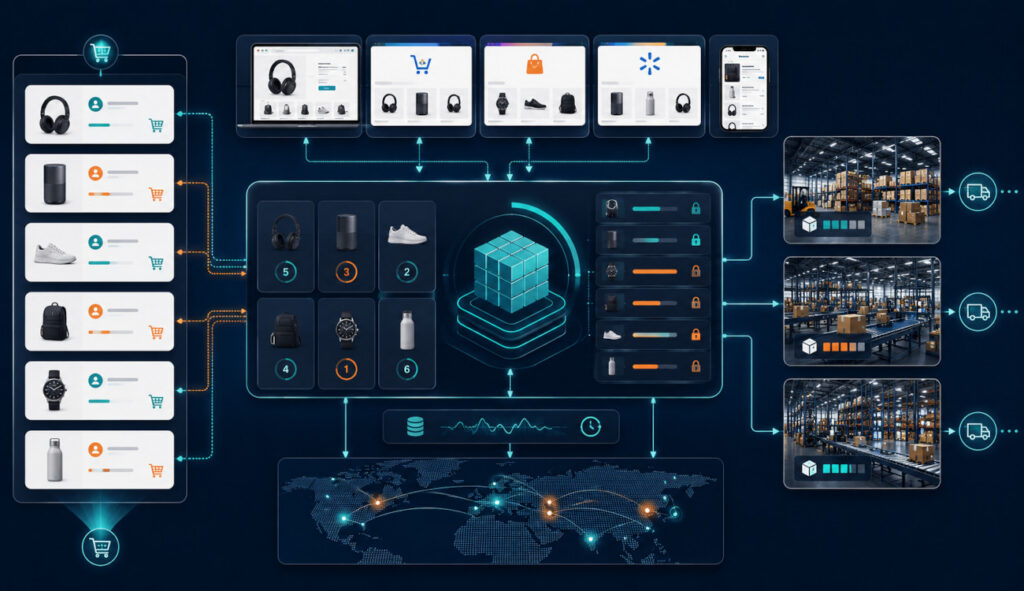
Preventing overselling across multiple sales channels requires more than updating stock after each completed order. The business needs a reliable way to determine what inventory is genuinely available, reserve it when an order is placed, and communicate every change across the sales and fulfillment network before another channel promises the same unit to someone else.
When that coordination is missing, the problem often remains invisible until a customer purchases an item that the warehouse can no longer ship.
Why Multichannel Inventory Becomes Difficult to Control
Inventory is relatively easy to understand when every order comes from one storefront and ships from one warehouse. The same system can receive the order, reduce the available quantity, and display the new balance to the next customer.
That process becomes less predictable as new channels are added.
Each marketplace or storefront may keep its own inventory record. Some channels process stock updates within seconds, while others place them in a queue or apply them in scheduled batches. One marketplace may reserve inventory as soon as an order is submitted, while another may wait until payment or fraud checks have been completed.
At the same time, inventory continues moving through the warehouse. New stock is received, orders are allocated, products are picked, transfers leave one facility and arrive at another, returns are inspected, and damaged units are removed from sale.
The quantity shown on a sales channel may therefore be accurate when it is published but outdated only a few moments later.
A warehouse system might show 12 units, while the eCommerce platform displays 10 and two marketplaces show different balances based on their most recent updates. None of those systems necessarily failed. They are simply looking at inventory from different points in time.
That timing difference is enough to create an oversold order.
Overselling Usually Begins With a Synchronization Delay
Most overselling incidents happen during the period between one inventory event and the moment every sales channel receives the updated quantity.
Imagine that only one unit of a product remains. It is available on a direct-to-consumer website and two marketplaces. A customer places an order through the website, but the stock update takes several minutes to reach the marketplaces.
During that delay, another customer purchases the same product through one of those marketplaces.
Both channels accepted the order because both believed the item was available. The problem was not caused by either order. It was caused by the absence of a fast, shared inventory decision between them.
Small delays may not cause visible issues during a quiet sales period. The risk changes during a product launch, seasonal promotion, flash sale, influencer campaign, or marketplace event. Orders may arrive faster than stock updates can move between systems.
A synchronization process that normally appears acceptable can quickly become the main cause of cancellations when order volume increases.
Physical Stock Is Not the Same as Sellable Stock
Another common cause of overselling is publishing the full physical inventory quantity to every sales channel.
Inventory on hand describes how many units are recorded in a warehouse or storage location. It does not describe how many of those units can safely be promised to new customers.
Some units may already belong to open orders. Others may be damaged, missing, waiting for inspection, assigned to wholesale commitments, held for another channel, or moving between facilities. The business may also want to preserve a small quantity as safety stock to absorb warehouse discrepancies and unexpected demand.
Suppose a warehouse physically contains 100 units of a product. Fifteen are already allocated to open orders, five are being inspected, and ten are held as a safety buffer. Although the inventory record shows 100 units on hand, only 70 units are realistically available for new sales.
Publishing 100 units to multiple channels creates risk before another customer has even placed an order.
A strong multichannel inventory process calculates availability from operational conditions rather than relying only on the physical balance. It considers existing commitments, reservations, restrictions, adjustments, and other events that affect whether a unit can actually be fulfilled.
Manual Channel Allocation Solves Only Part of the Problem
Some businesses attempt to prevent overselling by dividing inventory between channels.
A company may assign a portion of stock to its website, another portion to a marketplace, and a separate quantity to wholesale orders. Because each channel sells from its own allocation, two channels are less likely to compete for the final unit.
This method can work for smaller catalogs or tightly controlled sales programs. It may also be appropriate when a marketplace requires guaranteed stock or when a company wants to protect inventory for a major wholesale customer.
However, static allocations often create unused inventory.
A website may sell through its assigned quantity while stock remains available in a slower marketplace allocation. The website then displays the product as unavailable, even though the business still owns units that could have been sold there.
Someone must notice the imbalance and manually redistribute the remaining stock. That becomes increasingly difficult as the company adds products, warehouses, sales channels, and seasonal rules.
The operation may reduce overselling but lose sales because inventory is trapped in the wrong allocation.
Dynamic inventory control is more flexible. It allows channels to work from a shared available quantity while still applying reservations, buffers, and channel-specific restrictions where they are genuinely needed.
Warehouse Adjustments Must Reach Sales Channels
Orders are only one source of inventory change.
A warehouse employee may discover damaged products while picking. A cycle count may reveal that the physical quantity is lower than the system expected. A returned item may arrive but remain unavailable until it passes inspection. Inventory may leave one facility for a transfer without becoming immediately available at the destination.
Every one of these events changes what the business can safely sell.
Consider a product showing five available units. During picking, the warehouse discovers that two units are damaged and one unit cannot be located. The operation now has only two usable units, but the sales channels may continue showing five until the adjustment passes through every connected system.
If three customers order during that period, one order will eventually need to be delayed, substituted, split, or canceled.
Preventing overselling across multiple sales channels therefore depends on warehouse visibility as much as sales visibility. Inventory adjustments, allocations, receiving activity, transfer status, cancellations, and return inspections all need to influence the quantity presented to customers.
A stock update that only reacts to completed sales will always operate with an incomplete view of availability.
Multiple Warehouses Make Availability More Complex
Adding warehouses gives a business more fulfillment options, but it also complicates the inventory promise.
A product may be physically available across several locations, yet not every unit should be treated as equally sellable. One warehouse may not serve a particular region. Another may be overloaded, temporarily closed, or unable to meet the delivery promise shown on the storefront.
Some stock may be positioned too far from the customer to fulfill the order economically. Other units may be reserved for local demand, wholesale programs, marketplace commitments, or store replenishment.
Simply adding all warehouse balances together can create a misleading total.
For example, the network may contain 20 units of a product, but only six are in locations capable of fulfilling the current channel, destination, and promised service level. Publishing all 20 units without considering those conditions can create orders that are technically supported by inventory but operationally impossible to fulfill as promised.
Accurate availability must account for where the inventory is located and whether that location is eligible to serve the order.
This is where inventory management and order routing become closely connected. The system should not promise stock unless the operation has a realistic path for allocating and shipping it.
Order Reservations Need to Happen Early
A business can display an accurate quantity and still oversell if inventory is not reserved quickly enough.
The timing of the reservation matters. Waiting until an order reaches the warehouse may leave a long period during which several channels continue treating the same units as available.
Orders often pass through payment checks, fraud review, marketplace confirmation, tax calculation, address validation, or customer service review before entering fulfillment. If stock remains unrestricted during that process, another channel may sell it.
Reserving inventory as soon as an order reaches a defined valid status reduces this risk. The reservation should lower the available quantity across connected channels even if the physical unit has not yet been picked.
That does not mean every submitted cart should permanently consume inventory. Abandoned checkouts and failed payments can unnecessarily lock stock if the reservation process is too aggressive.
The business needs clear rules for when inventory is reserved, how long temporary reservations remain active, and when the quantity returns to availability after a failed, expired, or canceled order.
Without those rules, reservations can create their own inventory distortion.
Cancellations and Failed Orders Must Release Stock Correctly
Overselling prevention is not only about reducing available inventory. The operation must also return stock to sale when an order no longer needs it.
A canceled order may release inventory in the order management system but leave a marketplace quantity unchanged. A failed payment may continue holding units because the reservation never expires. Customer service may cancel only part of an order, while the entire quantity remains allocated.
These situations do not immediately cause overselling. Instead, they create false shortages and inconsistent stock levels across channels.
Over time, teams may begin correcting the differences manually. Manual adjustments can solve the visible problem while introducing new uncertainty about which system holds the trusted number.
A reliable process should release reservations automatically when the order status changes and then distribute the new available quantity to every applicable channel. The update should reflect whether the inventory is genuinely ready for resale rather than assuming that every cancellation immediately restores stock.
If the product has already been picked, packed, or transferred, additional warehouse activity may be required before it becomes available again.
Safety Stock Can Protect Against Small Inventory Errors
Even well-managed operations experience inventory discrepancies.
A product may be placed in the wrong bin, damaged without an immediate adjustment, counted incorrectly, or included in an order that has not yet reached the central system. When a channel publishes every recorded unit, even a small discrepancy can lead directly to an oversold order.
A safety stock buffer keeps a portion of inventory hidden from sales channels. If the system records ten available units, the business may publish only eight or nine.
The correct buffer depends on the product, sales velocity, warehouse accuracy, replenishment speed, and the consequences of canceling an order.
A high-volume product with frequent adjustments may need a larger buffer than a slow-moving product with stable inventory. A limited item that cannot be replenished may also require more caution than a standard product that can arrive from a supplier the following day.
Using the same buffer for every item is easy to manage but may unnecessarily suppress sales. Dynamic rules based on inventory risk allow the operation to protect vulnerable products without hiding too much sellable stock.
Safety stock should support accurate systems, not replace them. A large buffer can conceal synchronization problems temporarily, but it cannot fix the underlying process.
Channel Update Limits Must Be Understood
Sales channels do not all handle inventory updates in the same way.
Some platforms accept frequent quantity changes, while others limit how often a seller can send updates. A marketplace may process inventory messages in batches or delay updates during periods of heavy traffic. API interruptions can also prevent changes from reaching a channel even though the internal inventory is correct.
Businesses need to understand how each channel behaves rather than assuming that every update is applied immediately.
When a channel has slower processing, the operation may need a larger safety buffer, stricter allocation, or more conservative availability rule. High-risk items may need to be removed from that channel sooner than they would be removed from a faster storefront.
The inventory strategy should reflect the weakest connection in the sales network.
It is also important to track whether an update was accepted. Sending a quantity change does not guarantee that the channel applied it. Failed or delayed updates should be visible so the team can act before inaccurate stock creates additional orders.
Product Mapping Errors Can Cause Hidden Overselling
Inventory synchronization depends on accurate product relationships between systems.
The same product may use one SKU in the warehouse, another identifier in the eCommerce platform, and a marketplace-specific listing code. Variations such as size, color, pack quantity, or bundle configuration add further complexity.
If those records are mapped incorrectly, an inventory update may reduce the wrong item or fail to update anything.
A two-pack may be treated as a single unit. Two color variations may share an identifier. A marketplace listing may remain linked to a retired warehouse SKU after the catalog has been reorganized.
These errors can remain unnoticed because the integrations continue operating without obvious technical failure. Messages are sent and received, but they affect the wrong inventory record.
Product mapping should therefore be treated as part of inventory control, not merely as catalog administration. New listings, bundles, variation changes, and SKU replacements need validation before they begin accepting live orders.
Bundles Require Component-Level Availability
Bundles create another common source of overselling.
A sales channel may treat a bundle as one product, but fulfillment depends on several individual components. If one component becomes unavailable, the bundle can no longer be shipped even if the bundle listing still shows stock.
Suppose a gift set contains one bottle, one accessory, and one branded package. The warehouse has enough bottles and packaging for 50 sets but only six accessories. The true bundle availability is six.
If the bundle quantity is not calculated from its components, the business may continue selling after the limiting item is gone.
The same component may also appear in several bundles and as an individual product. A sale through any of those listings should reduce the component availability everywhere it is used.
This requires the inventory system to understand the relationship between finished listings and underlying stock. Publishing a fixed bundle quantity without recalculating component availability creates a delay between reality and what customers can purchase.
Promotions Increase the Cost of Slow Inventory Updates
Promotions expose weaknesses that may remain hidden during normal operations.
A discount campaign can increase order volume within minutes. Several channels may sell the same popular product simultaneously, while inventory updates struggle to keep pace. Bundles and promotional packs may consume components faster than the individual SKU records suggest.
Marketing teams often prepare promotional prices, creative assets, and channel schedules without checking how inventory will be protected during the event.
Before a major promotion begins, operations teams should confirm which inventory source each channel uses, how reservations work, how fast stock updates travel, and what happens when the available quantity becomes low.
A product with limited stock may require a temporary buffer or a controlled channel allocation. The business may also choose to stop publishing the product slightly before inventory reaches zero.
That can mean sacrificing a small number of possible sales to avoid a larger number of cancellations.
Centralized Inventory Decisions Reduce Channel Conflict
The most reliable way to prevent overselling is to stop allowing each channel to make independent inventory decisions.
A central system can receive inventory changes from warehouses, orders, returns, transfers, and adjustments. It can then calculate the quantity available for each channel based on current commitments and operational rules.
Instead of every marketplace maintaining its own interpretation of stock, the channels receive availability from a shared source.
This does not mean every channel must display the same number. The central inventory logic may apply different buffers, reservations, locations, or allocation rules depending on the channel. However, those differences come from one coordinated decision process rather than disconnected records.
CommerceBlitz supports this type of operational control by connecting sales channels, inventory sources, and order activity within one environment. As orders arrive and inventory conditions change, the business can maintain a clearer view of what has been sold, what has been reserved, and what remains available across the network.
The value is not simply faster synchronization. It is the ability to base channel availability on the same operational information used to manage fulfillment.
Exception Management Is as Important as Automation
No inventory process is perfect.
A channel may reject an update. A warehouse count may suddenly change. An integration may become unavailable. An order may arrive with a product identifier that cannot be matched to an inventory record.
When these exceptions are hidden, the system may continue selling from incorrect information.
Teams need visibility into inventory differences, failed channel updates, negative availability, unmapped products, delayed orders, and unusual reservation patterns. The goal is to identify a problem before customers begin receiving cancellation notices.
A good exception process also distinguishes between urgent and routine discrepancies.
A one-unit difference on a product with several thousand units may not require immediate intervention. A one-unit difference on a product with only one unit remaining can stop fulfillment entirely.
Prioritizing exceptions by risk helps operations teams focus on the situations most likely to create oversold orders.
Measuring the Real Impact of Overselling
Overselling is often measured only by the number of canceled orders. That does not show the full operational cost.
Customer service spends time explaining the problem, issuing refunds, offering alternatives, and handling complaints. Fulfillment teams may search several locations for stock that does not exist. Purchasing teams may expedite replenishment to protect important orders. Finance teams may process refunds and marketplace fees.
The damage may also extend beyond the individual order.
Marketplaces track cancellation rates and seller performance. Repeated stock-related cancellations can reduce listing visibility, affect seller ratings, or create account restrictions. Direct customers may lose confidence in inventory messages on the company website.
A low number of canceled orders can still represent a serious problem if those cancellations affect high-value customers, strategic marketplaces, or time-sensitive purchases.
The business should track why orders were canceled, which channel accepted them, which products were involved, and what inventory event created the discrepancy. That information reveals whether the cause is synchronization speed, warehouse accuracy, product mapping, reservation logic, or channel configuration.
Preventing Overselling Is an Operational Discipline
Preventing overselling across multiple sales channels is not a single integration setting. It depends on how inventory is recorded, reserved, adjusted, distributed, and monitored throughout the order lifecycle.
The business needs a trusted view of available stock, not just physical stock. Warehouse events must influence sales availability. Reservations should happen early enough to protect inventory, while cancellations and failed orders should release it correctly.
Multiple warehouses, bundles, promotions, and channel-specific limitations must also be included in the decision process.
As the sales network grows, manual inventory corrections become less reliable. Teams spend more time reconciling systems, moving stock between channel allocations, and responding to orders that should never have been accepted.
Centralized inventory control gives each sales channel a more accurate view of what the business can actually fulfill. It also gives operations teams the visibility needed to identify exceptions before they become customer problems.
Overselling may appear to be a storefront issue, but its real causes are usually found deeper in the operation. The solution is not simply to update quantities more often. It is to ensure that every sales channel works from the same understanding of inventory availability.