
Order Lifecycle Visibility: Why Operations Teams Need It
For a customer, an order can look remarkably simple. They place it, receive a confirmation email, wait for a shipping notification, and eventually see a package arrive at their door.
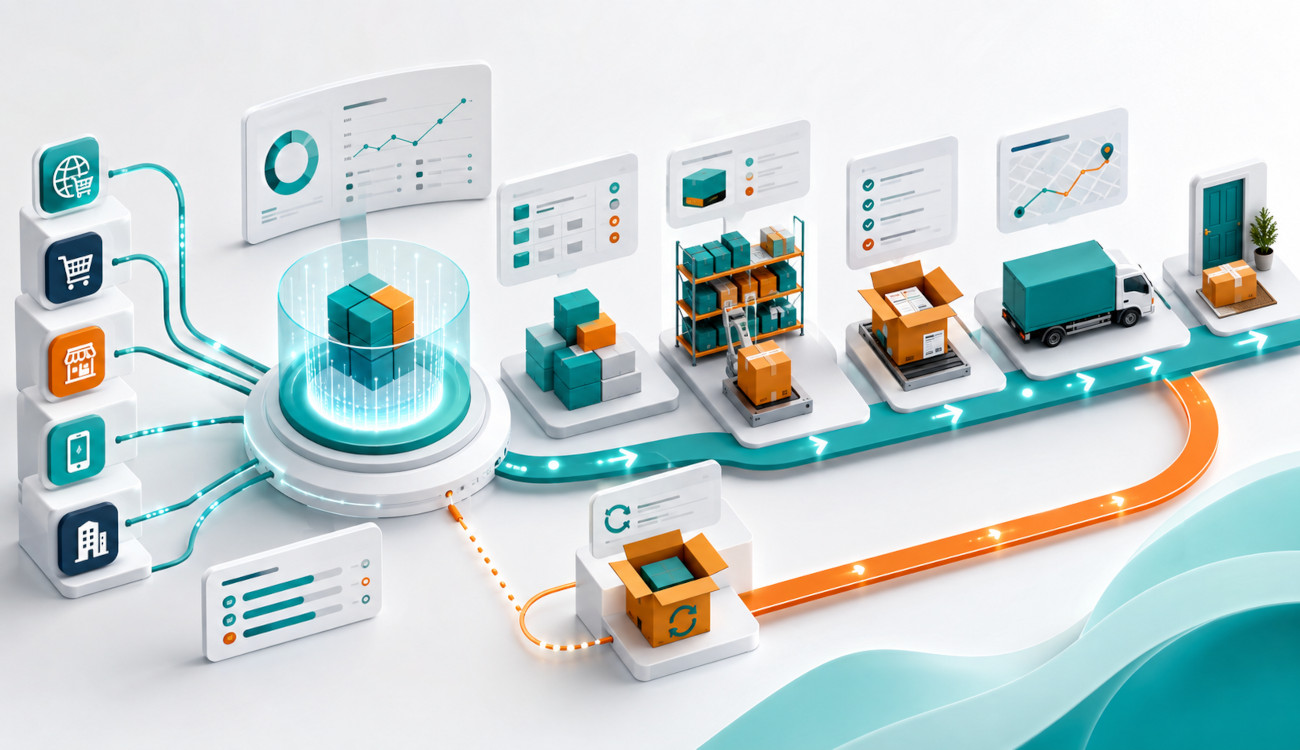
For the operations team responsible for making that happen, the same order may pass through an ecommerce platform, marketplace, inventory system, order management workflow, warehouse, shipping software, carrier network, customer service system, and potentially a returns process before it is truly complete.
Every handoff creates another point where information can become delayed, inconsistent, or difficult to find.
That is why order lifecycle visibility has become increasingly important for businesses managing growing order volumes, multiple sales channels, several fulfillment locations, or more complex warehouse operations. Operations teams do not simply need to know whether an order exists. They need to understand where it is, what has already happened, what should happen next, and whether anything is preventing the order from progressing normally.
Without that visibility, even relatively small fulfillment problems can take far longer to identify and resolve.
Order Lifecycle Visibility Starts the Moment an Order Is Placed
The order lifecycle begins before anyone in the warehouse touches a product.
When an order enters the business through Shopify, Amazon, Walmart Marketplace, eBay, a wholesale portal, EDI connection, or another sales channel, several things may need to happen almost immediately.
The order has to enter the appropriate operational system. Payment or order validation may need to occur. Inventory has to be confirmed or allocated. Business rules may determine which warehouse or fulfillment partner should receive the order. Shipping requirements, service levels, customer details, and marketplace requirements may also need to travel with it.
When these processes happen across separate systems, the storefront can show that an order was successfully placed even though something further downstream has already gone wrong.
An integration may fail to send the order to the warehouse. Inventory may appear available on the sales channel while the fulfillment system shows otherwise. An address validation issue may prevent the order from being released. A routing rule may fail to assign the correct facility.
To the customer, the order exists. To the warehouse, it may not.
This is one of the earliest reasons operations teams need visibility beyond the storefront order status. They need to know whether the order successfully moved from order capture into the next operational stage rather than assuming that every system received the same information.
Inventory Allocation Is Often the First Critical Decision
Once an order is accepted, the next question is whether the business can actually fulfill it.
For companies operating a single warehouse with a small catalog, this may be relatively straightforward. For businesses selling through several channels or maintaining inventory across multiple locations, inventory allocation can become one of the most important parts of the order lifecycle.
The business may technically have ten units of an item available, but those units could be distributed across several warehouses. Some may already be committed to other orders. Some may be unavailable because of damaged stock, receiving delays, inventory adjustments, or synchronization problems.
An order can therefore appear valid while still encountering an allocation problem.
This becomes especially important when businesses are trying to prevent overselling across multiple sales channels. Accurate inventory visibility and order visibility are closely connected because the operations team needs to understand not only how much inventory exists, but also which inventory has already been committed and where that stock is located.
When order and inventory information are disconnected, teams often discover problems only after fulfillment should have started.
By that point, someone may need to manually investigate the order, move inventory between facilities, split the shipment, substitute a product, delay the order, or contact the customer.
Order lifecycle visibility makes those allocation decisions easier to follow because the team can see whether inventory was successfully reserved and whether the order is ready to continue through fulfillment.
Order Routing Determines Where Fulfillment Actually Happens
After inventory is available, the order often needs to be assigned to a fulfillment location.
Businesses with multiple warehouses, third-party logistics providers, store fulfillment, or distributed inventory cannot treat this as a minor step. The routing decision affects fulfillment speed, shipping cost, inventory utilization, warehouse workload, and ultimately the customer experience.
An order might be routed according to inventory availability, customer location, warehouse capacity, shipping service, product type, business priority, or a combination of several rules.
The difficulty comes when the routing decision is not visible to the people managing the operation.
If an order has not shipped, the operations team should not have to search several systems just to determine which warehouse received it. They should be able to see where the order was routed, when it was assigned, whether the facility accepted it, and whether the order subsequently progressed into fulfillment.
This becomes even more valuable when something changes.
Perhaps the selected warehouse no longer has the required stock. Another location may be better positioned to fulfill the order. A facility may be experiencing an unusually high workload. An order may need to be split because no single warehouse contains all of the required items.
Without visibility into the routing decision and the order’s current state, these exceptions become difficult to manage.
Instead of proactively adjusting the fulfillment path, teams can end up reacting after the shipment is already late.
Warehouse Status Needs to Mean More Than “Processing”
Once an order reaches the warehouse, the lifecycle becomes more operationally detailed.
The order may need to be released to the floor, waved or queued, picked, packed, quality checked, labeled, staged, and handed to the carrier.
Each of those steps provides useful information.
If an order has been sitting in an unallocated state, the problem is different from an order that was released but never picked. An order that has been picked but not packed may indicate a packing bottleneck. An order with a label created but no carrier scan may be sitting in staging rather than moving through the transportation network.
A generic status such as “processing” hides those differences.
For operations teams, this is where detailed order lifecycle visibility becomes particularly valuable. They need enough context to understand what stage an order has reached and how long it has remained there.
The purpose is not to watch every normal order individually. In a healthy operation, most orders should move through the process without requiring attention.
The value comes from being able to identify the orders that are not moving normally.
When teams can see where orders are stalling, they can investigate the underlying operational issue instead of waiting for individual customer complaints to reveal it.
Exceptions Matter More Than Perfect Orders
Most fulfillment operations do not struggle because every order fails.
They struggle because a relatively small number of exceptions require disproportionate amounts of manual work.
An address may be incomplete. A product may be unavailable. An order may be duplicated. A payment or marketplace hold may prevent release. A warehouse may short-pick an item. A shipment may miss its carrier cutoff. An integration may fail. A carrier may accept a label but never receive the physical package.
Each of these situations creates an order that no longer follows the expected path.
At low volume, operations teams may be able to catch these situations through experience, spreadsheets, emails, warehouse conversations, or manual system checks.
That approach becomes much less reliable as the business grows.
If a company processes 200 orders per day and 2 percent require attention, that represents only four exception orders. At 5,000 orders per day, the same percentage creates 100 exceptions.
The percentage did not change. The operational workload did.
This is one of the reasons businesses often feel as though their fulfillment process suddenly becomes harder at scale. The standard orders may still move correctly, but the volume of exceptions grows beyond what the team can comfortably identify and investigate manually.
Order lifecycle visibility gives operations teams a way to separate normal order flow from orders that require intervention.
Shipping Visibility Begins Before the Tracking Page
Shipping is another area where businesses often mistake customer-facing tracking for true operational visibility.
A tracking number is useful, but it does not tell the entire story.
Operations teams need to know when the shipping label was generated, whether the package was actually manifested, when the carrier received it, whether the first scan occurred, and whether the shipment is progressing according to expectations.
A label can exist even when the package is still sitting inside the warehouse.
That difference matters.
If the storefront automatically marks an order as shipped when a label is created, customer service may tell the buyer that the package is on its way even though the carrier has not yet received it.
From an operational perspective, those are two different stages of the lifecycle.
Visibility across both warehouse fulfillment and carrier activity helps teams distinguish between a warehouse delay and a transportation delay. That makes troubleshooting faster and prevents teams from wasting time investigating the wrong part of the process.
Delivery Does Not Always Mean the Order Is Finished
For many businesses, shipment delivery is treated as the end of the order lifecycle.
Operationally, that is not always the case.
Orders may still result in delivery exceptions, refused shipments, lost packages, returns, exchanges, replacement orders, refunds, or inventory that needs to be received back into the warehouse.
These processes matter because they affect both the customer experience and inventory accuracy.
Consider a returned item.
The customer may have already shipped the product back, but the warehouse may not yet have received it. The return may have arrived physically but still be waiting for inspection. The refund may depend on the condition of the product. The inventory may need to move into sellable, damaged, or quarantine stock.
If the return process is disconnected from the original order, operations teams lose part of the history needed to understand what happened.
True lifecycle visibility therefore extends beyond outbound fulfillment. It connects the order with the activities that follow it until the transaction is operationally complete.
Fragmented Systems Make Simple Questions Surprisingly Difficult
When businesses grow, they rarely replace their entire technology stack at once.
Instead, they add systems as new needs appear.
A new marketplace is connected. Another warehouse opens. A shipping application is introduced. A 3PL starts handling part of the catalog. Wholesale orders move through a different workflow. Returns are handled somewhere else.
Each system may perform its own function perfectly well, but operations teams can still struggle if the information remains fragmented.
That fragmentation becomes obvious when someone asks a simple question:
What is happening with this order?
One system may show that it was accepted. Another may show an allocation. The warehouse system may show that it was picked. The shipping platform may show a label. The carrier may show no scan.
Someone has to put those pieces together before the team can determine what actually happened.
The problem is not necessarily a lack of data.
Often, there is too much data spread across too many places.
The operational challenge is turning that information into a coherent view of the order.
A Shared Order View Improves Coordination Between Teams
Order lifecycle visibility also affects how different departments work together.
Operations, warehouse teams, customer service, ecommerce teams, and management frequently need information about the same orders for different reasons.
Customer service wants to answer a buyer’s question.
Warehouse leadership wants to understand whether fulfillment is on schedule.
Operations wants to identify exceptions.
Management wants to understand whether order volume is moving through the network effectively.
When each department sees a different version of the order, communication slows down.
Customer service may ask operations to investigate a shipment. Operations may then contact the warehouse. The warehouse may check another system before responding. By the time the original question is answered, several people have spent time reconstructing information that already existed somewhere in the organization.
A shared operational view reduces that back-and-forth.
Teams can see the same order history and understand what occurred at each stage without relying on separate interpretations of the order status.
Visibility Also Reveals Problems in the Fulfillment Process
The value of order lifecycle visibility goes beyond resolving individual orders. When teams can follow how orders move through each stage of fulfillment, they can also spot recurring patterns that point to larger operational problems.
Orders that regularly stall before allocation, for example, may indicate inaccurate inventory data or synchronization issues between systems. A growing queue of orders waiting to be picked could point to capacity constraints, inefficient warehouse workflows, or staffing challenges at a particular fulfillment location.
Shipping activity can reveal similar patterns. When teams create labels on time, but carrier scans consistently appear much later, the delay may be occurring during staging or carrier handoff rather than during picking and packing. Likewise, an unusually high number of failed or delayed orders from one sales channel can signal problems with an integration, routing rule, or the data entering the fulfillment workflow.
Looking at these patterns across hundreds or thousands of orders gives operations teams something that individual order statuses cannot provide: context. Instead of repeatedly fixing the same type of exception, they can identify where the process is breaking down and address the underlying cause.
That is where visibility starts to support more than day-to-day troubleshooting. It gives operations teams a clearer picture of how well the entire fulfillment process is working and where changes can make the biggest difference.
CommerceBlitz Connects the Operational Story of an Order
This is also where platforms such as CommerceBlitz become valuable within a growing commerce operation.
CommerceBlitz is designed to connect order, inventory, warehouse, and fulfillment activity across the systems businesses already rely on. Rather than requiring operations teams to interpret a collection of isolated statuses, the goal is to provide a clearer operational view of how orders move through the business.
An order can enter through a sales channel, move through inventory allocation and routing, reach the appropriate fulfillment location, progress through warehouse activity, and continue into shipping without each step becoming a separate informational silo.
That connected view is particularly useful for companies operating across multiple sales channels or warehouses because those environments naturally create more handoffs and more possible exceptions.
The more complex the fulfillment network becomes, the more important it is for the operations team to understand the relationship between those systems rather than viewing each one independently.
CommerceBlitz helps bring that activity together so teams can focus less on searching for order information and more on managing the operation itself.
Order Lifecycle Visibility Becomes More Valuable as the Business Grows
A small operation can survive with limited visibility for a surprisingly long time.
People know which orders are unusual. Someone remembers what happened yesterday. Warehouse staff can walk across the building and ask whether a shipment went out. Customer service knows whom to message when something looks wrong.
Those informal processes work because the number of orders, systems, and people involved remains manageable.
Growth changes that.
More sales channels create more incoming order flows. More warehouses create more routing decisions. Higher order volume creates more exceptions. Additional employees create more handoffs. Customer expectations remain high even as the operation becomes more complicated behind the scenes.
At that point, visibility is no longer simply convenient.
It becomes part of the infrastructure required to manage the business effectively.
Operations teams need to know whether orders are moving as expected, where problems are occurring, which exceptions require attention, and how those patterns affect the broader fulfillment network.
The goal is not to add another dashboard for teams to watch.
It is to give them enough context to understand the order lifecycle without reconstructing it manually every time something goes wrong.
When the entire journey of an order is visible, operations teams can identify issues sooner, investigate them faster, coordinate more effectively with other departments, and make better decisions about the processes behind fulfillment.
For growing commerce businesses, that level of visibility can be the difference between simply processing more orders and actually maintaining control as the operation scales.