
Multi-Client Warehouse Management: What Breaks First
A warehouse can handle more clients for a while without looking very different from the outside. The racks are still there, the same teams are receiving and picking, and orders continue to leave through the same doors.
The pressure shows up somewhere else first. As the client mix grows, people need to keep track of more rules, more inventory ownership, more order priorities, more reporting expectations, and more exceptions inside the same operation.
That is usually where control starts to weaken. The first thing to break is rarely the physical space. It is the shared understanding of what should happen for each client and why.
Client Rules Become Harder to Hold Together
Every new account brings its own operating requirements. Those differences may include receiving checks, storage rules, packaging instructions, carrier preferences, returns handling, reporting needs, and billing logic.
None of those requirements is unusual on its own. The difficulty comes from managing all of them inside one warehouse without turning daily execution into a memory test.
A team may know exactly how to handle the first few clients because the rules are still familiar. As more accounts arrive, employees begin relying on notes, emails, shared files, or experienced coworkers to fill the gaps.
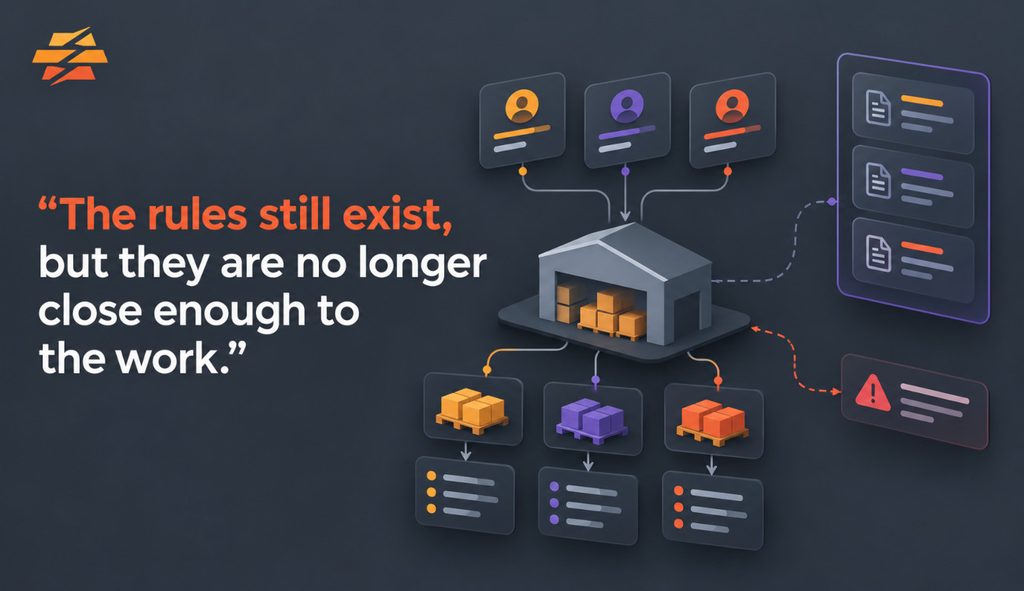
That is an early sign that multi-client warehouse management is becoming harder to control. The rules still exist, but they are no longer close enough to the work.
Standard Processes Start to Pick Up Exceptions
A shared warehouse needs repeatable processes. Receiving, putaway, picking, packing, shipping, returns, and cycle counts all work better when employees know the normal path.
Client requirements naturally create exceptions to that path. One account may need a different receiving check, another may require specific packaging, while another may have a special rule for returns.
A few exceptions are manageable. Problems begin when each account adds enough special handling that the standard process becomes difficult to recognize.
At that point, employees stop following one clear operating model with visible client rules. They begin navigating several versions of the same process, often without a reliable way to tell which version applies.
Inventory Ownership Gets More Difficult to See
Shared warehouses can hold inventory for several clients in the same building, and sometimes in the same broader storage areas. That makes client ownership a basic part of inventory control.
The challenge grows when clients carry similar products, use overlapping identifiers, or move stock between several facilities. A quantity can be physically correct while still being assigned to the wrong account.
That kind of error may not stop fulfillment immediately. The wrong unit can still reach the customer, which means the operational problem appears later through inventory reconciliation, reporting, or a shortage on another account.
Clear client ownership therefore needs to stay attached to inventory through receiving, storage, allocation, picking, adjustments, transfers, and returns. If ownership becomes unclear at any point, the warehouse may spend more time reconstructing what happened than moving the inventory itself.
Available Inventory Becomes Harder to Interpret
On-hand stock is not always the same as available stock. Some units may already be allocated to orders, placed on hold, waiting for inspection, or moving between locations.
In a multi-client environment, another layer sits underneath that status. The warehouse also needs to know which client owns the inventory before deciding whether an order can use it.
A combined warehouse quantity can therefore create the wrong impression. The building may have enough units of a product while the client that received the order has little or none available.
When teams lose that distinction, allocation becomes harder to trust. Customer service, account management, and warehouse operations may all start checking the same inventory from different views and reaching different conclusions.
Order Flow Starts Requiring More Interpretation
Order volume is only one part of warehouse workload. Different clients can send very different types of orders into the same operation.
One account may send simple consumer orders. Another may send wholesale orders with larger quantities, while another may rely on several ecommerce channels with different routing or shipping requirements.
The warehouse still needs to turn all of that activity into executable work. If order data arrives without enough client context, employees may need to determine which rules apply before fulfillment can begin.
That slows the operation in a way that is easy to miss. The team is not spending more time picking. It is spending more time interpreting the order before the pick can happen.
Exceptions Begin to Compete for Attention
Normal orders should move through the warehouse without much management attention. Exceptions are different because they require someone to understand what happened and decide what happens next.
A growing client base naturally creates more types of exceptions. Missing inventory, incomplete order data, receiving differences, returns decisions, carrier problems, and client-specific requests may all need different responses.
The risk is not simply having more exceptions. It is losing the ability to separate them from normal work and route them to the right person.
Once that happens, experienced employees become the default problem solvers. They spend more time investigating routine issues because the operation does not provide enough context for someone else to act confidently.
Labor Planning Becomes Less Predictable
Two clients can generate similar order counts and still create very different workloads.
One account may move through straightforward picking and packing. Another may require more scans, more documentation, more packaging steps, or more handling at receiving.
If labor planning relies mainly on transaction volume, those differences can remain hidden until the floor is already under pressure. The warehouse has people scheduled, but the work takes longer than expected because the client mix changed.
Multi-client warehouse management therefore needs more than a total order count. Managers need enough operational context to understand what kind of work is entering the building and where it will consume time.
Account Management Starts Carrying Operational Load
Account managers often become the bridge between clients and warehouse teams. That role is useful when they are coordinating changes, explaining exceptions, or helping both sides make decisions.
It becomes less useful when routine information depends on them. Inventory balances, order status, receiving progress, shipment details, and basic warehouse questions should not require repeated manual research.
As the number of clients grows, that pattern becomes expensive in time even if nobody measures it directly. Every account creates another stream of questions that can pull account managers into data retrieval.
The warehouse then loses another layer of operational clarity. Information exists somewhere, but the person who knows how to find it becomes part of the workflow.

Reporting Begins to Fragment by Client
Client reporting often grows quietly.
One account asks for a different inventory view. Another wants a separate order report. A third needs more receiving detail, so the team creates another export or spreadsheet.
Each request may be reasonable. The problem appears when the 3PL starts maintaining several reporting processes that describe the same warehouse activity in different ways.
That creates extra work and can introduce different definitions for the same operational event. One report may describe an order as complete at one stage while another uses a later shipment event.
A common data structure helps prevent that fragmentation. Clients can still receive views that suit their operation, but the underlying definitions remain consistent across accounts.
Billing Becomes Harder to Reconstruct
Warehouse activity often feeds client billing. Receiving, storage, picking, packing, returns, special handling, and other services can all create billable events.
As the client base grows, those events become more difficult to trace when the operational record and billing logic are separated. Teams may need to look backward and determine which activity belongs to which account.
That is especially difficult when unusual work happens outside the normal process. If a special handling task was completed but not recorded with enough client context, the billing team may need help from operations later.
A stronger operating model keeps client ownership attached to the activity when the work happens. Billing can then follow the warehouse record instead of rebuilding it after the fact.
Onboarding Can Add Problems That Stay for Years
New client onboarding often focuses on getting the account live. Product data needs to be ready, integrations need to work, inventory needs to arrive, and orders need to start flowing.
That urgency can create temporary workarounds. A spreadsheet fills a data gap, an email handles a special approval, or one employee manually checks a client rule while the process is being completed.
The problem starts when those temporary steps never disappear. They become part of daily operations because the account is already running and nobody wants to disturb a process that appears to work.
Every new client can leave behind another small dependency. Over time, the warehouse ends up supporting growth with a collection of manual steps that nobody originally intended to keep.
System Boundaries Become More Visible
A multi-client 3PL rarely runs on one system. Warehouse execution may sit in the WMS, financial records may live elsewhere, EDI handles certain transactions, and ecommerce or carrier systems contribute other parts of the process.
Those systems can all work correctly while the operation still lacks a connected view. The problem appears when someone needs to understand one client event and has to search across several places to build the answer.
Growth makes that gap harder to hide. More clients create more transactions moving between the same systems, and manual reconciliation becomes part of normal operations.
CommerceBlitz OMNI fits into this type of environment as an additive bolt-on data layer. It can help connect information across existing systems while the WMS, ERP, EDI, and other tools continue performing the jobs they already handle.
The value is not replacing warehouse execution. It is giving operators a clearer view of the client, inventory, order, and fulfillment context around that execution.
Shared Definitions Start to Matter More
Operational language can become surprisingly inconsistent as a 3PL grows.
Available inventory, received stock, completed order, shipped order, and open exception may mean slightly different things depending on the team or system using the term. At smaller scale, employees often resolve those differences through conversation.
That becomes less reliable across more clients and locations. Teams need common definitions so that reports, warehouse activity, account conversations, and client views describe the same event in the same way.
Consistency reduces interpretation. It also makes it easier to tell whether a process is actually changing or whether two teams are simply describing the same activity differently.
Experienced Employees Become the Safety Net
Most growing warehouses have people who know where the weak points are.
They remember which client has an unusual rule, which product causes confusion, which report needs manual correction, and which order status does not mean exactly what it appears to mean.
That knowledge is valuable, but it becomes a risk when the operation depends on it. The warehouse may appear controlled because experienced employees quietly correct problems before anyone else sees them.
The real test is whether another trained employee can make the same decision with the information available in the process. If the answer depends on knowing who to ask, the control still lives with the person rather than the operation.
Adding Another Facility Magnifies Existing Weaknesses
A second or third warehouse does not create completely new problems. It usually makes existing ones easier to see.
Client rules now need to remain consistent across locations. Inventory ownership has to survive transfers, order routing needs to understand where stock sits, and reporting has to make sense across several operating teams.
Processes that depended on informal communication inside one building become harder to maintain across a network. The employee who could walk across the warehouse and ask a question may now need an answer from another facility.
That is why multi-client warehouse management becomes a different discipline once the network expands. Local execution still matters, but operators also need enough visibility to understand how client activity moves across locations.
What Usually Breaks First
The first failure is rarely dramatic. Orders still ship, inventory still moves, and employees keep finding ways to complete the work.
What starts to break is context. People spend more time looking for instructions, confirming ownership, reconciling reports, checking statuses, and asking experienced employees what a particular client requires.
Those small dependencies are easy to accept because each one solves an immediate problem. Together, they make the operation harder to understand and harder to scale.
The warehouse does not lose control in one moment. Control erodes when routine work increasingly depends on manual interpretation.
Build Control Before Adding More Complexity
Multi-client warehouses will always have variation. Different clients bring different products, order profiles, workflows, and service requirements, and a strong 3PL needs enough flexibility to support them.
The operating model still needs a stable foundation. Client rules should be visible, inventory ownership should remain clear, normal orders should move with limited intervention, and exceptions should reach the right people with enough context to act.
Reporting, billing, and account management should work from the same operational record rather than rebuilding it in separate processes. Existing systems can continue doing their jobs while connected visibility makes the broader client operation easier to understand.
Start by identifying the routine tasks that still require someone to search, ask, reconcile, or remember before work can continue. Those are usually the first places where multi-client complexity is already putting pressure on operational control.