
Real-Time Visibility as the Foundation of 3PL Client Trust
In the world of third-party logistics, trust is rarely declared. It is observed. It is measured in consistency, in clarity, and in the quiet confidence clients feel when they do not have to ask what is happening inside the warehouse because they already know. When brands outsource fulfillment to a 3PL provider, they are not simply delegating storage and shipping. They are placing their reputation, customer experience, revenue flow, and marketplace performance into someone else’s operational ecosystem. That level of responsibility cannot be supported by partial information or delayed reporting. It requires real-time visibility.
For modern 3PLs serving e-commerce brands, B2B distributors, and multi-channel sellers operating across platforms such as Shopify, Amazon, Walmart, and wholesale portals, real-time visibility is no longer an added benefit or a competitive extra. It has become the structural foundation upon which long-term client trust is built.
The Hidden Cost of Limited Visibility
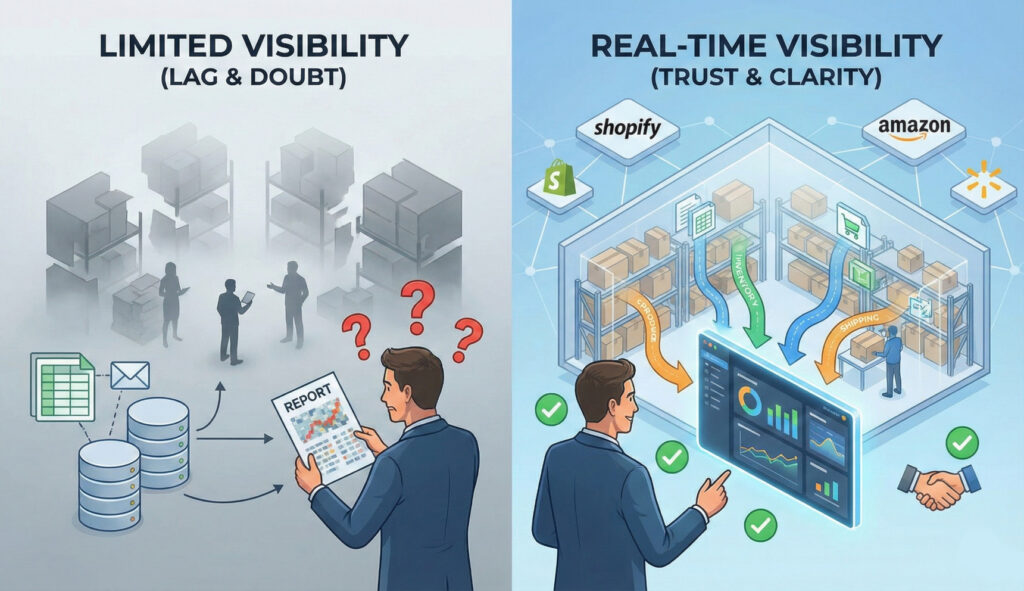
Traditional 3PL models often relied on scheduled exports, static inventory reports, and end-of-day order summaries. On paper, this approach provided information. In reality, it provided lag. A brand would receive a report showing available inventory hours after the actual movement occurred. Order status updates would appear only after batch synchronization. Discrepancies would surface only once someone manually compared reports across systems.
The operational consequences of this delay may appear minor at first, but they accumulate quickly. A merchant sees a stockout on their Shopify storefront while a warehouse report still shows units available. A B2B client expects a pallet to have shipped, yet tracking information has not been reflected in their system. A marketplace flags performance concerns because shipment confirmations were not updated in time. In each case, the issue is not always operational failure. It is informational delay.
When clients cannot see what is happening in real time, oversight naturally increases as a way to compensate for uncertainty. More frequent reports are requested, inventory levels are double checked before launching promotions, and urgent emails begin to replace quiet confidence. Parallel tracking spreadsheets emerge as an additional layer of reassurance. Over time, this pattern generates operational noise and gradually weakens trust, not because the 3PL is failing, but because transparency feels incomplete.
Trust, in logistics, is deeply tied to clarity. Without clarity, even strong operational performance can feel uncertain.
Real-Time Visibility Redefines the 3PL Relationship
Real-time visibility transforms the relationship between 3PL and client from reactive verification to proactive confidence. When inventory levels, order statuses, shipment confirmations, and return processing updates are visible immediately as they occur, the conversation changes. Instead of asking whether something happened, clients can see that it happened.
This immediacy reduces friction in subtle but powerful ways. Clients gain instant confirmation that inventory adjustments reflect physical reality. They can monitor order progress without relying on manual updates. They can reconcile sales channel data against warehouse activity without waiting for reports. Most importantly, they can make business decisions based on current information rather than yesterday’s snapshot.
In a multi-channel environment, this becomes even more critical. A product sold on Amazon must immediately reduce available inventory for Shopify. A wholesale order must adjust marketplace allocations without delay. Returns must be processed and reflected in sellable stock as soon as they are validated. Without synchronized visibility, even small timing gaps can create overselling, backorders, and marketplace penalties that damage both the brand and the 3PL.
Real-time visibility does not simply provide data. It establishes operational alignment across systems and stakeholders.

The Complexity of Multi-Channel and 3PL Environments
The complexity facing modern 3PL providers is significantly greater than it was a decade ago. Clients do not operate in isolated ecosystems. They run direct-to-consumer storefronts, maintain marketplace listings, process bulk B2B orders, and often test new channels simultaneously. Inventory must move fluidly across these demand sources while remaining accurate in each one.
In this environment, visibility fragmentation is dangerous. If inventory exists in one system but not another, or if order status flows in one direction but not back again, discrepancies multiply. Clients begin to question numbers. Customer service teams begin to intervene manually. Warehouse managers begin to adjust buffers to compensate for uncertainty. What begins as a synchronization issue gradually becomes an operational inefficiency.
For 3PLs, maintaining unified, real-time visibility is not only about technology performance. It is about demonstrating operational maturity. Clients interpret transparency as control. When they can clearly see inventory movement, order flow, and fulfillment progression, they associate that clarity with competence.
CommerceBlitz OMNI was designed with this reality in mind. It recognizes that inventory, order data, and warehouse workflows cannot exist in isolated layers if trust is the goal. They must operate from a centralized operational logic that ensures movements are reflected instantly and consistently.
Real-Time Inventory as a Source of Credibility
Inventory is the most sensitive element of any 3PL relationship. It represents ownership, capital, and revenue potential. When clients cannot confidently reconcile system inventory with physical inventory, doubt begins to grow.
Real-time inventory visibility allows clients to see current stock levels as transactions occur. Receiving updates reflect immediately. Picks reduce availability instantly. Returns increase sellable inventory once validated. Adjustments are traceable rather than hidden.
This level of transparency reduces disputes and eliminates the perception that inventory information is being filtered or delayed. It also improves internal alignment for the 3PL itself. Warehouse teams, account managers, and leadership operate from the same data source, reducing internal confusion and strengthening communication consistency with clients.
Over time, real-time inventory clarity becomes part of the 3PL’s identity. Clients begin to rely on the system with confidence rather than suspicion.
Order Flow Transparency and Client Confidence
Order visibility is equally essential. In multi-channel environments, orders are ingested continuously from different platforms, each with its own timing expectations and performance metrics. Delays in updating status can trigger automated penalties or negative customer feedback.
A 3PL equipped with real-time order visibility allows clients to monitor order progression as it moves from intake to picking, packing, and shipment confirmation. This transparency reduces escalation scenarios because clients can independently verify progress. Instead of asking for manual confirmation, they see movement in the system.
CommerceBlitz OMNI supports this structured flow by ensuring that order events are captured consistently within the operational framework. When order data moves through a centralized system, the visibility loop between warehouse and sales channel remains intact. This minimizes performance discrepancies and strengthens marketplace reliability.
Trust is reinforced not through reassurance, but through evidence.
Reporting, Accountability, and Long-Term Partnerships
Beyond daily operations, real-time visibility plays a crucial role in reconciliation and performance measurement. Billing accuracy, service level adherence, inventory ownership validation, and dispute resolution all depend on accessible, consistent data.
When every transaction leaves a clear trace and every adjustment is documented, accountability becomes embedded rather than reactive. Clients no longer need to request special reports to feel secure. Instead, they can rely on standardized visibility that supports predictable collaboration.
CommerceBlitz OMNI contributes to this structure by centralizing operational data in a way that reduces reliance on fragmented spreadsheets and disconnected reporting tools. The goal is not simply to present information, but to ensure that the information aligns with real warehouse activity at all times.
For 3PL providers, this reduces operational noise. Instead of allocating resources to repetitive clarification requests, teams can focus on optimization, growth initiatives, and strategic planning discussions with clients.
Visibility as a Competitive Advantage
In an increasingly competitive 3PL landscape, pricing and storage capacity are no longer sufficient differentiators. Technology maturity and operational transparency are now key selection criteria for brands seeking fulfillment partners.
A 3PL that offers structured, real-time visibility signals operational confidence. It demonstrates that inventory is controlled, that order flow is traceable, and that reporting is not an afterthought. It positions the provider as a technology-enabled logistics partner rather than a transactional warehouse.
CommerceBlitz OMNI supports this positioning by reinforcing a unified operational ecosystem where visibility is not an add-on but a core structural component. As 3PLs scale and onboard new clients, maintaining consistent visibility across accounts becomes increasingly complex. A centralized system ensures that growth does not compromise transparency.
From Visibility to Growth
Real-time visibility does more than reduce friction. It enables growth.
When clients trust their 3PL partner, they expand product lines with confidence and explore new sales channels without fear of inventory disruption. Greater operational clarity encourages brands to consolidate additional SKUs within the same warehouse instead of spreading inventory across multiple providers. As confidence grows and risk feels controlled, long-term commitments become a natural next step rather than a cautious decision.
Trust removes hesitation. And in logistics, hesitation often limits expansion.
By embedding real-time visibility into everyday operations, 3PL providers create an environment where clarity becomes standard and collaboration becomes strategic. CommerceBlitz OMNI helps support that environment by ensuring that inventory accuracy, synchronized order flows, and centralized data transparency remain stable as complexity increases.
Operational Clarity as a Strategic Imperative
Client trust in 3PL operations is not built through marketing language or service promises. It is built through consistent operational clarity. Real-time visibility provides that clarity by ensuring that inventory levels, order progression, and warehouse activity are aligned and accessible at all times.
In multi-channel commerce, where timing and synchronization directly impact revenue and reputation, this level of transparency is not optional. It is foundational.
Real-Time Visibility as the Foundation of 3PL Client Trust is not simply a statement. It reflects the operational reality that 3PL providers must embrace to remain competitive. With the support of a unified platform such as CommerceBlitz OMNI, visibility becomes structured, scalable, and sustainable, transforming client relationships from reactive oversight to confident partnership.