
Handling Split Orders in Multi-Warehouse Environments
As ecommerce businesses grow, fulfillment networks tend to become more complex. A company that once operated from a single warehouse may eventually add regional distribution centers, third-party logistics partners, retail locations, overflow storage, or specialized facilities designed to serve particular markets. This expansion can improve delivery speed, increase inventory availability, and create more flexibility across the supply chain. At the same time, growing operations often need to fulfill a single customer order from more than one location.
This is where split orders become part of everyday warehouse operations.
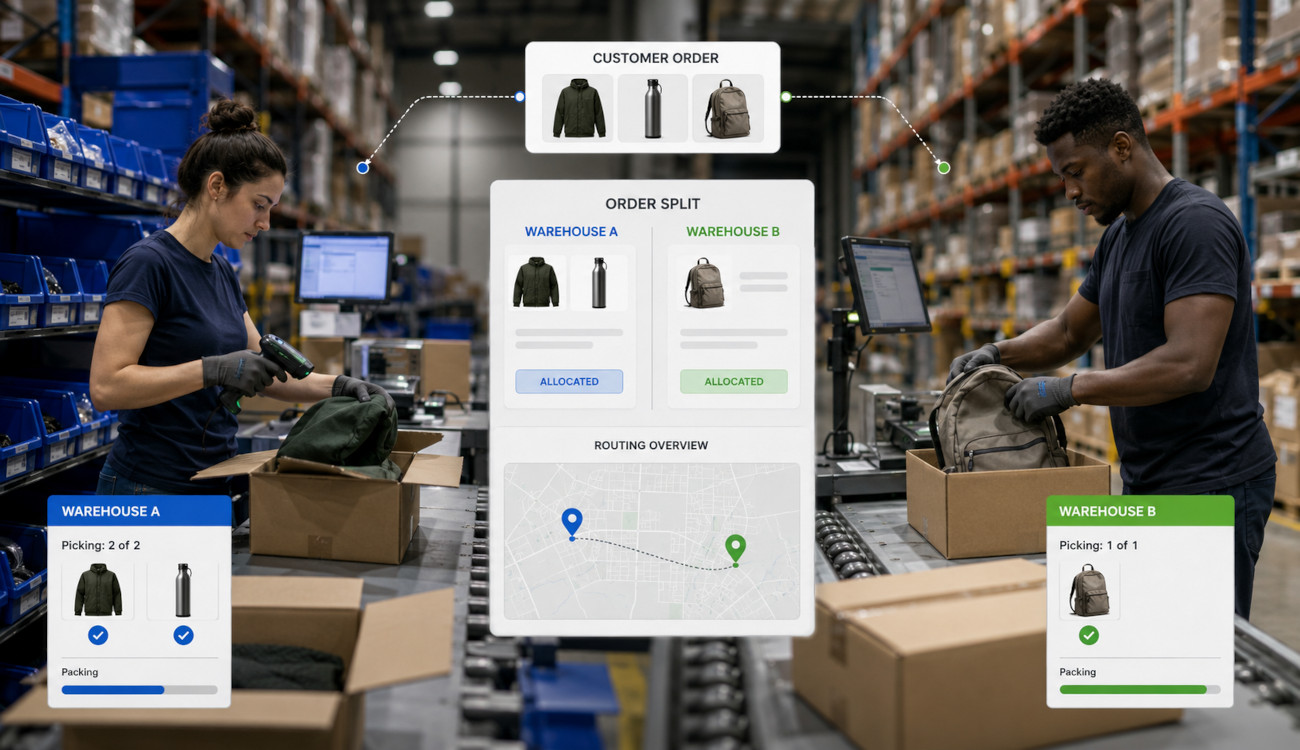
A split order occurs when multiple warehouses or inventory locations fulfill items from the same customer order. To the customer, the transaction still begins as one order. They add several items to a cart, complete one checkout, and receive one order confirmation. Behind the scenes, warehouse teams may divide that order into several fulfillment tasks. Different locations can pick, pack, and ship individual items, which may then arrive on different days.
Managing that process successfully requires more than simply finding the products somewhere in the network. Businesses need accurate inventory data, clear allocation rules, intelligent routing decisions, reliable shipment tracking, and consistent communication across every location involved. Without those elements, split fulfillment can quickly create unnecessary shipping costs, inventory errors, warehouse bottlenecks, and customer service problems.
For businesses operating multiple warehouses, the goal is not necessarily to eliminate split orders. In many cases, splitting an order is the most practical or efficient decision available. The real challenge is deciding when a split makes sense and coordinating the process from order placement until every item reaches the customer.
Managing Split Orders in Multi-Warehouse Environments
Split orders are often a natural result of expanding inventory networks.
A smaller ecommerce business may keep most or all of its inventory in one location, which makes order fulfillment relatively straightforward. If a customer purchases several products and they are all available, the warehouse picks the items, packs them together, and ships the order as a single package.
Once inventory is distributed across multiple locations, that simplicity begins to disappear.
Consider a customer who orders four products. Warehouse A has three of them in stock, while Warehouse B has the remaining item. Warehouse C may technically have all four products, but it is located much farther from the customer and would require a more expensive shipping service to meet the promised delivery date. Another warehouse may have the necessary inventory but already be operating near capacity.
The business now has several possible fulfillment paths, and none of them are determined by inventory availability alone.
One option is to split the order between Warehouses A and B, allowing available products to ship quickly while creating two separate shipments. Another approach is to route the entire order through Warehouse C and accept the higher transportation cost. Inventory could also be transferred between warehouses before fulfillment, reducing customer-facing packages but adding time and internal handling. In some cases, holding part of the order until inventory becomes available at the preferred location may be the better choice.
Each option affects cost, speed, labor, inventory levels, and customer expectations differently.
As the number of warehouses increases, these decisions become more frequent. Businesses also tend to experience more split-order scenarios as they expand their catalog, because every additional SKU increases the likelihood that products within the same order will be stored in different places.
This is why managing split orders in multi-warehouse environments should be treated as a core part of fulfillment strategy rather than an occasional exception.
Inventory Visibility for Split Orders in Multi-Warehouse Environments
Before a business can make a good decision about how to fulfill an order, it needs reliable information about where inventory actually exists.
That sounds simple, but inventory visibility becomes significantly more difficult when several warehouses, sales channels, and fulfillment partners are involved. A product may appear to have ten units available across the network, but those units could be spread across four different facilities. Some may already be allocated to open orders, some may be in the middle of an inventory transfer, and others may have been picked but not yet reflected in another connected system.
If the fulfillment system only sees a total inventory quantity without understanding the location and availability of those units, routing decisions can become inaccurate very quickly.
For example, a business may receive an order for two units of the same product. The system shows four units available across the company, but each warehouse only has one available unit. What looks like a simple order now requires either two shipments or a different fulfillment strategy.
This is why multi-location inventory needs to be visible at the warehouse level. Businesses should be able to identify not only how much inventory they own, but also how much is available to promise, how much has already been allocated, where it is physically located, and whether that location can fulfill the order within the required timeframe.
Accurate inventory visibility also helps prevent overselling. When warehouse systems update slowly or operate independently, two fulfillment locations may believe the same inventory is available for different orders. By the time the discrepancy is discovered, one of those orders may already have been accepted and promised to the customer.
Connected inventory data reduces that risk by giving order routing decisions a stronger foundation. It also allows teams to see inventory across the network as a shared resource rather than as isolated stock belonging to individual warehouses.
Order Allocation for Split Orders
One of the most important parts of split-order management is deciding when inventory becomes allocated to a specific order.
When an order enters the system, available inventory should be evaluated before fulfillment begins. The system needs to determine which location or combination of locations will be responsible for the order and reserve the appropriate quantities accordingly.
If allocation happens too late, warehouses may start competing for the same units.
For example, Warehouse A may begin picking an item while another order has already consumed the last available unit in the central inventory system. The warehouse worker may then reach the bin and discover that the physical stock does not match the expected quantity. At that point, the order has to be reassigned, partially fulfilled, delayed, or canceled.
These exceptions are expensive because they create additional work after the fulfillment process has already started.
Good allocation logic can reduce that disruption by considering available inventory before the order is released for picking. Once a location is assigned, the inventory should be reserved so that other orders cannot accidentally consume the same units.
This becomes particularly important during periods of high demand when multiple customers may be purchasing the same products within minutes or seconds of each other.
Not Every Split Order Should Be Treated the Same Way
A common mistake in multi-warehouse fulfillment is applying the same rule to every order.
Some businesses attempt to avoid split shipments whenever possible. Others automatically divide an order as soon as products are located in different warehouses. Both approaches can create unnecessary costs because the best decision depends on the specific order.
A high-value order with an expedited delivery promise may justify multiple shipments if splitting allows the products to reach the customer on time. A low-margin order containing inexpensive items may be better consolidated if shipping two packages would cost more than the business can reasonably absorb.
Product characteristics also matter.
Large or heavy items may already need to ship separately regardless of warehouse location. Fragile products may require specialized packaging. Hazardous or regulated goods may have specific carrier or facility requirements. Certain products may only be fulfilled from approved locations.
The order itself may also contain customer preferences that affect the decision. Some customers may prefer everything to arrive together, while others are primarily concerned with receiving available items as quickly as possible.
This means split-order logic works best when it is flexible. Instead of relying on a single rule, businesses can define routing priorities based on inventory availability, shipping cost, delivery expectations, product type, warehouse capacity, and other operational factors.
How Split Orders Affect Shipping Costs
Shipping cost is one of the most important financial considerations when managing split orders.
Every additional shipment introduces another package, label, carrier charge, and handling process. Even if the products themselves are inexpensive, sending them separately can significantly increase the total cost of fulfilling the order.
Imagine a customer places a $60 order containing three products. Two are available at a warehouse near the customer, while the third is located several states away. Shipping all three separately may still meet the delivery promise, but the additional transportation cost could consume a large portion of the order’s margin.
The business therefore needs to evaluate whether the service improvement created by the split is worth the additional expense.
This calculation becomes even more important for companies offering free shipping. The customer may not see any difference in price, but the business still pays for every package sent. If split shipments happen frequently, the accumulated transportation cost can become substantial.
There are also hidden costs beyond carrier fees. Every additional package requires picking, packing materials, warehouse labor, label generation, tracking, and potentially additional customer service if the shipments arrive at different times.
Because of this, routing logic should consider the total cost of fulfillment rather than only the distance between a warehouse and the customer.
The Closest Warehouse Is Not Always the Best Choice
Geographic proximity is often a useful routing factor, but it should not be treated as the only one.
A warehouse located closest to the customer may offer the shortest transit distance, but that does not automatically make it the most efficient fulfillment location.
The facility may have limited inventory, high labor utilization, a carrier cutoff approaching, or a backlog of orders that could delay processing. Another warehouse located slightly farther away may have better inventory availability and enough capacity to ship immediately.
Carrier pricing also varies by location. A warehouse that is geographically farther from the customer may have better negotiated shipping rates or access to a carrier service that makes the final cost more competitive.
This is why effective order routing needs to consider the entire fulfillment environment.
Distance matters, but so do inventory depth, warehouse workload, transportation rates, delivery promises, and the likelihood that additional orders will require the same inventory later.
A routing decision that looks optimal for one order in isolation may not be optimal for the network as a whole.
Warehouse Capacity and Split Order Fulfillment
Multi-warehouse fulfillment is not only about where inventory is stored. It is also about how much work each location can realistically process.
Warehouse capacity can change throughout the day, week, or season. Promotions, product launches, holidays, staffing shortages, equipment issues, or carrier delays can place significant pressure on a particular location.
If routing rules continue sending orders to an overloaded warehouse simply because it has the inventory, the resulting backlog can erase any advantage created by selecting that location.
In some situations, splitting an order can actually help balance the fulfillment network. One warehouse may handle part of the order while another processes the remaining items, preventing a heavily loaded facility from becoming an even larger bottleneck.
Businesses with several fulfillment locations can benefit from treating warehouse workload as a dynamic routing factor rather than a fixed assumption.
This allows orders to move through the network based not only on where inventory exists, but also on where fulfillment capacity is currently available.
Internal Inventory Transfers Can Sometimes Prevent a Customer-Facing Split
Not every inventory imbalance needs to result in multiple customer shipments.
In some cases, businesses can rebalance inventory between warehouses before customer orders are fulfilled. Regular internal transfers can move products from locations with excess stock to facilities where demand is consistently higher.
This strategy becomes especially valuable when businesses have enough historical data to understand regional purchasing patterns.
If a particular product frequently sells in one region but most of its inventory is stored elsewhere, continuing to split customer orders may be less efficient than changing how the inventory is positioned across the network.
Proactive inventory balancing can therefore reduce future split shipments.
However, transfers also have costs. Inventory must be picked, transported, received, and made available again at the destination warehouse. During that process, the units may temporarily be unavailable for customer orders.
Businesses need visibility into inventory that is in transit so that those units are not accidentally promised before they arrive.
The goal should not be to move products constantly, but to use fulfillment data to identify patterns that justify smarter inventory placement.
Keeping Split Orders Connected Across Warehouses
Once an order is divided between multiple warehouses, the business needs to maintain a clear relationship between every shipment and the original order.
This sounds straightforward, but operational confusion can develop quickly if fulfillment records become disconnected.
One warehouse may ship its portion of the order immediately, while another is still waiting for inventory or processing the pick. Customer service needs to know that the first package does not represent the entire order. The customer needs to understand that additional items are still coming. The inventory system needs to record which units have already left each facility.
Without a connected view, the same order can appear differently depending on which system or warehouse someone is looking at.
A well-managed split order should therefore maintain a parent-child relationship between the original order and its individual shipments. Teams should be able to see what the customer originally purchased, which warehouse was assigned each item, what has already shipped, what remains open, and which tracking number belongs to each package.
This level of visibility makes split fulfillment easier to manage operationally and dramatically improves the quality of customer service when questions arise.
Partial Shipments Require Better Tracking and Communication
Customers are generally comfortable receiving an order in multiple packages as long as they understand what is happening.
Problems begin when the communication is unclear.
If a customer orders four products and receives a shipping confirmation showing only two of them, they may assume that the remaining items were forgotten or canceled. If one package arrives several days before another without an explanation, the customer may contact support believing part of the order is missing.
The fulfillment process may be functioning exactly as designed, but poor communication can still make the experience feel broken.
Each shipment should clearly identify which items it contains and provide the appropriate tracking information. Customers should be able to understand whether their order is complete, partially shipped, or still being processed.
This information should also be visible to customer service teams. When a customer contacts support, the representative should not have to search across several systems or contact individual warehouses to determine where each item is located.
Clear shipment visibility turns split fulfillment from a potential source of confusion into a manageable customer experience.
Returns Can Become More Complicated After Split Fulfillment
Split orders do not stop being complex once delivery is complete.
Returns introduce another set of routing decisions.
If a customer returns products that originally shipped from two different warehouses, should each item return to its original location? Should everything go to a centralized returns facility? Should the products be routed to whichever warehouse currently needs the inventory most?
There is no universal answer.
Returning products to the original warehouse can simplify reconciliation because the inventory goes back to the location that fulfilled the order. However, a centralized returns operation may be more efficient for inspection, refurbishment, or disposal.
In other cases, returning an item to the warehouse with the strongest demand may improve inventory positioning.
Whatever strategy the business chooses, return information needs to remain connected to the original order and shipment. Teams should be able to identify where the product came from, where it was returned, what condition it is in, and when it becomes available for sale again.
Otherwise, returned inventory can become another source of inaccurate stock data across the network.
Automation Becomes More Important as Order Volume Increases
Manual split-order decisions may work when order volume is relatively low.
A small fulfillment team can review inventory, decide which warehouse should ship each product, and make exceptions as they arise. As order volume grows, however, this approach becomes increasingly difficult to maintain.
Hundreds or thousands of daily orders create too many routing decisions for teams to evaluate individually.
Automation allows businesses to establish rules that determine how orders should move through the fulfillment network.
For example, a business may prioritize fulfilling from a single warehouse whenever possible, but allow a split when doing so prevents a significant delivery delay. Another company may prioritize the lowest overall shipping cost while maintaining a specific delivery window. Others may route orders based on regional warehouse assignments, inventory thresholds, carrier availability, or product-specific requirements.
The value of automation is not simply that it removes manual work. It also helps apply fulfillment logic consistently.
When order, inventory, warehouse, and shipment data are connected, platforms such as CommerceBlitz can help operations teams maintain a clearer view of the fulfillment process across multiple locations. Instead of switching between disconnected records, teams can make routing and inventory decisions using information that reflects the broader operation.
For growing businesses, this type of visibility becomes increasingly important because the number of fulfillment decisions grows much faster than the number of people available to manage them manually.
Split Orders Can Reveal Larger Inventory Problems
Split-order data can also provide valuable information about the health of the fulfillment network.
If certain products are frequently causing orders to split, the issue may not be order routing at all. It may indicate that inventory is positioned poorly.
For example, a product that is consistently purchased together with another item but stored primarily in a different warehouse will generate repeated split shipments. Over time, those additional shipping costs may exceed the cost of repositioning inventory.
Businesses can analyze split-order patterns to understand which SKUs frequently appear together, which warehouses repeatedly depend on other locations, and which regions experience the highest number of multi-package orders.
This data can influence purchasing, replenishment, warehouse allocation, and safety stock strategies.
A fulfillment problem can therefore become a source of planning insight.
Instead of viewing split orders only as exceptions that need to be processed, businesses can use them to understand how customer demand interacts with inventory placement.
Measuring the Real Impact of Split Fulfillment
Businesses that operate several warehouses should monitor more than the number of split orders they process.
The more useful question is what those splits are costing and whether they are improving fulfillment outcomes.
Metrics such as average shipments per order, shipping cost per order, fulfillment time, order cycle time, warehouse utilization, cancellation rates, and customer service contacts can help reveal whether the current strategy is working.
A high split-order rate is not automatically negative. If splitting orders allows a business to consistently meet delivery commitments while maintaining reasonable margins, the strategy may be performing exactly as intended.
However, if split shipments are increasing transportation costs without meaningfully improving delivery speed, the network may need different routing rules or better inventory positioning.
Businesses should also watch how frequently one warehouse must rely on another to complete customer orders. Repeated patterns can reveal regional stock shortages, poor replenishment timing, or demand shifts that have not yet been reflected in inventory planning.
The ability to measure these patterns gives operations teams a better foundation for improving the network over time.
The Customer Should Experience One Order, Even When Operations See Several
From an operational perspective, split fulfillment may involve several warehouses, multiple inventory reservations, different picking teams, and more than one shipment.
From the customer’s perspective, it is still one purchase.
That distinction is important.
Customers should not be expected to understand the internal structure of a company’s fulfillment network. They should receive clear information about what has shipped, what is still coming, and when they can expect each package.
When the process is managed well, the complexity remains behind the scenes.
A customer may receive two packages instead of one, but the experience can still feel organized and reliable because tracking information is accurate, delivery expectations are clear, and customer service has access to the complete order history.
This is ultimately what successful multi-warehouse fulfillment should accomplish. The business gains the flexibility of distributed inventory without transferring the operational complexity to the customer.
Building a Smarter Multi-Warehouse Fulfillment Strategy
Split orders are often treated as a fulfillment problem, but they are really the result of several operational decisions coming together.
Inventory placement determines where products are available. Allocation rules determine which units belong to each order. Routing logic determines which warehouse should fulfill them. Warehouse capacity affects how quickly they can be processed. Carrier selection influences cost and delivery speed. Shipment tracking determines how clearly the process can be communicated to the customer.
Improving split-order management therefore requires more than changing a single warehouse process.
Businesses need visibility across the entire fulfillment network.
When inventory, orders, warehouses, shipping activity, and returns are connected, teams can make better decisions about whether an order should be split and which locations should be responsible for each part of it. They can also identify recurring patterns that point to larger opportunities to improve inventory placement and reduce unnecessary transportation.
As ecommerce operations continue to expand across multiple warehouses and fulfillment partners, split orders will remain a normal part of the process. The businesses that manage them most effectively will not necessarily be the ones that avoid splitting orders entirely. They will be the ones that understand when a split creates value, when it creates unnecessary cost, and how to coordinate every part of the process without losing visibility.
A customer may only see one order confirmation at checkout, but behind that simple transaction is a network of inventory and fulfillment decisions. When those decisions are supported by accurate data and connected systems, multi-warehouse fulfillment becomes more than a way to handle complexity. It becomes a way to use that network more intelligently.