
The Operational Cost of Poor Order Status Visibility
Customers may see order status as a simple question: Where is my order? For operations teams, the answer can involve much more. An order may pass through several systems, warehouses, sales channels, carriers, and internal teams before it reaches the customer. When those systems do not share accurate information, a simple status check can become a costly operational problem.
Poor order status visibility creates work that should not exist. Customer service teams search across platforms for updates. Warehouse employees stop fulfillment tasks to answer questions. Operations managers investigate exceptions manually. Customers send repeated emails because they cannot tell whether an order has shipped, stalled, or disappeared somewhere in the process.
None of these activities directly help fulfill the order. They consume time because the business lacks a clear, reliable view of what is already happening.
As order volume grows, the impact becomes more serious. A few unclear orders may seem manageable when a business processes dozens of shipments each day. At hundreds or thousands of orders, even a small percentage of unclear statuses can create a steady stream of support tickets, warehouse interruptions, duplicate work, and unnecessary escalations.
Improving order status visibility therefore affects much more than customer communication. It can reduce operational cost, improve employee productivity, shorten response times, and help teams identify fulfillment problems before those problems reach the customer.
Order Status Is More Than Shipped or Not Shipped
Many businesses still think about order status in broad stages such as processing, shipped, and delivered. Those labels may be enough for a basic customer notification, but they often provide too little information for operations teams.
An order can move through many steps before shipment. Inventory may need allocation. A warehouse may receive the fulfillment request. Employees may pick the items, pack them, create a label, and place the package into a carrier pickup queue. A split order may follow several paths at once. A backordered item may hold part of the fulfillment while the rest moves forward.
If the system only reports that the order is “processing,” employees still need to determine what that actually means.
Is inventory available? Has the warehouse received the order? Has picking started? Is one item missing? Has a label already been created? Did the carrier collect the package? Is the order waiting because of an exception?
Clear order status visibility answers these questions without requiring someone to investigate manually. It gives each team enough context to understand where the order sits in the fulfillment process and what needs to happen next.
Without that detail, the status exists, but it does not provide useful operational visibility.
Manual Status Checks Create Hidden Labor Costs
One of the most common costs of poor order status visibility is employee time.
A customer contacts support because an order has not arrived. The customer service representative checks the ecommerce platform, but the order only shows a general status. They then look at the warehouse system, search for a tracking number, check the carrier website, or send a message to the fulfillment team.
A question that should take less than a minute can easily turn into a ten-minute investigation.
The cost becomes much larger when the same pattern happens repeatedly. If twenty customers contact support about unclear orders each day and each investigation takes ten extra minutes, the business loses more than three hours of employee time every day. That does not include the interruptions created for other departments.
The problem also affects experienced employees more heavily. Complicated order investigations often escalate to supervisors, warehouse leads, or operations managers because newer employees do not know where to find the missing information.
Those employees usually have higher-value work waiting for them. Every manual status investigation pulls attention away from inventory planning, fulfillment performance, process improvement, or other operational priorities.
Better order status visibility reduces this unnecessary labor by making the answer available before someone needs to ask for it.
Customer Service Becomes an Operations Department
When order information is incomplete, customer service teams often become the connection between systems that should already communicate with each other.
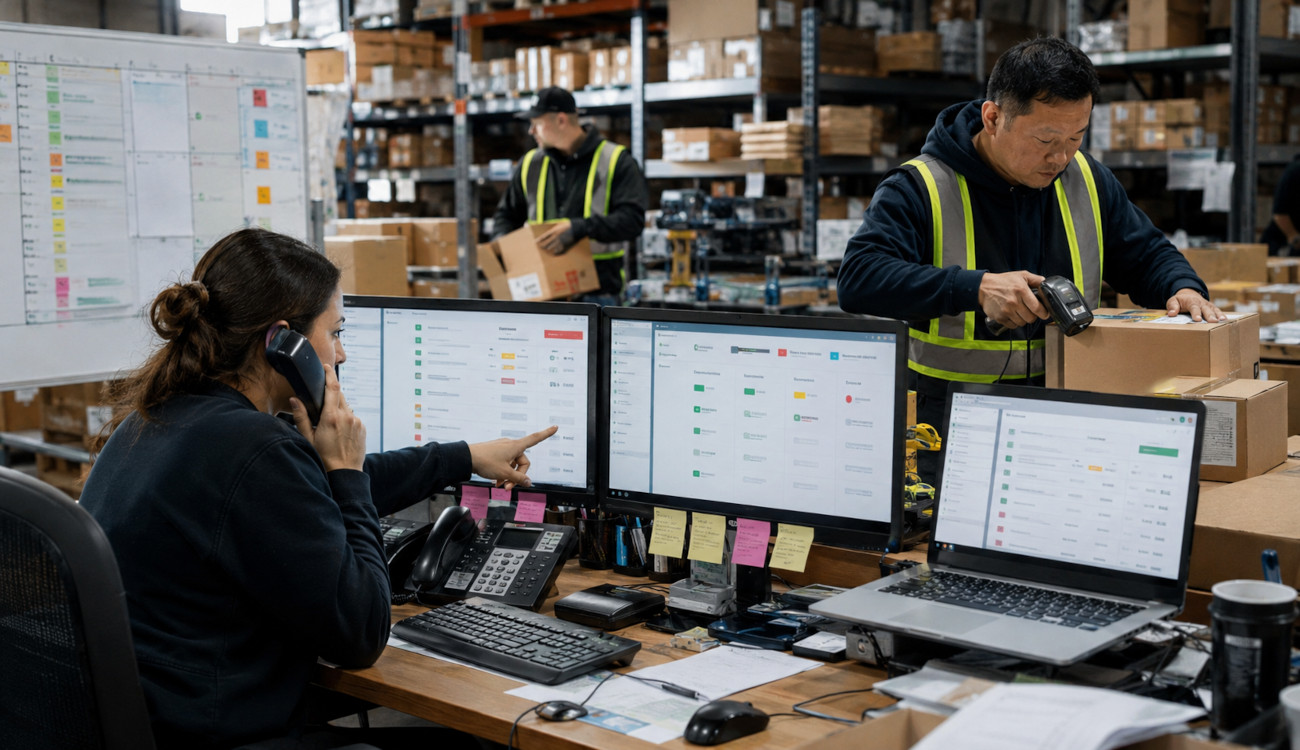
Support representatives contact warehouses for shipment updates. They ask operations teams whether inventory exists. They request tracking numbers from fulfillment partners. They compare order records against carrier portals and try to determine whether a package actually left the building.
Over time, these tasks become part of the daily routine.
That may hide the problem because the organization learns how to work around poor visibility. Customer service develops spreadsheets, internal notes, Slack messages, email threads, and informal escalation procedures to track what the system cannot show clearly.
The process works, but it carries a cost.
Employees spend more time coordinating information and less time helping customers. Response times increase. Training becomes more complicated because new employees must learn not only the official process, but also the workarounds that experienced team members use.
Good order status visibility changes the role of customer service. Instead of investigating basic fulfillment information, representatives can focus on solving actual customer problems.
That distinction becomes increasingly important as order volume grows.
Warehouse Interruptions Reduce Fulfillment Productivity
Poor order status visibility does not stay inside the customer service department.
When support teams cannot find an answer, they often contact the warehouse. Someone on the fulfillment floor then needs to stop what they are doing, search for the order, and report what happened.
The interruption may seem small. A warehouse employee walks to another station, checks a picking queue, looks for a package, or asks another employee whether the order has already moved.
The problem is repetition.
Warehouse productivity depends on consistent workflows. Picking, packing, receiving, replenishment, and shipping all become less efficient when employees frequently stop to investigate individual orders.
Interruptions can also create new errors. An employee who leaves a task halfway through may return to the wrong package, miss a scan, or lose track of where they were in the process.
The operational cost therefore extends beyond the minutes spent answering the question. Poor visibility can disrupt the rhythm of the warehouse itself.
Accurate order status visibility allows customer service and operations teams to find answers without pulling warehouse employees away from fulfillment work.
Unclear Statuses Make Exceptions Harder to Find
Every fulfillment operation experiences exceptions. Inventory can be missing. A carrier can miss a pickup. A payment issue can hold an order. A label can fail. A product may become damaged during picking.
The important question is how quickly the business identifies the problem.
When teams have strong order status visibility, exceptions stand out because most orders move through predictable stages. Operations managers can identify an order that has remained in one status too long and investigate before the customer notices a delay.
Poor visibility makes that much harder.
If hundreds of orders simply appear as “processing,” a genuinely stuck order looks exactly like an order moving normally through the warehouse. Teams may not discover the problem until the customer contacts support.
At that point, the business has moved from proactive exception management to reactive customer service.
The difference matters. Finding a warehouse issue two hours after it occurs may allow the team to ship the order the same day. Discovering it two days later may require expedited shipping, a refund, a discount, or another costly recovery action.
Order status visibility helps teams find exceptions while they still have options.
Poor Visibility Can Increase Shipping Costs
Order status problems can also create direct transportation expenses.
When a business cannot confidently determine whether an order shipped, employees may create a replacement shipment to protect the customer experience. If the original package later appears in the carrier network, the business has now paid to fulfill the same order twice.
Similar problems occur when shipping information arrives too late.
An operations team may not realize that an order missed a carrier cutoff until the next morning. To maintain the original delivery commitment, the business may upgrade the shipping service and absorb the additional cost.
Split shipments create another challenge. A customer may receive one package and report missing items because they cannot see that another package is still in transit. Customer service may start a replacement process before confirming the status of the second shipment.
These situations do not always happen because employees made poor decisions. Often, they made the safest decision with incomplete information.
Better visibility changes the decision itself. When teams can see which items shipped, which warehouse handled them, and which tracking number belongs to each package, they can avoid unnecessary replacements and shipping upgrades.
Refunds and Reshipments Can Hide the Original Problem
Businesses often track refunds, credits, discounts, and replacement shipments as customer service costs. However, some of those expenses begin much earlier in the fulfillment process.
A customer who receives no useful updates may assume the order has been lost. After several days without clear information, they contact support. If the support team cannot confirm what happened, issuing a refund or replacement may feel like the fastest solution.
The customer problem gets resolved, but the business may never identify why the information was missing in the first place.
Over time, these recovery actions can normalize poor visibility.
Refunds become easier than investigations. Reshipments become a standard response to uncertain tracking. Discounts compensate customers for delays that operations teams could have identified earlier.
The visible cost appears in the customer service budget, while the underlying problem sits in order management and fulfillment visibility.
Organizations that analyze these cases often find that reducing uncertainty can lower recovery costs without changing the customer service policy itself.
When employees know what happened to an order, they can make a more accurate decision about what the customer actually needs.
Multiple Sales Channels Increase the Visibility Challenge
Order status becomes more complicated when a business sells through several channels.
Orders may originate from a direct ecommerce store, marketplaces, wholesale accounts, retail partners, or other sales platforms. Each channel may use different order statuses and update rules. Fulfillment may happen through internal warehouses, third-party logistics providers, dropship suppliers, or marketplace fulfillment programs.
Without a connected order view, teams can end up checking several systems for the same basic information.
One channel may say the order is fulfilled while the warehouse still shows it in a packing queue. Another system may create a tracking number before the carrier physically receives the package. A marketplace may display a shipping confirmation that does not match the internal fulfillment stage.
These differences become difficult to manage manually as channel volume increases.
Strong order status visibility does not require every system to use identical terminology. It does require the business to understand how those statuses relate to each other.
A connected order management process can translate activity from different channels and fulfillment sources into a clearer operational picture. Teams can then work from consistent information instead of interpreting each platform separately.
Split Orders Make Status Visibility Even More Important
A single order can become several fulfillment processes when inventory sits across multiple warehouses.
One location may ship its portion immediately. Another may wait for replenishment. A third-party partner may fulfill a separate item. The customer still sees one original purchase, but operations teams may need to manage several shipment records.
Poor order status visibility makes these scenarios particularly difficult.
If the system only shows the original order as shipped, customer service may not know whether every item actually left the network. If it shows the order as partially fulfilled without more detail, employees still need to determine which products remain open and why.
The business needs visibility at both the order and shipment level.
Teams should be able to see the original customer order, the location responsible for each item, the status of every fulfillment, and the tracking information connected to each package.
This approach keeps the customer transaction intact while giving operations teams the detail they need to manage separate fulfillment paths.
As multi-warehouse networks become more common, this level of order status visibility becomes increasingly important.
Carrier Tracking Alone Does Not Solve the Problem
Carrier tracking provides valuable information, but it represents only one part of the order lifecycle.
A carrier can usually report what happened after it receives a package. It cannot explain why the warehouse has not picked the order, whether inventory allocation failed, or why a shipment label exists without physical movement.
Businesses sometimes rely too heavily on tracking links because they are easy to provide to customers.
That works when fulfillment proceeds normally. It becomes less useful when an order stalls before carrier acceptance.
A tracking number may exist for hours or even days before the first scan. Customers see little or no movement and contact support. The support team then needs to determine whether the package is waiting at the warehouse, sitting on a trailer, or missing entirely.
Effective order status visibility connects carrier activity with internal fulfillment activity.
Teams should know when the warehouse released the shipment, when the carrier accepted it, and when transportation actually began. That context helps distinguish a normal delay in scanning from a genuine fulfillment problem.
Better Visibility Improves Internal Accountability
Clear order statuses also make it easier to understand where delays occur.
When information remains fragmented, teams often spend time determining who owns the problem. The warehouse believes it completed the order. Customer service sees no tracking movement. The carrier has no record of receiving the shipment. Operations then needs to reconstruct the timeline manually.
Accurate status records create a clearer chain of events.
Teams can see when the order entered fulfillment, when inventory allocation occurred, when employees picked and packed the items, when the warehouse created the shipment, and when the carrier accepted it.
This does not exist to assign blame. It helps teams identify the part of the process that needs improvement.
If orders regularly wait too long between picking and packing, managers can review warehouse capacity. If packages leave the warehouse but carrier scans appear much later, the business can investigate pickup procedures. If orders remain unallocated despite available inventory, the problem may sit in routing or system configuration.
Order status visibility turns vague delays into measurable operational issues.
Visibility Data Can Improve Process Planning
Once a business can trust its order status data, that information becomes useful beyond individual customer inquiries.
Operations teams can analyze how long orders spend in each stage of fulfillment. They can compare warehouses, channels, carriers, and order types. They can identify where delays occur most frequently and whether those patterns change during peak periods.
This makes order status visibility a planning tool rather than just a tracking feature.
For example, a warehouse may consistently complete picking quickly but accumulate a backlog at packing stations. Another location may process orders efficiently until a certain carrier cutoff approaches. Wholesale orders may remain in allocation longer than direct ecommerce orders because of different inventory rules.
These patterns are difficult to detect when statuses are inconsistent or incomplete.
Reliable data helps managers make better decisions about staffing, warehouse layout, shipping schedules, system rules, and inventory allocation.
It also gives the business a better baseline for measuring whether operational changes actually improve performance.
Automation Works Better When Status Data Is Reliable
Many order management workflows depend on automation.
Businesses may automatically release orders to warehouses, send shipping notifications, flag delayed shipments, update sales channels, or trigger customer service alerts.
Automation only works well when the underlying status information is accurate.
If a system marks an order as shipped too early, customers may receive misleading notifications. If a warehouse fails to update a completed pick, the order may trigger an unnecessary delay alert. If systems use conflicting statuses, automated workflows can create more confusion instead of reducing it.
Reliable order status visibility gives automation clear events to respond to.
For example, a business can automatically flag orders that remain in allocation beyond a defined period. It can identify shipments that received labels but never reached carrier acceptance. It can notify customer service when an order misses a fulfillment milestone before the customer contacts them.
Connected platforms such as CommerceBlitz can support this type of workflow by bringing order, inventory, fulfillment, and shipment information into a more consistent operational view. The goal is not simply to display more data. It is to make the data useful enough that teams and automated processes can act on it confidently.
Customers Feel Operational Uncertainty Quickly
Customers rarely know why an order is delayed, but they notice when the business appears not to know either.
A delayed shipment with a clear explanation may still create disappointment, but it usually creates less frustration than silence or conflicting information. Customers want to know what happened, what the business is doing about it, and when they can expect the next update.
Poor internal visibility makes that communication difficult.
Support teams may provide vague answers because they cannot verify the real status. Automated emails may conflict with warehouse activity. Tracking pages may show no movement while internal teams struggle to determine whether the package actually shipped.
That uncertainty damages trust.
Better order status visibility allows businesses to communicate with more confidence. Even when something goes wrong, teams can provide accurate information and realistic expectations.
The customer experience therefore improves not because every order arrives perfectly, but because the business understands what is happening when fulfillment does not go according to plan.
Measuring the Cost of Poor Order Status Visibility
The cost of poor visibility does not usually appear as a single line item.
It spreads across several departments.
Customer service spends more time investigating orders. Warehouse teams lose productivity to interruptions. Operations managers handle more escalations. Businesses pay for avoidable reshipments, expedited transportation, refunds, and discounts. Employees maintain spreadsheets and manual processes because the primary systems do not provide enough information.
These costs can be difficult to recognize because each one appears relatively small on its own.
Businesses can start measuring the problem by tracking how often employees manually investigate order status. They can review how many support tickets involve “Where is my order?” questions, how often warehouses receive status requests, and how many replacement shipments result from uncertain fulfillment information.
They can also measure the time orders spend in different stages.
The objective is not to eliminate every customer inquiry. It is to identify how much work exists only because employees cannot easily see what the order is doing.
Once that cost becomes visible, investments in better order management and fulfillment visibility become easier to evaluate.
Turning Order Status Into Operational Visibility
Order status should do more than reassure customers that a package is moving.
For operations teams, it should provide a reliable view of how work moves through the business.
That means connecting inventory allocation, warehouse activity, shipment creation, carrier acceptance, partial fulfillment, exceptions, and delivery information. It also means presenting that information clearly enough that employees do not need to reconstruct the order history every time something goes wrong.
Businesses with strong order status visibility can answer customer questions faster, reduce warehouse interruptions, identify fulfillment exceptions earlier, and make better decisions about their operations.
The benefit becomes more significant as the organization grows. More orders, more warehouses, more channels, and more fulfillment partners create more opportunities for information to become fragmented.
Poor visibility turns that complexity into labor.
Good visibility turns it into information that teams can use.
The operational cost of unclear order status is therefore not limited to support tickets or customer frustration. It affects productivity, shipping expense, exception management, employee workload, and the ability to improve fulfillment performance over time.
When everyone involved can see what an order is doing and what needs to happen next, the business spends less time searching for answers and more time moving orders forward.