
From Reporting to Action: How AI Is Changing Order Management
For years, AI in order management has largely been used to help businesses understand what is happening across their operations. It can analyze data, identify patterns, forecast demand, flag exceptions, and turn large amounts of information into reports that are easier for teams to interpret.
That visibility is valuable. However, a report still leaves one important step unfinished.
Someone has to act on it.
If a system identifies that inventory is running low at one warehouse, an employee may still need to determine whether stock exists somewhere else. If an order cannot be fulfilled from its assigned location, someone may need to review alternative warehouses, shipping costs, delivery requirements, and inventory availability before deciding where the order should go next.
The next stage of AI in operations is beginning to close that gap between identifying a problem and responding to it.
Instead of only explaining what happened or recommending what someone should do, action-oriented AI can become part of the operational workflow itself. Within the right rules and controls, it can evaluate changing conditions, determine an appropriate response, and initiate the next step.
That shift changes AI from something businesses consult into something that can actively support how operations run.
The Difference Between Seeing a Problem and Solving It
Consider the difference between observation and action.
A drone equipped with a camera can fly over an area and show an operator exactly what is happening below. It may provide excellent visibility, but the information still has to be interpreted before someone decides what to do.
An action-oriented system goes further. It uses the information it receives to determine whether a response is required and, when permitted, carries out that response.
The same distinction applies to commerce operations.
A traditional analytics system might show that one fulfillment location is approaching a stockout. It could highlight the affected SKUs, display recent sales velocity, and show how much inventory remains.
That is useful information.
A more functional form of AI could evaluate that same condition against inventory elsewhere in the network, open orders, channel priorities, fulfillment rules, and expected demand. Instead of simply alerting the team, it could help determine what should happen next.
Depending on the controls established by the business, that could mean adjusting available inventory, changing an order route, escalating a true exception, or triggering another predefined workflow.
The important difference is not simply that the AI knows more. It is that the information can lead directly to an operational action.
Inventory Management Shows Why Action Matters
Inventory is a good example because the underlying conditions rarely remain static.
Stock levels change as orders arrive. Inventory is received, allocated, transferred, damaged, returned, reserved, or sold through different channels. What appeared to be the best decision an hour ago may no longer be appropriate once those conditions change.
Reporting can tell a business that inventory has fallen below a threshold. Analytics can show which products are moving quickly or which locations are carrying too much stock.
The operational question is what happens after that information becomes available.
If every response requires an employee to open several systems, compare quantities, check outstanding orders, review channel requirements, and manually make a change, the business still has a significant decision-making bottleneck.
Functional AI changes the role of the system.
Rather than stopping at the alert, it can evaluate the situation in context. When one location is running low while another has sufficient availability, the system can determine whether the condition requires a change. Selling quantities can also be protected on a particular channel by applying the appropriate business rules. When a situation falls outside those rules, the system can send the exception to a person instead of treating every inventory change as something that requires manual attention.
That distinction becomes increasingly important as order volume and the number of inventory locations grow.
The goal is not to remove people from inventory management. It is to stop requiring people to make the same predictable decisions thousands of times.
Order Routing Turns AI Into an Operational Tool
Order routing makes the difference even easier to see.
Imagine an order has been assigned to a warehouse that can no longer fulfill it as expected. Inventory may have changed after the order was placed. The facility may be approaching capacity. A cutoff may have been missed, or another location may now provide a better fulfillment option.
A reporting system can identify the problem and place the order on an exception list.
Then someone has to investigate.
They may need to check whether another warehouse has the complete order, compare shipping distance, consider the delivery commitment, determine whether a split shipment would be necessary, and review the cost of each available option.
At low order volumes, experienced employees can handle those decisions manually.
At scale, the same process becomes difficult to manage consistently.
Action-oriented AI can evaluate those variables as part of the workflow. When an alternative route satisfies the company’s established requirements, the order can be redirected without waiting for someone to discover the problem in a report.
The result is not simply faster analysis.
It is a shorter distance between a changing operational condition and the response to that condition.
Functional AI Still Needs Rules
Giving AI the ability to act does not mean giving it unlimited control.
In order management, inventory, and fulfillment, businesses already operate according to rules. Certain inventory may be protected for a sales channel. Specific products may need to ship from particular locations. Marketplace orders may carry strict service requirements. Some customers may have priority agreements, while certain decisions may require human approval regardless of what the system recommends.
Action-oriented AI has to operate within that business context.
For routine situations with clear parameters, the system may be able to complete the response automatically. When confidence is low, financial impact is high, or an exception falls outside established rules, the appropriate action may instead be to surface the issue to an employee with the relevant information already assembled.
That creates an important balance.
Automation handles the decisions that are repetitive and well defined. People remain involved where judgment, approval, or unusual circumstances require them.
The purpose is not autonomous decision-making for its own sake. The purpose is faster and more consistent execution where automation actually improves the operation.
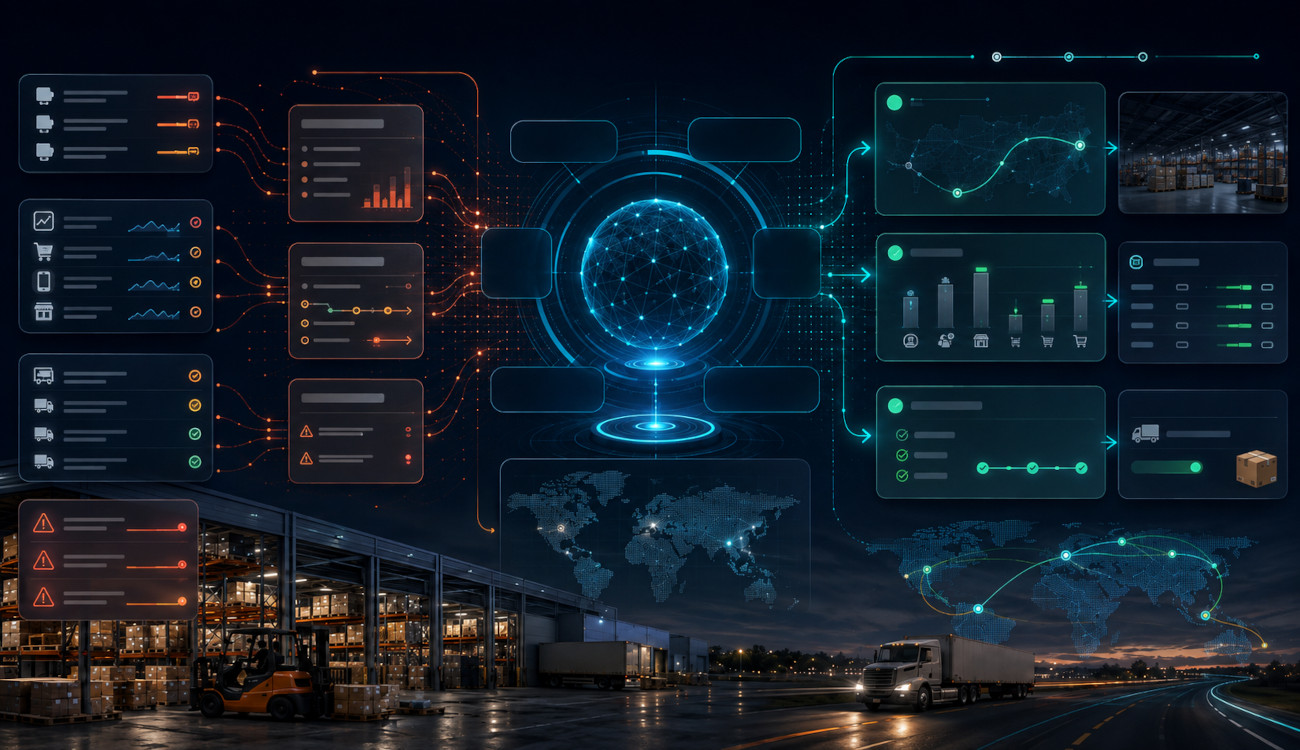
Connected Operational Data Makes Action Possible
AI cannot make useful operational decisions if it only sees part of the business.
An order routing decision may depend on inventory availability, warehouse location, shipping cost, delivery requirements, capacity, customer priority, product restrictions, and channel rules.
If those pieces of information live in disconnected systems, even an advanced AI model is working with an incomplete picture.
This is why the underlying operational infrastructure matters as much as the intelligence layered on top of it.
Before a system can decide where an order should be fulfilled, it needs reliable information about the inventory that is actually available. Responding to a shortage also requires visibility into whether the issue affects the entire network or only one location. Changing an order route depends on access to the rules that determine which alternatives are acceptable.
AI can improve the decision layer, but connected data gives it something reliable to act on.
From More Alerts to Fewer Exceptions
Many growing operations do not suffer from a lack of information.
They suffer from too much information requiring too many manual responses.
Dashboards produce alerts. Systems create reports. Employees receive notifications. Exception queues grow, and teams spend increasing amounts of time deciding which problem needs attention first.
Adding another layer of reporting does not necessarily solve that problem.
The more useful question is whether the system can resolve routine situations before they become exceptions that require human intervention.
If inventory changes, can the operation adjust availability before an oversell occurs?
When the original fulfillment location cannot complete an order, can another valid route be selected before the shipment becomes late?
And when several possible fulfillment paths exist, can the system evaluate them according to the priorities the business has already established?
This is where action-oriented AI becomes operationally meaningful.
The value comes from reducing the number of situations that employees have to manually discover, evaluate, and correct.
Where CommerceBlitz OMNI Fits Into the Shift
The ability to take meaningful action depends on having orders, inventory, channels, warehouses, and fulfillment rules connected in the same operational environment.
CommerceBlitz OMNI brings those elements together by maintaining inventory visibility across connected sources and channels while providing tools for inventory balancing and order routing.
That foundation matters because operational decisions cannot be made from isolated data.
When inventory quantities change, the impact may extend across several sales channels. When an order needs to be routed, the decision may depend on geography, cost, service requirements, margin, inventory source, and the fulfillment hierarchy established by the business.
Connecting those conditions creates the environment in which more intelligent automation becomes useful.
Instead of using AI as another layer that produces information for employees to interpret, businesses can begin thinking about where intelligence can participate directly in the decisions that keep orders and inventory moving.
The Next Step for AI in Order Management Is Action
AI does not become more valuable simply because it can generate a better report.
Its operational value increases when the time between identifying a condition and responding to it becomes shorter.
For inventory management, that could mean recognizing a risk and applying the appropriate availability rule. In fulfillment, it could mean identifying that an order can no longer follow its original path and evaluating another route. Exception handling could involve resolving routine issues automatically while directing unusual situations to the right person.
Reports will continue to matter. Visibility will continue to matter. Human oversight will continue to matter.
The difference is that they no longer have to represent the end of the process.
As AI becomes more deeply connected to operational systems, the opportunity is to close the loop between understanding what is happening and doing something useful about it.
For order management, that may be the shift that matters most: moving from AI that tells the operation what happened to AI that helps the operation respond.